You need a 3,000 to 4,000 watt generator to run a 30 amp RV with its air conditioner, since the service tops out at 3,600 watts. Below are the 30-amp math, a worked load example, and what soft-start kits, altitude and connections change.
30 amp RV generator wattage: the 3,600-watt ceiling
A 30 amp RV service carries 30 amps at 120 volts, and 30 × 120 = 3,600 watts. That is the most the RV can pull, so you never need more than 3,600 running watts.
Two numbers matter. Running watts are the steady load. Starting watts are the brief surge when a motor, such as the AC compressor, kicks on.
- With one AC: 3,000 to 4,000 watts. Cummins suggests 4,000 watts for extra motor-starting margin.
- Without AC: 2,000 to 3,000 watts covers the fridge, lights, microwave and chargers.
Decision rule: choose a generator whose running rating is above your total running load, and whose starting rating is above the AC’s start draw plus everything already running.
Running and starting watts of 13,500 and 15,000 BTU RV air conditioners
Cummins gives a 15,000 BTU RV air conditioner as needing about 3,500 watts to start and about 1,500 watts while running. A 13,500 BTU unit is typically a little lower on both, but the exact figures are on the AC’s data plate or the manufacturer’s spec sheet. Read yours rather than relying on a typical number.
The starting surge lasts a fraction of a second, but it is the reason a generator that handles the running load can still stall or trip when the compressor starts.
Do soft-start kits change the answer?
Yes. A soft-start kit reduces the compressor’s starting surge, which lowers the starting watts your generator must supply. The size of the reduction depends on the kit and your AC, so use the kit maker’s published spec for your model. Running watts do not change.
For sizing by RV type rather than by AC, see what size generator for an RV.
Worked example: AC, microwave, fridge, lights and charger
The inputs below are typical values, not measurements of a specific RV. Swap in the watts printed on your own appliances.
| Load | Running watts | Starting watts |
|---|---|---|
| 15,000 BTU air conditioner | 1,500 | 3,500 |
| Microwave | 1,200 | 1,200 |
| Refrigerator | 150 | 150 |
| LED lights | 100 | 100 |
| Chargers and electronics | 200 | 200 |
- All five running: 1,500 + 1,200 + 150 + 100 + 200 = 3,150 W. That is under the 3,600 W ceiling.
- Starting the AC with fridge, lights and chargers on: 3,500 + 150 + 100 + 200 = 3,950 W peak. The generator needs a starting rating near 4,000 W, or a soft-start kit.
- AC alone, running: 1,500 W, plus 450 W of base loads, is 1,950 W. A 2,000 W generator holds that steady but cannot supply the 3,950 W start.
The practical habit: start the AC first, let it settle, then run the microwave. Never start both at the same moment. For other appliances, check how many appliances a generator can run by size.
Altitude and heat reduce the watts you actually get
Gasoline engines lose power in thin air. A commonly cited figure is about 3.5% per 1,000 feet of elevation, and high temperatures take off more. Exact derating depends on the engine, so check the manual.
Example at 5,000 feet using that figure: 5 × 3.5% = 17.5% loss, so a generator rated 3,500 W delivers about 3,500 × 0.825 = 2,888 W. Your 3,150 W running load from the example would not fit. A 4,000 W generator would deliver about 4,000 × 0.825 = 3,300 W, which does cover that load. This is why campers in the mountains size toward the top of the 3,000 to 4,000 watt range.
Inverter, conventional and dual-fuel generators on a 30 amp RV
Inverter generators produce clean, stable power, run quieter, and slow their engine when the load is light, which saves fuel. They cost more per watt.
Conventional open-frame generators give more watts for the money but run louder at a fixed engine speed, and their voltage can fluctuate more. Use a surge protector or electrical management system with them.
Dual-fuel models can run on propane, which stores well and burns cleaner. Propane output is usually rated lower than gasoline output, so confirm the propane watts in the manual before sizing around it.
If one unit is too heavy or too large, two matching inverter generators with a parallel kit can share the load. Only use the kit made for that exact model.
Connecting the generator to a 30 amp RV
The RV inlet is a 30 amp TT-30 plug. Your generator needs a matching 30 amp (TT-30R) outlet, or an adapter, plus a cord rated for 30 amps.
- Set the generator outdoors on level ground, exhaust pointed away from windows, doors and vents. Follow the manual for clearance.
- Turn the generator off, switch off the RV main breaker and big appliances.
- Run a 30 amp RV-rated cord from the generator’s TT-30R outlet to the RV inlet. If the generator has a twist-lock L5-30R outlet, use an L5-30P to TT-30R adapter.
- Start the generator, let it settle, then switch on the RV breaker.
- Start the AC first, then add other large loads.
A generator with only 20 amp household outlets is limited to 20 × 120 = 2,400 W per outlet and cannot feed the full RV panel safely. Never backfeed through a wall outlet, and keep a working CO alarm inside the RV.
Campground, noise and CARB restrictions
Many campgrounds, parks and forest areas set generator quiet hours or limit run times, and some cap noise levels. Check the rules when you book, because a quiet inverter may be allowed where a loud open-frame unit is not.
In California and other states that follow its rules, generators sold new generally must be CARB-compliant. Check the label or manual for CARB or EPA compliance if you travel there. Local fire restrictions can also ban generator use in dry conditions.
Our Top Picks
Ready to shop? These are the top-rated options from our related roundup, Best Generators To Run 30 Amp RV of 2026.
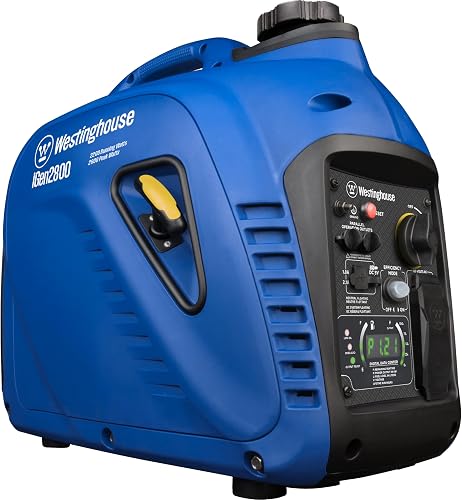
Westinghouse iGen2800 2800 Peak Watt Super Quiet Lightweight Portable Inverter Generator - Gas Powered, Parallel Ready

PowerSmart 3800 Watt Dual Fuel Inverter Generator Quiet Portable Gas Propane with CO Sensor RV Ready

WEN RV-Ready 4000-Watt Open Frame Inverter Generator GN400iM
As an Amazon Associate we earn from qualifying purchases. Product prices and availability are accurate as of the date/time indicated.
Related reading: RV Generator Size: 3,500 Watts for a One-AC 30-Amp RV · How Many Watt Generator to Run a Refrigerator?
Frequently Asked Questions
Can a 2,000 W inverter generator run a 30 amp RV AC?
Not a 15,000 BTU one. Its start draw of about 3,500 watts is well above 2,000 watts, so the generator will likely overload or stall. Two matching 2,000 W units in parallel, or a soft-start kit, are the usual ways around this.
Will a 3,500 W generator start a 15,000 BTU AC without a soft start?
Not reliably. The AC needs about 3,500 watts to start, and any fridge, lights or chargers running add to that, pushing the peak near 3,950 watts. Choose a generator with a starting rating near 4,000 watts, or add a soft-start kit.
Can I run two 2,000-watt inverter generators in parallel for a 30 amp RV?
Yes, if both are the same model and you use the maker’s parallel kit. Their running output combines, which gets you into the 3,000 to 4,000 watt range. Check the kit’s rated combined output and confirm it has a 30 amp outlet or adapter.
Do I need a surge protector when running the RV on a generator?
Yes, it is a good idea, especially with a conventional generator whose voltage can swing. Pick a protector that is rated 30 amps and plug it between the generator cord and the RV inlet.
{“@context”: “https://schema.org”, “@type”: “FAQPage”, “mainEntity”: [{“@type”: “Question”, “name”: “Can a 2,000 W inverter generator run a 30 amp RV AC?”, “acceptedAnswer”: {“@type”: “Answer”, “text”: “Not a 15,000 BTU one. Its start draw of about 3,500 watts is well above 2,000 watts, so the generator will likely overload or stall. Two matching 2,000 W units in parallel, or a soft-start kit, are the usual ways around this.”}}, {“@type”: “Question”, “name”: “Will a 3,500 W generator start a 15,000 BTU AC without a soft start?”, “acceptedAnswer”: {“@type”: “Answer”, “text”: “Not reliably. The AC needs about 3,500 watts to start, and any fridge, lights or chargers running add to that, pushing the peak near 3,950 watts. Choose a generator with a starting rating near 4,000 watts, or add a soft-start kit.”}}, {“@type”: “Question”, “name”: “Can I run two 2,000-watt inverter generators in parallel for a 30 amp RV?”, “acceptedAnswer”: {“@type”: “Answer”, “text”: “Yes, if both are the same model and you use the maker’s parallel kit. Their running output combines, which gets you into the 3,000 to 4,000 watt range. Check the kit’s rated combined output and confirm it has a 30 amp outlet or adapter.”}}, {“@type”: “Question”, “name”: “Do I need a surge protector when running the RV on a generator?”, “acceptedAnswer”: {“@type”: “Answer”, “text”: “Yes, it is a good idea, especially with a conventional generator whose voltage can swing. Pick a protector that is rated 30 amps and plug it between the generator cord and the RV inlet.”}}]}