Our editorial team weighed WEN's published specifications and how it stacks up against similar products in the generators category. What stands out: Versatile RV/Transfer-Switch Outlets, Long Runtime, and Wheels & Handles. Where it falls short: Needs Gasoline Storage and Noisier Than Inverter Models. That puts it at 8.2/10 on our WG Score – an excellent, well-rounded option.
 Reviewed byDaniel
Yes, a generator can run on propane, but only if it is a dual fuel, tri-fuel or propane-only model, or a gasoline unit fitted with a conversion kit approved for that exact model. Expect about 10% less running wattage on propane than on gasoline (varies by model; check the spec sheet). Below are the runtime math, conversion risks and safety rules.
Which generators can run on propane?
A gasoline-only generator cannot burn propane as it comes from the factory. Only these types can:
| Type | Fuels | Good to know |
|---|---|---|
| Dual fuel | Gasoline or propane | Switch with a selector; most common choice for homeowners |
| Tri-fuel | Gasoline, propane or natural gas | Needs a separate natural gas hookup; check the manual for each fuel’s rated watts |
| Propane-only | Propane | No gasoline to store or go stale; no backup fuel |
| Gasoline with conversion kit | Gasoline plus propane | Only with a kit made for your exact model; see the next section |
A propane-only generator generally cannot run on natural gas without a model-specific modification. The jets and regulator are set for propane pressure.
If you are shopping, start with our roundup of the best propane portable generators, which covers dual fuel and propane-only units.
Can you convert a gasoline generator to run on propane?
Sometimes, but it is often a poor trade. A conversion kit adds a propane regulator and a fuel mixer or carburetor adapter so the engine can draw gas vapor. Kits only fit specific engines, and quality varies.
What a conversion can cost you
- Warranty: Many manufacturers void the engine warranty if you modify the fuel system. Ask the maker in writing before you buy a kit.
- Emissions compliance: Federal EPA rules, and California CARB rules in that state, certify an engine as sold. A kit that is not approved for your model can put it out of compliance. Rules vary by state; check with the kit maker.
- Leaks and carbon monoxide: A poorly fitted fitting or hose leaks flammable gas. A wrong air-fuel mix raises carbon monoxide (CO) output.
- Power: Expect the same drop as a dual fuel unit, and sometimes more with a mismatched kit.
Decision rule
Convert only if all three are true: the kit maker lists your exact generator model, the warranty is expired or the manufacturer approves in writing, and the kit installs without cutting or drilling the fuel system. If any one is false, buy a dual fuel model instead. Inverter generators with fuel injection are poor candidates.
For a permanent hookup, use a licensed installer. Local code decides what is allowed.
How much power do you lose running a generator on propane?
A common rule of thumb is about 10% less running wattage on propane than on gasoline. The exact figure varies by model, so read the propane rating on the spec sheet or data label rather than assuming.
Example: a dual fuel unit rated 3,500 running watts on gasoline loses about 350 W, leaving about 3,150 W on propane (estimate: 3,500 x 0.90). The starting (surge) rating drops too.
This matters when you size the unit. Add up what you need to run using the propane number, not the gasoline number. Our generator wattage chart lists typical running and starting watts for common appliances so you can check the total against 3,150 W.
Common mistake: buying a generator whose gasoline rating just covers your load. On propane, it may trip overload.
How long does a 20 lb propane tank run a generator?
Runtime depends on the model and load, so use this worksheet with the fuel use on your spec sheet. Most manufacturers list runtime on gasoline at 25% and 50% load.
- Tank volume: 20 lb of propane / about 4.24 lb per gallon = about 4.7 gal.
- Tank energy: 4.7 gal x about 91,500 BTU per gallon = about 430,000 BTU.
- Gasoline fuel rate: tank size in gallons / listed hours at that load = gallons per hour.
- Convert to propane: multiply by 1.25 (gasoline is about 114,000 BTU per gallon, propane about 91,500; 114,000 / 91,500 = about 1.25).
- Hours: 4.7 / propane gallons per hour.
Worked example with a hypothetical generator: 4-gallon gas tank, listed 18 hours at 25% load, 10 hours at 50%, 5 hours at 100%. These are assumed numbers, not a real model.
| Load | Gasoline gal/hr | Propane gal/hr (x1.25) | Hours on 20 lb tank (estimate) |
|---|---|---|---|
| 25% | 0.22 | 0.28 | 16.9 |
| 50% | 0.40 | 0.50 | 9.4 |
| 100% | 0.80 | 1.00 | 4.7 |
Your result will differ. If the manual lists propane runtime directly, use that figure. Real tanks also deliver less in cold weather and when the tank is not full. For overnight use, a larger cylinder (up to 100 lb) or two tanks on a manifold extends the time; check that your generator’s regulator and hose support it.
Hose, regulator and placement rules for propane generators
Propane is flammable and the engine exhaust contains CO, so setup matters more than fuel choice.
- Outdoors only. Never run a generator in a garage, basement, shed or near an open window. Many manuals call for at least 20 feet from the house with the exhaust pointed away from doors, windows and vents. Follow your manual and local code for the exact distance.
- Use propane-rated parts. Use the hose and regulator supplied for your model, or ones rated for propane and matched to its pressure. Do not stretch the run with an unrated hose.
- Check for leaks. Brush soapy water on every fitting with the valve open. Bubbles mean a leak. Close the valve and fix it before starting.
- Tank placement. Keep the cylinder upright, secured so it cannot tip, and away from the hot engine and exhaust. Close the valve when you stop.
- CO alarms. Install battery-powered or battery-backup CO alarms inside the home.
Never refill or swap a cylinder while the engine is hot or running.
Propane vs gasoline for generators: storage, cost and cold weather
Neither fuel wins every case. Our gasoline vs. propane vs. diesel generators comparison goes deeper. These are the points that matter most for propane.
Storage life
Propane does not go stale in a sealed cylinder, and it does not gum a carburetor. Gasoline can degrade within months without stabilizer. That makes propane a good fit for a generator that sits unused until an outage.
Cost per kWh
Prices vary by region and season, so compare your local numbers with this formula: cost per kWh = price per gallon / kWh per gallon.
Using the hypothetical generator at 50% load: propane gives 1,575 W (50% of 3,150 W) x 9.4 h = about 14.8 kWh from 4.7 gal, or about 3.15 kWh per gallon. Gasoline gives 1,750 W x 10 h = 17.5 kWh from 4 gal, or about 4.4 kWh per gallon. With placeholder prices of $3.00 per gallon of propane and $3.50 for gasoline, that is about $0.95 and $0.80 per kWh. These prices are only for the arithmetic. See how much it costs to run a generator for more.
Cold weather
Propane stays gaseous at very low temperatures, but a cylinder vaporizes more slowly in the cold, especially under heavy load and with a low tank. Output can sag or the engine can stall. A larger or fuller tank helps. Cold starting depends on the model; check the manual for the recommended fuel below freezing.
Which to choose
- Home backup, rarely used: propane or dual fuel, because the fuel keeps. See the best propane generators for home backup.
- Maximum power per fill-up: gasoline.
- Long outages: dual fuel, so you can use either fuel.
Our Top Picks
Ready to shop? These are the top-rated options from our hands-on roundup, Best Dual Fuel Generators 4000-7000 Watt of 2026.

Westinghouse iGen4000DFc 4000 Peak Watt Dual Fuel Inverter Generator - Super Quiet RV Ready Remote Start CO Sensor

WEN GN5602X 5600W Portable Generator Electric Start RV-Ready CO Sensor 4500 Running Watts
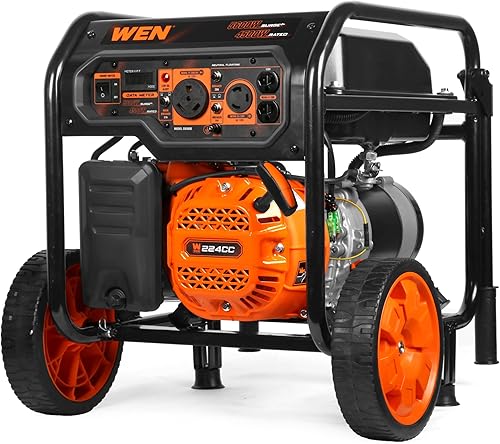
WEN GN5600 5600W Portable Generator RV-Ready Transfer Switch 4500 Running Watts 224cc Engine
As an Amazon Associate we earn from qualifying purchases. Product prices and availability are accurate as of the date/time indicated.
Frequently Asked Questions
Can a propane generator run on natural gas?
Not without a modification. A propane-only generator is set up for propane pressure and fuel jets. Tri-fuel models are built for natural gas, and kits exist for some units, but compatibility varies. Use only a kit approved for your model, and have a pro handle permanent gas lines.
Can I run a generator on a small camping propane cylinder?
Only if the generator’s manual allows it and you use the correct adapter hose. A 1 lb cylinder holds about 0.2 gal of propane, so it runs a generator for a very short time. A 20 lb tank is the usual minimum for real use.
Can I switch fuels while a dual fuel generator is running?
Check the manual. Many models want you to stop the engine before changing the fuel selector, and some let you run the carburetor dry first. Never switch fuels or disconnect a hose with the engine running unless the manual says to.
Does a propane tank need to be full to run a generator well?
A fuller tank delivers gas more reliably, especially in cold weather or at high load. As the tank empties, there is less surface area to vaporize, and pressure can drop. Plan to swap or refill before the tank is nearly empty.
{“@context”: “https://schema.org”, “@type”: “FAQPage”, “mainEntity”: [{“@type”: “Question”, “name”: “Can a propane generator run on natural gas?”, “acceptedAnswer”: {“@type”: “Answer”, “text”: “Not without a modification. A propane-only generator is set up for propane pressure and fuel jets. Tri-fuel models are built for natural gas, and kits exist for some units, but compatibility varies. Use only a kit approved for your model, and have a pro handle permanent gas lines.”}}, {“@type”: “Question”, “name”: “Can I run a generator on a small camping propane cylinder?”, “acceptedAnswer”: {“@type”: “Answer”, “text”: “Only if the generator’s manual allows it and you use the correct adapter hose. A 1 lb cylinder holds about 0.2 gal of propane, so it runs a generator for a very short time. A 20 lb tank is the usual minimum for real use.”}}, {“@type”: “Question”, “name”: “Can I switch fuels while a dual fuel generator is running?”, “acceptedAnswer”: {“@type”: “Answer”, “text”: “Check the manual. Many models want you to stop the engine before changing the fuel selector, and some let you run the carburetor dry first. Never switch fuels or disconnect a hose with the engine running unless the manual says to.”}}, {“@type”: “Question”, “name”: “Does a propane tank need to be full to run a generator well?”, “acceptedAnswer”: {“@type”: “Answer”, “text”: “A fuller tank delivers gas more reliably, especially in cold weather or at high load. As the tank empties, there is less surface area to vaporize, and pressure can drop. Plan to swap or refill before the tank is nearly empty.”}}]}