Generator sizing comes down to one rule: add every running watt plus only the largest starting surge, then keep the running load under about 80% of the rating. Below are where to find each number, a worked home example, and when to call an electrician.
Running watts vs starting watts
Running (rated) watts are what a generator can supply continuously. Starting (surge) watts are a short burst, lasting a few seconds, that covers the jolt a motor draws when it kicks on.
Only motor loads need a surge allowance: refrigerator and freezer compressors, sump pumps, furnace blowers, well pumps and air conditioners. Lights, TVs, laptops and space heaters draw close to the same wattage from the first second.
Starting watts for motors are generally about 3 times running watts, but the appliance label is the number to trust. A generator’s label lists both ratings, so you compare your loads to two different figures.
How are generators sized: five steps
- List what you must power. Split the list into essentials (refrigerator, sump pump, furnace fan, a few lights) and optional loads (central AC, microwave, dryer). Size for the essentials first.
- Find the running watts of each item on its label or manual.
- Find the starting watts of each motor load, then subtract running watts from starting watts to get its surge extra.
- Add all running watts, then add only the single largest surge extra. The result is your peak load. Motors rarely start at the same instant, so adding every starting figure produces an oversized, costlier generator.
- Check both generator ratings. Your running total divided by 0.8 must not exceed the generator’s running rating, which keeps continuous load at or below 80%. Your peak load must fit within its starting rating.
Finding real wattage numbers for your appliances
Check the nameplate first. It is usually on the back, inside the door or on the motor housing. Some show watts. Others show volts and amps, and you convert with watts = volts × amps. For example, 120 V × 6 A = 720 W.
For starting watts, a nameplate that lists LRA (locked rotor amps) beats the 3x rule of thumb. Starting watts = volts × LRA. A 240 V pump with a 30 A LRA, as an example value, needs 240 × 30 = 7,200 W to start.
If a label is missing, use the manufacturer’s data sheet or manual. The U.S. Department of Energy also publishes typical appliance wattage ranges. Treat those as a starting point, since the same appliance type varies by model and age.
Larger and standby units are often rated in kW or kVA instead of watts. kW = kVA × power factor, and a power factor of 0.8 is common. A 10 kVA unit at 0.8 delivers 8 kW, or 8,000 W. Convert before you compare it to your load.
Worked example: fridge, sump pump, furnace fan and lights
These are typical values, not fixed ones. The refrigerator figures come from a common wattage chart, and the other starting values use the 3x rule. Replace them with your own labels.
| Load | Running W | Starting W | Surge extra (starting − running) |
|---|---|---|---|
| Refrigerator | 700 | 2,200 | 1,500 |
| Sump pump (1/3 hp) | 800 | 2,400 | 1,600 |
| Furnace fan | 600 | 1,800 | 1,200 |
| 10 LED bulbs at 10 W | 100 | 100 | 0 |
| Central AC, small (optional) | 2,500 | 4,500 | 2,000 |
Essentials only:
- Running total: 700 + 800 + 600 + 100 = 2,200 W
- Largest surge extra: sump pump, 1,600 W
- Peak load: 2,200 + 1,600 = 3,800 W
- Minimum running rating: 2,200 ÷ 0.8 = 2,750 W
- Minimum starting rating: 3,800 W
A 3,500-watt-class portable generator usually meets both numbers, but confirm each rating on the label.
Adding the central AC: running total 2,200 + 2,500 = 4,700 W. The AC’s 2,000 W surge extra is now the largest, so peak load is 4,700 + 2,000 = 6,700 W. The running rating needed is 4,700 ÷ 0.8 = 5,875 W. That is beyond a 5,000-watt generator.
Altitude, temperature and propane change usable watts
Rated watts are measured under test conditions. Engines make less power in thin or hot air, so derate before you run the 80% check.
- Altitude: many manufacturers publish a loss of about 3.5% per 1,000 feet above sea level for gasoline engines. At 5,000 feet that is 17.5%, so a 5,000 W rating becomes 5,000 × 0.825 = 4,125 W. Apply the 80% check to 4,125 W.
- Heat: hot weather also cuts output. Your manual lists the exact correction for your engine.
- Propane or natural gas: output is lower than on gasoline. Use the separate fuel rating printed in the manual when shopping among dual-fuel generators.
Lower the peak instead of buying bigger
Start the largest motor first, then the others one at a time. Shed optional loads while a motor starts. A soft starter on an air conditioner, or an inverter-driven AC, reduces the surge. Size to the manufacturer’s published starting figure for that equipment.
When sizing needs an electrician
Call a licensed electrician when you want to power the house through the panel. A transfer switch or interlock must be installed with a permit under local code. Never backfeed a house through a wall outlet.
240V loads such as a well pump, central AC or electric dryer need a 240V generator outlet and a transfer switch circuit rated for them. Your electrician should confirm the switch is matched to the generator’s output. For permanently installed units, see our home standby generator guide.
Common sizing mistakes
- Copying a chart instead of the label. The same appliance type varies widely by model, so a chart is only a placeholder.
- Shopping by the starting-watt headline. That figure lasts seconds. The running rating decides what you can power for hours.
- Forgetting resistive heat. A 1,500 W space heater counts 1,500 W continuously, with no surge to subtract.
Once you have your peak and running numbers, match them to the right type. Essentials-only loads like the first example usually fit the portable generators in the 3,500-watt class.
Our Top Picks
Ready to shop? These are the top-rated options from our hands-on roundup, Best Inverter Generators For High Altitude of 2026.
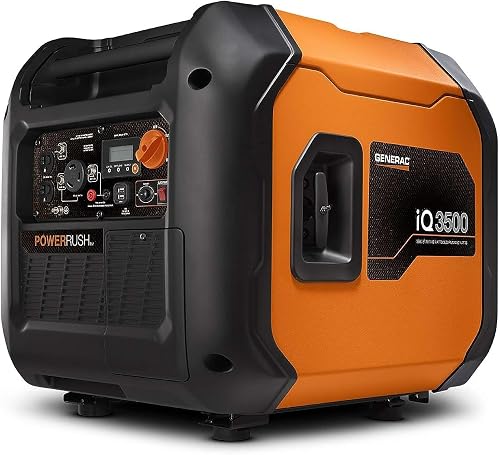
Generac iQ3500 3500W Portable Inverter Generator - Quiet, Lightweight, Electric Start, CARB Compliant for Camping & Jobsites

Pulsar 2300W Portable Gas Inverter Generator with USB Outlet and Parallel Capability

maXpeedingrods MXR4000GT 4000W Dual Fuel Inverter Generator with Bluetooth App Control
As an Amazon Associate we earn from qualifying purchases. Product prices and availability are accurate as of the date/time indicated.
Frequently Asked Questions
Is a 2,500-watt generator enough for a refrigerator and sump pump?
Probably not. With this guide’s typical values, running load is 1,500 W, which is under the 2,000 W limit (80%) for a 2,500 W unit. But peak is 1,500 + 1,600 = 3,100 W, so the generator’s starting rating must be at least 3,100 W. Check the label; if it lists less, choose a larger unit.
Can a soft starter let a smaller generator run my central AC?
Yes. A soft starter lowers the AC’s starting surge, so the peak load drops. Use the soft starter maker’s published starting current or watts in your math instead of the 3x rule, and have an installer fit it.
Can I size a generator from my breaker panel?
No. The panel shows the most the house could draw, not what you need during an outage. List the loads you will actually run, calculate running and peak watts, then have an electrician match the transfer switch to the generator output.
Does an inverter generator use the same sizing math?
Yes. Use the same running and starting totals. The gap between running and starting ratings varies by model, so read the starting figure on the label before assuming it covers a motor load.
{“@context”: “https://schema.org”, “@type”: “FAQPage”, “mainEntity”: [{“@type”: “Question”, “name”: “Is a 2,500-watt generator enough for a refrigerator and sump pump?”, “acceptedAnswer”: {“@type”: “Answer”, “text”: “Probably not. With this guide’s typical values, running load is 1,500 W, which is under the 2,000 W limit (80%) for a 2,500 W unit. But peak is 1,500 + 1,600 = 3,100 W, so the generator’s starting rating must be at least 3,100 W. Check the label; if it lists less, choose a larger unit.”}}, {“@type”: “Question”, “name”: “Can a soft starter let a smaller generator run my central AC?”, “acceptedAnswer”: {“@type”: “Answer”, “text”: “Yes. A soft starter lowers the AC’s starting surge, so the peak load drops. Use the soft starter maker’s published starting current or watts in your math instead of the 3x rule, and have an installer fit it.”}}, {“@type”: “Question”, “name”: “Can I size a generator from my breaker panel?”, “acceptedAnswer”: {“@type”: “Answer”, “text”: “No. The panel shows the most the house could draw, not what you need during an outage. List the loads you will actually run, calculate running and peak watts, then have an electrician match the transfer switch to the generator output.”}}, {“@type”: “Question”, “name”: “Does an inverter generator use the same sizing math?”, “acceptedAnswer”: {“@type”: “Answer”, “text”: “Yes. Use the same running and starting totals. The gap between running and starting ratings varies by model, so read the starting figure on the label before assuming it covers a motor load.”}}]}