The generator wattage you need equals your total running watts plus the largest starting surge, plus 20% headroom. For most essentials backups (fridge, a few lights, a sump pump or furnace fan, and a router), that comes to about 3,000-5,000 watts.
Generator wattage you need by use case
Start with the job, then refine with your own appliance list. These are typical sizes for each situation:
| Use case | What it covers | Typical generator size |
|---|---|---|
| Camping or RV without AC | Lights, phone and laptop charging, small fridge or cooler, fan | 1,000-2,000 W |
| Essentials backup | Fridge, a few lights, router, TV, furnace fan or sump pump | 3,000-5,000 W |
| Essentials plus a pump or window AC | Everything above plus a well pump or a window air conditioner | 7,000-10,000 W |
| Whole-home backup with central AC | Most circuits, including central air | 15,000-20,000 W |
Whole-home sizes usually mean a standby unit or a large portable wired through a transfer switch. For a deeper look at the portable range, see how many watts a portable generator needs.
Running watts vs. starting watts
Running watts are what an appliance draws continuously. Starting (surge) watts are the brief extra draw when a motor or compressor kicks on, lasting a second or two.
Resistive loads such as lights, space heaters and microwaves have no surge. Motor loads such as refrigerators, sump pumps, well pumps and air conditioners can briefly draw about two to three times their running watts.
A generator lists both numbers. The running (rated) figure is what it can supply continuously, and the starting (peak) figure is what it can supply for a few seconds.
Where to find an appliance’s real wattage
Typical numbers are only a starting point. Your appliance may differ, so use the nameplate sticker (inside the fridge door, on the back of a pump or on the AC unit’s side panel) or the manual.
- Watts listed: use it as the running figure.
- Only volts and amps listed: watts = volts x amps. A 120-volt appliance rated 10 amps draws 1,200 W.
- Locked rotor amps (LRA) listed: multiply by the voltage to approximate the starting watts of that motor.
- Nothing legible: a plug-in watt meter shows the running draw, though it may miss the brief startup spike.
Typical running and starting watts by appliance
These are typical values for planning. Check the nameplate on yours, because efficiency and motor size change the result. A broader list is in this generator wattage chart.
| Appliance | Running watts | Starting watts |
|---|---|---|
| Refrigerator | 700 | 2,100 |
| Sump pump (1/3 hp) | 800 | 2,400 |
| Well pump (1/2 hp) | 1,000 | 3,000 |
| Furnace fan | 600 | 1,800 |
| Window AC | 1,200 | 2,400 |
| Central AC (3-ton) | 3,500 | 6,000 |
| Microwave | 1,000 | 1,000 |
| LED light bulb | 10 | 10 |
How to calculate the generator wattage you need in 5 steps
- List every appliance you want to power at the same time, with its running watts from the nameplate.
- Add the running watts of all of them.
- For each motor, subtract running watts from starting watts. The biggest difference is your largest startup surge.
- Add that single surge to the running total. Motors start one at a time, so you do not add every surge.
- Multiply the result by 1.2 for 20% headroom, then round up to the next generator size.
Headroom keeps the generator out of constant maximum output and covers items you forgot, such as a phone charger or a second light.
Worked example: an essentials outage list
Using the typical values from the table above, plus 100 W of LED lighting and 150 W for a router, TV and chargers:
| Load | Running W | Extra at startup W |
|---|---|---|
| Refrigerator | 700 | 1,400 |
| Sump pump | 800 | 1,600 |
| Furnace fan | 600 | 1,200 |
| LED lights | 100 | 0 |
| Router, TV, chargers | 150 | 0 |
| Total | 2,350 | Largest: 1,600 |
Peak need: 2,350 + 1,600 = 3,950 W. With headroom: 3,950 x 1.2 = 4,740 W, so a 5,000-watt-class generator fits.
Add a window AC. Running rises to 3,550 W. The largest surge is still the sump pump at 1,600 W (the AC adds only 1,200 W). Peak: 3,550 + 1,600 = 5,150 W, and 5,150 x 1.2 = 6,180 W. That points to a 7,000-watt-class unit.
120V vs. 240V, outlets and transfer switches
Total watts is not the only limit. A standard 15-amp, 120-volt outlet delivers at most 1,800 W, and a 20-amp outlet 2,400 W, so spread loads across outlets and do not plug a large load into one extension cord.
Central AC, many well pumps and electric dryers run on 240 volts. They need a generator with a 240V outlet and a proper connection to the home’s panel.
Never backfeed a house through a wall outlet. Have a licensed electrician install a transfer switch or interlock that meets local code. Run the generator outdoors only, keep it away from doors and windows as the manual directs, and use a battery-powered CO alarm indoors.
Sizing mistakes that cause overloads
- Counting running watts only. The fridge will run fine, then trip the generator the moment the sump pump starts.
- Ignoring derating. Altitude and high heat reduce output; the manual lists how much for your model.
Our Top Picks
Ready to shop? These are the top-rated options from our related roundup, Best Portable Inverter Generators For Home Use of 2026.
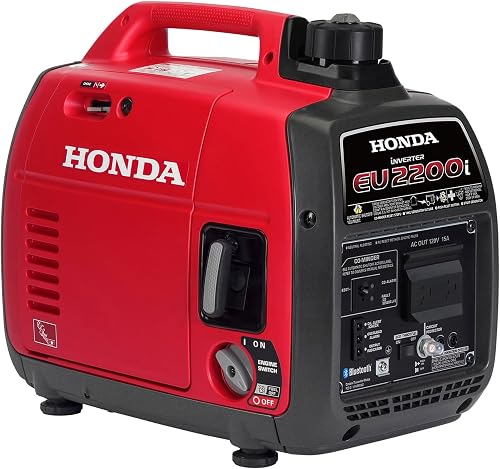
Honda EU2200i 2200W Super Quiet Inverter Generator - Portable Gas Power for Camping, RV & Home Backup, 8.1H Runtime

WEN 56235i 2350W Super Quiet Portable Inverter Generator - Ultra Lightweight 39lbs, Fuel Shut-Off, Clean Power for Camping RV

Westinghouse iGen4000DFc 4000 Peak Watt Dual Fuel Inverter Generator - Super Quiet RV Ready Remote Start CO Sensor
As an Amazon Associate we earn from qualifying purchases. Product prices and availability are accurate as of the date/time indicated.
Frequently Asked Questions
Can a 5,000-watt generator run a central air conditioner?
No, not a 3-ton unit. It needs about 3,500 running watts and 6,000 starting watts, which exceeds a 5,000-watt generator’s starting capacity. Only a smaller 1.5-2 ton unit with a soft starter might work, so check the AC nameplate first.
Is a 7,500-watt generator enough for a house?
Not for everything at once. Through a transfer switch it can run chosen circuits such as the fridge, furnace and lights, but not central AC plus an electric range or dryer together.
Can I use two small generators instead of one large one?
Yes, but only inverter models designed to link with the manufacturer’s parallel kit. Their outputs combine. Never connect unrelated generators to each other or to a panel.
Is a generator that is much bigger than my load a problem?
No, it is safe. It just burns more fuel than a right-sized unit, and some conventional engines run poorly at very light loads. Your manual states the minimum recommended load.
Do I need a bigger generator at altitude?
Yes. Altitude and high heat reduce output, so size up and check your manual for the derating for your model.
{“@context”: “https://schema.org”, “@type”: “FAQPage”, “mainEntity”: [{“@type”: “Question”, “name”: “Can a 5,000-watt generator run a central air conditioner?”, “acceptedAnswer”: {“@type”: “Answer”, “text”: “No, not a 3-ton unit. It needs about 3,500 running watts and 6,000 starting watts, which exceeds a 5,000-watt generator’s starting capacity. Only a smaller 1.5-2 ton unit with a soft starter might work, so check the AC nameplate first.”}}, {“@type”: “Question”, “name”: “Is a 7,500-watt generator enough for a house?”, “acceptedAnswer”: {“@type”: “Answer”, “text”: “Not for everything at once. Through a transfer switch it can run chosen circuits such as the fridge, furnace and lights, but not central AC plus an electric range or dryer together.”}}, {“@type”: “Question”, “name”: “Can I use two small generators instead of one large one?”, “acceptedAnswer”: {“@type”: “Answer”, “text”: “Yes, but only inverter models designed to link with the manufacturer’s parallel kit. Their outputs combine. Never connect unrelated generators to each other or to a panel.”}}, {“@type”: “Question”, “name”: “Is a generator that is much bigger than my load a problem?”, “acceptedAnswer”: {“@type”: “Answer”, “text”: “No, it is safe. It just burns more fuel than a right-sized unit, and some conventional engines run poorly at very light loads. Your manual states the minimum recommended load.”}}, {“@type”: “Question”, “name”: “Do I need a bigger generator at altitude?”, “acceptedAnswer”: {“@type”: “Answer”, “text”: “Yes. Altitude and high heat reduce output, so size up and check your manual for the derating for your model.”}}]}