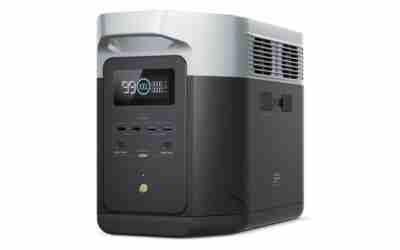
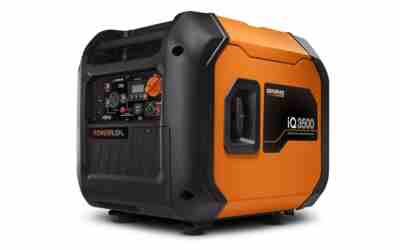
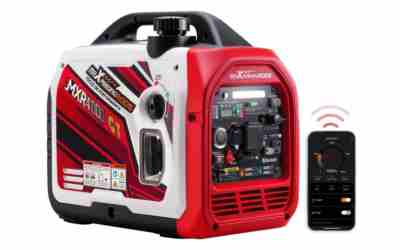
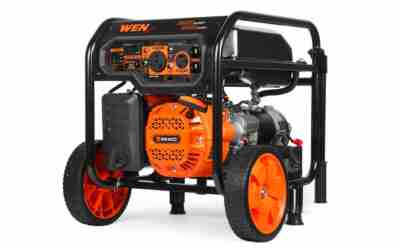
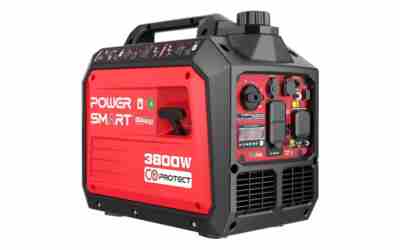
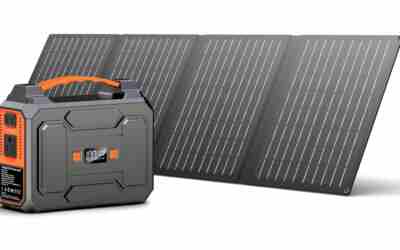
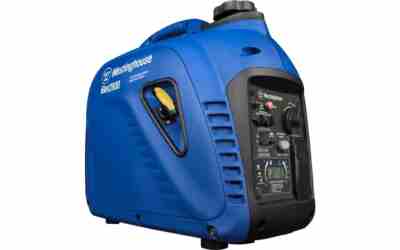
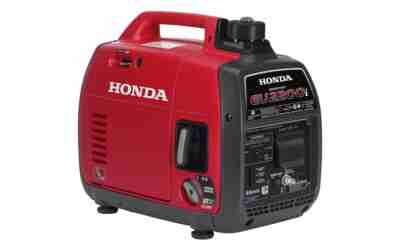
Our editorial team weighed Honda's published specifications and how it stacks up against similar products in the generators category. What stands out: Exceptionally Quiet, Reliable Honda Engine, and Compact Size. Where it falls short: Recoil Start Only and Gasoline Only. That puts it at 8.9/10 on our WG Score – an excellent, well-rounded option.
 Reviewed byDaniel
The right generator size for RV AC is about 3,000 watts for a 13,500 BTU unit and about 4,000 watts for a 15,000 BTU unit. Those numbers come from startup surge, not running watts, so the sections below show how to read your nameplate, add other loads and check the result.
How to find your AC’s running and starting watts
Both numbers come from the AC’s nameplate (a label on the unit, often visible from inside the ceiling assembly) or its manual. Look for RLA (rated load amps, the running current) and LRA (locked rotor amps, the starting current). Multiply each by 120 volts.
- Running watts = RLA × 120
- Starting watts = LRA × 120
Typical values for illustration: a 13,500 BTU unit at 12.5 A RLA and 23.3 A LRA works out to 1,500 W running and 2,800 W starting. A 15,000 BTU unit at 15 A and 29.2 A works out to 1,800 W and 3,500 W. Brands differ, so your label overrides these figures.
The two numbers differ because the compressor motor starts from a standstill and pulls locked-rotor current for a fraction of a second before settling to its running draw. The generator has to supply that spike, so its surge rating, not just its running rating, decides whether the AC starts.
Generator size for RV AC: step-by-step calculation
- Write down the AC’s running and starting watts from the nameplate.
- List every other load that will be on while the AC runs, each at its running watts (converter/charger, refrigerator, TV, lights, microwave).
- Peak watts = AC starting watts + the other loads already on when the compressor kicks in.
- Running watts = AC running watts + all other loads.
- Choose a generator whose surge rating is at or above peak watts and whose continuous rating is at or above running watts.
Do the math on the AC alone first, then add loads. If you want the same method applied to the whole rig, our guide on what size generator for an RV covers the other appliances.
Worked example: 13,500 and 15,000 BTU units
Assume a typical 650 W of other loads: converter/charger 300 W, refrigerator 200 W, TV and lights 150 W (300 + 200 + 150 = 650). Your own loads will differ; the power a refrigerator needs depends on its type.
| AC size | AC running W | AC starting W | Other loads W | Peak W, all on | Running W |
|---|---|---|---|---|---|
| 13,500 BTU | 1,500 | 2,800 | 650 | 3,450 | 2,150 |
| 15,000 BTU | 1,800 | 3,500 | 650 | 4,150 | 2,450 |
Peak is 2,800 + 650 = 3,450 W and 3,500 + 650 = 4,150 W. You can lower it by starting the AC first and adding loads afterward. Then the surge only has to cover the AC start plus the 200 W refrigerator: 3,000 W and 3,700 W. That is why 3,000 W and 4,000 W are the usual sizes.
A 1,000 W microwave on top of the 13,500 BTU running total gives 2,150 + 1,000 = 3,150 W, which is over a 3,000 W rating. Run the microwave with the AC off.
What a soft-start kit changes
A soft starter ramps the compressor up gradually instead of letting it draw full locked-rotor current. Micro-Air states that its EasyStart cuts starting current by about 65%; confirm the figure for your AC model with the maker.
Applied to the 13,500 BTU unit: 2,800 W × (1 − 0.65) = 980 W, which is below the 1,500 W running draw. Sizing then follows running watts, not the spike. The AC plus the refrigerator and lights is 1,500 + 200 + 150 = 1,850 W, which fits within a 2,000 W generator’s continuous rating. Add the converter and microwave and it no longer fits.
Without a soft starter, a 2,000 W generator generally cannot start a standard rooftop AC, because 2,800 W exceeds what it can deliver.
Running two RV air conditioners
Add the running watts of both, then add the starting watts of the second as it kicks in. Start them one at a time, never together.
For two 13,500 BTU units with the same 650 W of other loads:
- Running: 1,500 + 1,500 + 650 = 3,650 W
- Peak when the second starts: 1,500 (first AC running) + 2,800 (second AC starting) + 650 = 4,950 W
That points to a generator with a surge rating of about 5,000 W or more. With soft starters on both, the peak falls toward the 3,650 W running total.
Two matching inverter generators joined with a parallel kit add their ratings together, which is a way to reach that size from portable units. Use the maker’s kit and check that the combined output reaches your RV outlet.
30A or 50A inlet, altitude and heat limits
Inlet: a 30A inlet carries at most 120 V × 30 A = 3,600 W for the whole RV. The 3,650 W two-AC running total above is already over that, so two ACs need a 50A coach, which has two 120 V legs and a 12,000 W ceiling. The generator needs a matching 30A or 50A outlet, or the correct adapter.
Altitude: gasoline engines commonly lose about 3.5% of output per 1,000 ft. At 5,000 ft that is 5 × 3.5 = 17.5%, so a 3,000 W generator delivers about 3,000 × 0.825 = 2,475 W.
Heat and fuel: hot weather lowers output further, and the AC works harder when it is hot. Dual-fuel units usually list a lower rating on propane. Use the derating chart and fuel ratings in your generator’s manual, and size up if you camp high or hot.
Connecting and running the generator safely
- Run it outdoors only, on level ground, with the exhaust pointed away from the RV, neighbors and any windows, doors or vents. Follow the distance in your manual.
- Never run it in a garage, under an awning or in any enclosed space; carbon monoxide builds up there.
- Keep working CO alarms inside the RV, and replace them when they expire.
- Turn the RV’s AC and breakers off, connect the cord, start the generator, then switch loads on.
- Use an undamaged, RV-rated cord or adapter sized for the 30A or 50A circuit.
- Ground and fuel it per the manual, and let it cool before refilling.
- Check campground quiet hours and generator rules.
An AC held on all night burns fuel steadily, so it helps to know how much it costs to run a generator before a long stay.
Our Top Picks
Ready to shop? These are the top-rated options from our related roundup, Best Generators To Run RV Air Conditioner of 2026.
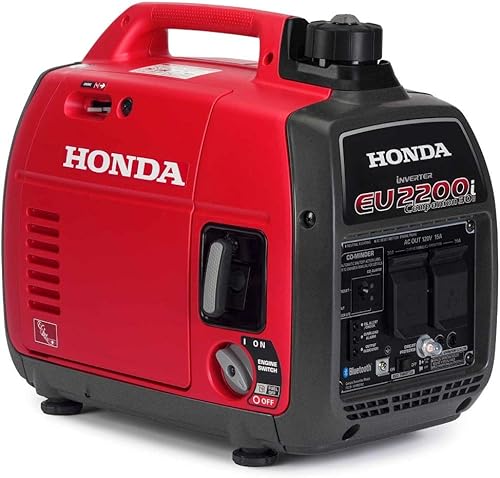
Honda EU2200ITAN1 2200-Watt Super Quiet Portable Inverter Generator with CO-Minder

Honda EU2200i 2200W Super Quiet Portable Inverter Generator with CO-Minder & Bluetooth App

Pulsar PG1202SA 1200W Portable Gas Generator with Handle - Compact Camping Powerhouse
As an Amazon Associate we earn from qualifying purchases. Product prices and availability are accurate as of the date/time indicated.
Frequently Asked Questions
Will a 3,000-watt generator run a 15,000 BTU RV AC?
Usually not without a soft starter. The unit needs about 3,500 W to start, which is above a 3,000 W rating. With a soft starter the draw drops to near running watts, and it can work if few other loads are on.
Can I run an RV AC from a portable power station?
Only if its inverter can handle the AC’s starting watts and its battery is large. A 1,500 W AC uses 1,500 Wh each hour, so a 2,000 Wh station lasts about 1 hour 20 minutes before conversion losses.
Is a generator that is too big bad for my RV AC?
No. The AC draws only what it needs, so a larger generator will not harm it. The downside is extra weight, noise and fuel burned at light load. Inverter models with an economy mode reduce that.
Do I need the generator’s surge rating or its running rating?
Check both. Surge must cover the AC’s starting watts plus loads already on, and the running rating must cover the AC plus everything else. A generator that meets only the running figure may still stall when the compressor starts.
{“@context”: “https://schema.org”, “@type”: “FAQPage”, “mainEntity”: [{“@type”: “Question”, “name”: “Will a 3,000-watt generator run a 15,000 BTU RV AC?”, “acceptedAnswer”: {“@type”: “Answer”, “text”: “Usually not without a soft starter. The unit needs about 3,500 W to start, which is above a 3,000 W rating. With a soft starter the draw drops to near running watts, and it can work if few other loads are on.”}}, {“@type”: “Question”, “name”: “Can I run an RV AC from a portable power station?”, “acceptedAnswer”: {“@type”: “Answer”, “text”: “Only if its inverter can handle the AC’s starting watts and its battery is large. A 1,500 W AC uses 1,500 Wh each hour, so a 2,000 Wh station lasts about 1 hour 20 minutes before conversion losses.”}}, {“@type”: “Question”, “name”: “Is a generator that is too big bad for my RV AC?”, “acceptedAnswer”: {“@type”: “Answer”, “text”: “No. The AC draws only what it needs, so a larger generator will not harm it. The downside is extra weight, noise and fuel burned at light load. Inverter models with an economy mode reduce that.”}}, {“@type”: “Question”, “name”: “Do I need the generator’s surge rating or its running rating?”, “acceptedAnswer”: {“@type”: “Answer”, “text”: “Check both. Surge must cover the AC’s starting watts plus loads already on, and the running rating must cover the AC plus everything else. A generator that meets only the running figure may still stall when the compressor starts.”}}]}