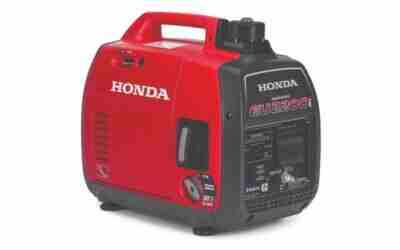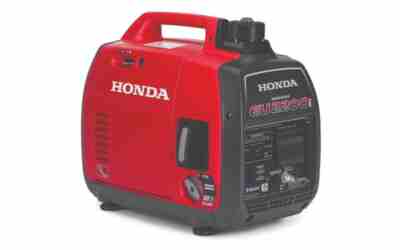

Our editorial team weighed Honda's published specifications and how it stacks up against similar products in the generators category. What stands out: Exceptionally Quiet, CO-Minder Safety Tech, and Portable & Lightweight. Where it falls short: Recoil Start Only and 3.2h Runtime at Full Load. That puts it at 8.9/10 on our WG Score – an excellent, well-rounded option.
 Reviewed byEthan
The generator power to run a refrigerator is about 700 running watts and 2,100 starting watts, so a generator rated at 2,500 starting watts handles most single fridges. Your own fridge’s label sets the exact figure, and the steps below show how to read it and add other loads.
Running watts vs. starting watts for a refrigerator
Running watts are what the compressor draws while it is on. Starting watts are the short spike when the compressor kicks in, lasting a second or two. The generator has to cover both, and the starting spike is usually what decides the size.
- Mini fridge: about 70-90 running watts and 280-360 starting watts.
- Modern full-size fridge: roughly 350-800 running watts and 1,200-2,000 starting watts.
- Older or less efficient fridge: can draw 1,000 running watts or more.
These ranges are wide because size, age, compressor type and features like ice makers all change the draw. Treat the list as orientation and take your real number from the fridge itself.
How to find your fridge’s actual wattage
- Find the nameplate, usually on the inside wall of the fresh-food compartment, on the ceiling, or behind the bottom grille.
- Look for watts. If the label shows only volts and amps, multiply them: 120 V × 5.8 A = 696, or about 700 running watts.
- The label rarely lists starting watts. As a planning figure, multiply running watts by 3: 700 × 3 = 2,100 starting watts. Inverter-compressor fridges often surge less, and some older units surge more, so treat 3 as a rough guide.
- For a real reading, plug the fridge into a plug-in watt meter such as a Kill-A-Watt and record the peak over a full day, including a defrost cycle.
Then compare your numbers with the "running" and "starting" (or surge) ratings in the generator manual. For other household loads, the generator wattage chart lists typical figures.
Generator power to run a refrigerator: the sizing formula
Add up the running watts of everything you will run, then add the largest extra surge, which is a load’s starting watts minus its running watts. The result is the starting watts you need.
Single fridge: the extra surge is 2,100 – 700 = 1,400 watts. The need is 700 + 1,400 = 2,100 starting watts.
Now add the margin once. Keeping the load at or below 90% of the rating leaves headroom, so divide by 0.9:
- Starting: 2,100 ÷ 0.9 = 2,333, so shop for 2,500 starting watts.
- Running: 700 ÷ 0.9 = 778, so the running rating should be at least 800 watts.
Undersizing can trip the breaker or sag the voltage, which stresses the compressor. If you want a lookup by generator size instead, see how many watts a generator needs to run a refrigerator.
Sizing for a fridge, freezer, lights and a phone charger
The inputs below are typical values; replace them with your own label or meter readings.
| Load | Running W | Starting W |
|---|---|---|
| Refrigerator | 700 | 2,100 |
| Chest freezer | 300 | 900 |
| Two LED bulbs | 20 | 20 |
| Phone charger | 10 | 10 |
| Total running | 1,030 | – |
The worst moment is the fridge starting while everything else is already running: 2,100 + 300 + 20 + 10 = 2,430 starting watts. With the 90% margin:
- Running: 1,030 ÷ 0.9 = 1,144, so at least 1,150 watts.
- Starting: 2,430 ÷ 0.9 = 2,700, so a 3,000 starting-watt generator.
Start the loads one at a time, largest first, so only one compressor surges at once.
Inverter generators and power stations at fridge startup
Either generator type works if its starting (surge) rating covers your fridge’s starting watts and its running rating covers the total load. Inverter models deliver cleaner power, and their listed surge is often available only briefly, so read the manual’s surge duration. Conventional models are judged by the same two ratings.
A portable power station follows the same rule: its inverter must cover your running and starting watts. Battery capacity is a separate question, covered in can a solar generator power a refrigerator.
Connecting the fridge safely
- Run the generator outdoors only, never in a garage, and keep it clear of windows, doors and vents with the exhaust pointed away. Follow the distance in your manual or on its label.
- Put a battery-powered CO alarm inside the home.
- Use a heavy-duty, outdoor-rated extension cord with a gauge matched to the load and length, as the cord label and manual specify.
- Never backfeed the house through a wall outlet. Powering house circuits needs a transfer switch or interlock installed by a licensed electrician under local code.
- Keep the generator on a dry surface and let it cool before refueling.
Fuel use and how long the fridge can run
A fridge cycles on and off, and a modern full-size model averages roughly 1-2 kWh a day. A generator sized for startup therefore runs lightly loaded most of the time. Your manual’s runtime chart is the source for tank life: use the figure at 25% load for the closest match, and do not rely on a general number.
For fuel cost per hour, see how much it costs to run a generator.
You also do not have to run it nonstop. USDA guidance says an unopened fridge keeps food safe for about 4 hours, and a full freezer for about 48 hours (24 hours if half full). Many people run the generator in blocks, keep doors closed, and confirm with a thermometer that the fridge stays at 40°F or below.
Our Top Picks
Ready to shop? These are the top-rated options from our related roundup, Best Portable Power Inverter Generators of 2026.

Honda EU2200i 2200W Super Quiet Portable Inverter Generator with CO-Minder & Bluetooth App

Westinghouse iGen5000DF 5000 Peak Watt Dual Fuel Inverter Generator - Super Quiet RV Ready Remote Start

maXpeedingrods MXR4000GT 4000W Dual Fuel Inverter Generator with Bluetooth App Control
As an Amazon Associate we earn from qualifying purchases. Product prices and availability are accurate as of the date/time indicated.
Frequently Asked Questions
Can a 2,000-watt generator run a refrigerator?
Yes, if the fridge’s starting watts fit within the generator’s starting rating, not just its running rating. An efficient fridge with 1,500 starting watts works; the 2,100-starting-watt example above does not. Check the fridge label, then the generator manual.
Can a 1,500-watt generator run a fridge and freezer together?
Only with small, efficient units whose combined running load and largest surge both fit under its ratings. The 1,030 running watts in the example table fit, but its 2,430-watt peak does not, so that pair needs a larger generator.
Does an ice maker or water dispenser change the wattage?
Yes. Ice makers and defrost heaters add draw on some models, so a label or one-time reading can miss it. Plug in a watt meter for a full day, including a defrost cycle, and size from the highest reading.
Is a 3,000-watt generator too big for one fridge?
No. It starts the fridge easily, but it runs lightly loaded, so it burns fuel for a small load. Check the manual’s runtime at 25% load and consider running it in blocks while keeping the fridge door closed.
{“@context”: “https://schema.org”, “@type”: “FAQPage”, “mainEntity”: [{“@type”: “Question”, “name”: “Can a 2,000-watt generator run a refrigerator?”, “acceptedAnswer”: {“@type”: “Answer”, “text”: “Yes, if the fridge’s starting watts fit within the generator’s starting rating, not just its running rating. An efficient fridge with 1,500 starting watts works; the 2,100-starting-watt example above does not. Check the fridge label, then the generator manual.”}}, {“@type”: “Question”, “name”: “Can a 1,500-watt generator run a fridge and freezer together?”, “acceptedAnswer”: {“@type”: “Answer”, “text”: “Only with small, efficient units whose combined running load and largest surge both fit under its ratings. The 1,030 running watts in the example table fit, but its 2,430-watt peak does not, so that pair needs a larger generator.”}}, {“@type”: “Question”, “name”: “Does an ice maker or water dispenser change the wattage?”, “acceptedAnswer”: {“@type”: “Answer”, “text”: “Yes. Ice makers and defrost heaters add draw on some models, so a label or one-time reading can miss it. Plug in a watt meter for a full day, including a defrost cycle, and size from the highest reading.”}}, {“@type”: “Question”, “name”: “Is a 3,000-watt generator too big for one fridge?”, “acceptedAnswer”: {“@type”: “Answer”, “text”: “No. It starts the fridge easily, but it runs lightly loaded, so it burns fuel for a small load. Check the manual’s runtime at 25% load and consider running it in blocks while keeping the fridge door closed.”}}]}