A good portable generator has enough running watts plus CO shutdown, solid runtime, a listed noise rating, protected outlets and a clear warranty.
What makes a good portable generator? Six checks
Run any model through these six checks before you compare brands. Every figure below comes from the nameplate, the manual or the manufacturer’s spec sheet, so read those for the exact unit you are considering, and follow local code for any home connection.
| Check | Pass mark |
|---|---|
| 1. Running watts | Rated running watts at or above your total load; starting watts at or above that total plus your largest surge |
| 2. CO shutdown | Built-in sensor that stops the engine when carbon monoxide builds up |
| 3. Runtime | About 10 hours at 50% load on a full tank is a useful guideline |
| 4. Noise | A dBA rating that lists the test distance and load |
| 5. Protected outlets | GFCI outlets, low-oil shutoff, and a 30-amp locking outlet if you plan to use a transfer switch |
| 6. Warranty | Length stated in years, home use covered, service available near you |
Running watts decide whether the generator can power your essentials at all, so they come first. CO shutdown is the check that separates a current design from an older one, and it is the one pass mark that should be non-negotiable.
The 10-hour runtime figure is a guideline, not a rule. Many good units fall short of it, especially larger ones with a high burn rate. If a model misses it, ask how many hours you actually need between refuelings and whether you can refuel safely during an outage.
Decision rule: choose on running watts first, then pick the type that fits how you will use it. If a model has no CO shutdown, skip it.
How many running watts do you need? A worked example
Add the running watts of everything you want on at once. Then add the single largest starting-watt surplus (starting watts minus running watts). Motors draw their surge one at a time if you start them one at a time, so you add only the biggest surplus, not every one.
| Item | Running watts | Starting watts | Surplus |
|---|---|---|---|
| Refrigerator | 700 | 2,200 | 1,500 |
| Sump pump (1/3 hp) | 800 | 1,300 | 500 |
| LED lights (10 bulbs) | 100 | 100 | 0 |
| TV | 150 | 150 | 0 |
| Router and phone chargers | 100 | 100 | 0 |
Running watts: 700 + 800 + 100 + 150 + 100 = 1,850. Starting watts needed: 1,850 + 1,500 (the refrigerator’s surplus) = 3,350.
Your target is at least 1,850 running and 3,350 starting watts. A unit rated 3,000 running and 3,500 starting technically covers it, but it leaves only 150 W of surge headroom (3,500 − 3,350). A unit rated 3,500 running and 4,000 starting leaves 650 W (4,000 − 3,350), which is a more comfortable choice.
These are typical values. Use the labels on your own appliances, because refrigerators and pumps differ widely.
Rule-of-thumb size tiers
- 3,000 to 4,000 watts: a refrigerator, sump pump, lights and TV, as in the example.
- 5,000 to 8,500 watts: the same essentials plus extra motor loads such as a well pump or window AC.
- About 10,000 watts: whole-circuit loads such as central AC or an electric range, which means a transfer switch. For example, a 3,500 W central AC and a 4,500 W range plus the 1,850 W essentials total 9,850 running watts, before any startup surge.
Conventional vs inverter vs dual fuel: which should you choose?
Match the type to the job. Each one wins somewhere and loses somewhere else.
| Type | Choose it if | Where it loses |
|---|---|---|
| Conventional open-frame | You want the most watts per dollar for storm backup | Louder and heavier; output is less suited to sensitive electronics unless the model lists low distortion |
| Inverter | You want RV, camping or tailgating power, or a quieter unit for laptops and phones | Costs more per running watt and tops out at smaller sizes, so it suits short load lists |
| Dual fuel | You want propane for long storage with gasoline as a backup | Output on propane is typically lower than on gasoline; the manual lists both numbers |
By use case: for storm backup, choose conventional or dual fuel sized with the math above. For RV, camping or tailgating, choose an inverter. If you want fuel that stores for years, choose dual fuel and run it on propane.
Whichever type you pick, size it from the running and starting numbers in the manual, not from the headline wattage on the box.
How do you read a spec sheet?
Spec sheets lead with the most flattering number. Check these details instead.
- Rated vs peak watts. Size on the running (rated) number, and use the peak number only for surge. For example, a model sold as 2,500 watts may list 2,500 starting and 2,000 running, so it is a 2,000-watt generator for continuous loads.
- Runtime and load. Runtime figures at 25% load look longer than at 50%. Divide tank size by burn rate: a 6-gallon tank burning 0.6 gallons per hour at 50% load gives 6 ÷ 0.6 = 10 hours.
- Noise. A dBA number means little without the distance and load. Every 10 dBA difference is perceived as roughly twice as loud, so compare models at the same distance and load. Our list of quiet portable generators helps if noise is your priority.
- Warranty. Look for the length in years and whether home use is covered.
- Fuel. Propane stores well. Gasoline goes stale, so plan for fuel stabilizer and rotating your supply.
If two models pass the same checks, the one that publishes more detail, such as test load, test distance and propane output, is usually easier to trust and easier to compare.
How do you connect it and run it safely?
Carbon monoxide is the main danger. Run the generator outdoors only, never in a garage or basement, and place and aim the exhaust as your manual specifies. Install battery-powered CO alarms inside the home. A CO shutdown sensor adds protection, but it does not replace placing the unit outside. For fuller rules, read our portable generator safety guide.
You have two safe ways to deliver power. For a few items, run heavy-duty outdoor extension cords rated for the load from the generator to each appliance. For hardwired circuits, have a licensed electrician install a transfer switch or interlock.
Never plug a generator into a wall outlet to power the house. That backfeeds the lines and can injure utility workers and start fires. Permits and inspection rules depend on your area, so ask your electrician and local building department before installing anything.
Keep the unit dry and on level ground, let the engine cool before refueling, and store fuel in approved containers.
Our Top Picks
Ready to shop? These are the top-rated options from our hands-on roundup, Best Portable Dual Fuel Generators For Home Backup of 2026.

Westinghouse iGen4000DFc 4000 Peak Watt Dual Fuel Inverter Generator - Super Quiet RV Ready Remote Start CO Sensor

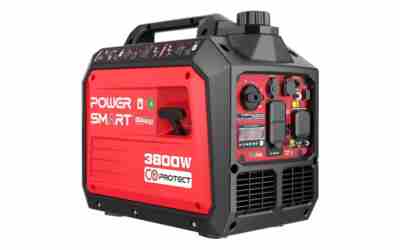
PowerSmart 3800 Watt Dual Fuel Inverter Generator Quiet Portable Gas Propane with CO Sensor RV Ready

maXpeedingrods MXR4000GT 4000W Dual Fuel Inverter Generator with Bluetooth App Control
As an Amazon Associate we earn from qualifying purchases. Product prices and availability are accurate as of the date/time indicated.
Frequently Asked Questions
Is a dual-fuel generator worth it?
It is worth it if you want propane for long-term storage, since propane keeps better than gasoline. It costs more and usually produces fewer watts on propane, so size the unit from the propane rating in the manual.
Can a small portable generator run a window AC?
Often yes, if you add the AC to your load total. A 5,000 BTU window AC draws about 500 W running and about 1,500 W starting. Added to the example load, that is 1,850 + 500 = 2,350 running watts and 2,350 + 1,500 = 3,850 starting watts, since the refrigerator’s 1,500 W surplus is still the largest. A 3,500 running / 4,000 starting unit covers it. Check your own AC’s label.
Is a 3,500-watt generator too small for a whole house?
Usually yes. A 3,500-watt unit suits a refrigerator, sump pump, lights and electronics, as in the example. Central AC or an electric range pushes you toward the 10,000-watt tier and a transfer switch. Decision rule: if you want only essentials, 3,500 is enough; if you want whole-house comfort, size up.
Can an inverter generator run a refrigerator?
Yes, if its starting watts clear the refrigerator’s surge and its running watts cover everything else on your list. Check the refrigerator’s label for starting watts, then compare it with the inverter’s listed starting and running numbers.
Can a portable power station replace a generator?
For a few small loads, yes. A power station is limited by battery watt-hours. Divide watt-hours by your load in watts for hours of use. For a refrigerator and sump pump over several days, a generator fits better.
{“@context”: “https://schema.org”, “@type”: “FAQPage”, “mainEntity”: [{“@type”: “Question”, “name”: “Is a dual-fuel generator worth it?”, “acceptedAnswer”: {“@type”: “Answer”, “text”: “It is worth it if you want propane for long-term storage, since propane keeps better than gasoline. It costs more and usually produces fewer watts on propane, so size the unit from the propane rating in the manual.”}}, {“@type”: “Question”, “name”: “Can a small portable generator run a window AC?”, “acceptedAnswer”: {“@type”: “Answer”, “text”: “Often yes, if you add the AC to your load total. A 5,000 BTU window AC draws about 500 W running and about 1,500 W starting. Added to the example load, that is 1,850 + 500 = 2,350 running watts and 2,350 + 1,500 = 3,850 starting watts, since the refrigerator’s 1,500 W surplus is still the largest. A 3,500 running / 4,000 starting unit covers it. Check your own AC’s label.”}}, {“@type”: “Question”, “name”: “Is a 3,500-watt generator too small for a whole house?”, “acceptedAnswer”: {“@type”: “Answer”, “text”: “Usually yes. A 3,500-watt unit suits a refrigerator, sump pump, lights and electronics, as in the example. Central AC or an electric range pushes you toward the 10,000-watt tier and a transfer switch. Decision rule: if you want only essentials, 3,500 is enough; if you want whole-house comfort, size up.”}}, {“@type”: “Question”, “name”: “Can an inverter generator run a refrigerator?”, “acceptedAnswer”: {“@type”: “Answer”, “text”: “Yes, if its starting watts clear the refrigerator’s surge and its running watts cover everything else on your list. Check the refrigerator’s label for starting watts, then compare it with the inverter’s listed starting and running numbers.”}}, {“@type”: “Question”, “name”: “Can a portable power station replace a generator?”, “acceptedAnswer”: {“@type”: “Answer”, “text”: “For a few small loads, yes. A power station is limited by battery watt-hours. Divide watt-hours by your load in watts for hours of use. For a refrigerator and sump pump over several days, a generator fits better.”}}]}