For a 30-amp RV with one air conditioner, the right RV generator size is about 3,500 running watts.
RV generator size by setup
Size the generator to the air conditioner first, because it is the biggest load in an RV and has the biggest startup surge. The table below applies the steps later in this guide to three common setups. Each one includes 650 watts of base loads (fridge 150, converter 300, lights 100, TV 100) and one 20% buffer.
| Setup | Buffered running total | Buffered peak at AC start |
|---|---|---|
| One 13,500 BTU AC | 2,460 W | 4,140 W |
| One 15,000 BTU AC | 2,700 W | 4,380 W |
| Two 15,000 BTU ACs, started one at a time | 4,620 W | 6,300 W |
The peak column assumes one air conditioner starts while everything else is already running. Round up to the next generator rating, never down. Your AC’s data label and your generator’s manual decide the final number.
A rig with two air conditioners needs a generator whose running rating clears 4,620 W, which is more than a 30-amp rig can supply. Two-AC rigs usually run on 50-amp service, so the 50-amp section below covers the outlet you need. For more AC sizes and combinations, see our generator size chart for RV air conditioners.
How many watts does a 13,500 or 15,000 BTU RV air conditioner need?
An RV air conditioner runs on far less power than it needs to start. The compressor motor pulls roughly double its running draw for a moment when it kicks on, and that surge is what overloads a generator that looks big enough on paper.
| AC size | Running watts | Starting watts | Running amps at 120 V |
|---|---|---|---|
| 13,500 BTU | 1,400 | 2,800 | 11.7 |
| 15,000 BTU | 1,600 | 3,000 | 13.3 |
These are typical values for rooftop units, not figures from a specific model. Your AC’s nameplate lists the real numbers, usually as rated load amps for running and locked rotor amps for the startup surge. Multiply either figure by 120 volts to get watts, then use those in place of the ones above.
Starting watts last only a moment, but a generator that cannot cover them can stall or trip its breaker when the compressor kicks on. A soft start device lowers that surge, and the soft-start section below explains how that changes the size.
How to add up running and starting watts
- List everything you will run at the same time. Take watts from each label, or multiply amps by 120 volts.
- Add the running watts for the whole list.
- Find the biggest startup surge, usually the AC. Peak watts equal the running total, minus that item’s running watts, plus its starting watts.
- Add 20% to the running total and to the peak. Do this once, not at every step.
- Match the running total to the generator’s running rating, and the peak to its starting rating.
Count only what really runs at once. Cooking, hot water and cooling rarely need to overlap, and staggering them is the cheapest way to cut the peak.
Worked example: 30-amp trailer, one 15,000 BTU AC
The wattages below are typical values. Swap in the numbers from your labels.
- AC: 1,600 running, 3,000 starting
- Fridge: 150
- Converter: 300
- Lights: 100
- TV: 100
Running total: 1,600 + 150 + 300 + 100 + 100 = 2,250 W. With the 20% buffer, that is 2,700 W.
Peak when the AC starts: 2,250 − 1,600 + 3,000 = 3,650 W. With the buffer, that is 4,380 W.
The microwave (1,000 W) is used with the AC off: 1,000 + 150 + 300 + 100 + 100 = 1,650 W, or 1,980 W with the buffer. That fits easily.
Result: without a soft start, match 2,700 running and 4,380 starting watts. With a soft start, the 2,700 W running total decides.
Because the microwave and the AC never run together in this plan, the AC case sets the size. If you want both on at once, add the microwave’s 1,000 W to the AC case and run the steps again. Then confirm both ratings on the spec sheet of the generator you pick.
30-amp vs 50-amp RV: what the generator must supply
A 30-amp RV is capped at 30 A × 120 V = 3,600 W for the whole rig. That is why a generator rated about 3,500 running watts is the practical size for a one-AC rig: a larger unit cannot push more through the 30-amp inlet. Check that its starting rating covers your buffered peak.
A 50-amp RV has two 120-volt legs at 50 A each. That is 6,000 W per leg and 12,000 W in total. Few rigs ever draw that much, so size a 50-amp rig to its actual loads, not to its service rating.
Can a 30-amp generator run a 50-amp RV?
Yes, through a 30-to-50-amp adapter, but the RV then gets only the 30-amp ceiling. In practice that means one AC and careful load management. Check your RV manual to see how the two legs are fed through the adapter, and use cords and adapters rated for the amperage.
To use the full 50-amp capacity, you need a generator with a 120/240-volt 50-amp outlet. Those are larger conventional or high-output units.
Do a soft start, a parallel pair, altitude or heat change the size?
Yes, all of them can. Here is how to decide between the options.
- Soft start: it cuts the startup surge, so the running total decides the size instead of the peak. It is a common way to get a smaller generator to start an AC. Confirm with the soft-start maker that the model fits your compressor.
- Two paralleled inverter units: two 2,000 W units made to parallel give 4,000 W running, which clears the 2,700 W running total in the example. You can run one unit alone for light use, and each piece is easier to carry. Check the kit’s output limit before you count on the full sum.
- One bigger generator: this wins for two ACs, a 50-amp 240-volt hookup, or a single unit that is simpler to run.
Decision rule: with a soft start, buy to the buffered running total. Without one, the generator must clear both the buffered running total and the buffered peak, so choose the smallest unit that meets both ratings. If no single unit does, use a parallel pair or one larger generator.
Altitude and heat
A common rule of thumb is a 3–4% output loss per 1,000 feet above sea level. At 6,000 feet, a 3,500 W generator delivers about 2,660–2,870 W. That is borderline against the 2,700 W running total in the example, so go up a size for mountain camping. Heat and fuel type also change output, so follow the manual’s ratings for your conditions.
Placement, exhaust direction and carbon monoxide rules also come from the manual or label, so follow them.
Our Top Picks
Ready to shop? These are the top-rated options from our hands-on roundup, Best RV Generators For 15000 Btu Air Conditioner of 2026.
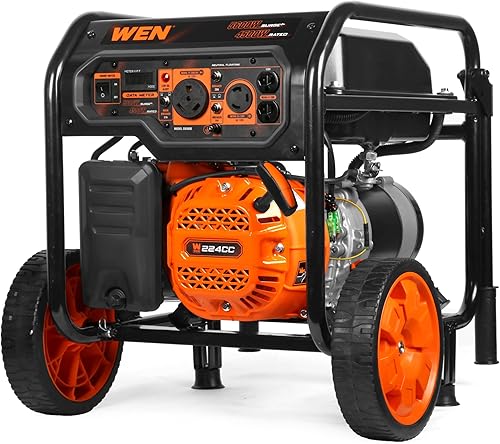
WEN GN5600 5600W Portable Generator RV-Ready Transfer Switch 4500 Running Watts 224cc Engine

WEN RV-Ready 4000-Watt Open Frame Inverter Generator GN400iM

Pulsar PG1202SA 1200W Portable Gas Generator with Handle - Compact Camping Powerhouse
As an Amazon Associate we earn from qualifying purchases. Product prices and availability are accurate as of the date/time indicated.
Related reading: How to Size a Generator for Your Home: A Step-by-Step Guide · The Best 2,000-Watt Generators for RV Camping in 2026
Frequently Asked Questions
Can a 2,000-watt generator run an RV air conditioner?
Yes, a 13,500 BTU unit with a matched soft start can run on one when only the fridge is on. The 1,400 W AC plus the 150 W fridge is 1,550 W, or 1,860 W buffered. Without a soft start the buffered peak is 3,540 W, so plan on a larger unit.
Can one generator run two RV air conditioners at once?
Not on a 30-amp rig. Two 15,000 BTU units draw 3,200 W before any base loads, which is already past what that service can supply once the fridge and converter are added. On a 50-amp rig, stagger the starts.
Can I run an RV on a 2,200-watt inverter at altitude?
For light loads only. At 6,000 feet the same 3–4% rule leaves about 1,670–1,800 W, enough for the 650 W of base loads but not for an air conditioner.
Can a portable power station replace a generator for RV air conditioning?
Only for short runs. A 1,600 W AC drains a 2,000 Wh station in about 1.25 hours at best. Power stations suit the fridge, lights and electronics, while a generator suits all-day cooling.
Is a 4,000-watt generator too big for a 30-amp RV?
No. It runs the RV fine, but the 30-amp inlet still limits the rig, so the extra capacity goes unused.
{“@context”: “https://schema.org”, “@type”: “FAQPage”, “mainEntity”: [{“@type”: “Question”, “name”: “Can a 2,000-watt generator run an RV air conditioner?”, “acceptedAnswer”: {“@type”: “Answer”, “text”: “Yes, a 13,500 BTU unit with a matched soft start can run on one when only the fridge is on. The 1,400 W AC plus the 150 W fridge is 1,550 W, or 1,860 W buffered. Without a soft start the buffered peak is 3,540 W, so plan on a larger unit.”}}, {“@type”: “Question”, “name”: “Can one generator run two RV air conditioners at once?”, “acceptedAnswer”: {“@type”: “Answer”, “text”: “Not on a 30-amp rig. Two 15,000 BTU units draw 3,200 W before any base loads, which is already past what that service can supply once the fridge and converter are added. On a 50-amp rig, stagger the starts.”}}, {“@type”: “Question”, “name”: “Can I run an RV on a 2,200-watt inverter at altitude?”, “acceptedAnswer”: {“@type”: “Answer”, “text”: “For light loads only. At 6,000 feet the same 3–4% rule leaves about 1,670–1,800 W, enough for the 650 W of base loads but not for an air conditioner.”}}, {“@type”: “Question”, “name”: “Can a portable power station replace a generator for RV air conditioning?”, “acceptedAnswer”: {“@type”: “Answer”, “text”: “Only for short runs. A 1,600 W AC drains a 2,000 Wh station in about 1.25 hours at best. Power stations suit the fridge, lights and electronics, while a generator suits all-day cooling.”}}, {“@type”: “Question”, “name”: “Is a 4,000-watt generator too big for a 30-amp RV?”, “acceptedAnswer”: {“@type”: “Answer”, “text”: “No. It runs the RV fine, but the 30-amp inlet still limits the rig, so the extra capacity goes unused.”}}]}