Your solar generator size comes down to daily watt-hours: 300-500 Wh covers phones, lights and a router, 1,000 Wh covers a CPAP and laptop while camping, 2,000 Wh runs a fridge for about a day, and 3,000+ Wh backs up home essentials. Pick the battery by daily watt-hours, then confirm the inverter’s watts exceed your biggest load, including startup surge.
Solar generator size by use: quick chart
Match the battery (watt-hours, Wh) to the energy you use per day, and the inverter (watts, W) to the most you run at once. Usable energy is about 83% of the rated Wh (estimate: real-world efficiency is roughly 80-90%, and it varies by model; check the label or manual), so a 1,000 Wh unit delivers about 830 Wh.
| Rated size | Usable (about 83%) | Good for | Won’t handle |
|---|---|---|---|
| 500 Wh | about 415 Wh | Phones, laptop, LED lights, router; CPAP one night (about 10 hours at 40 W) | A fridge for a full day, any heater or air conditioner |
| 1,000 Wh | about 830 Wh | Camping and RV basics; CPAP for two 8-hour nights; fridge alone for about 16 hours | A 1,500 W space heater (about 33 minutes), most air conditioners |
| 2,000 Wh | about 1,660 Wh | Fridge alone for about 1.4 days; fridge, router and lights for about 1.1 days; a 500 W window AC for about 3.3 hours | Electric dryers, ranges, whole-house loads |
| 3,000+ Wh | about 2,490 Wh or more | Essential home backup for about 1.1 days: fridge, router, lights, TV, laptop (example 3) | Central AC, electric range or dryer; well pumps unless the inverter’s surge rating covers them |
Fridge rows assume a full-size fridge using 1,200 Wh a day, an average of 50 W (1,200 ÷ 24). A fridge draws 100-200 W only while its compressor runs, roughly a third of the time, so use the 50 W average for runtime and the running and startup watts for inverter sizing. Runtimes are estimates: usable Wh ÷ load watts.
Watts vs. watt-hours
Watt-hours are the size of the tank. Watts are how fast you can pull from it. A 1,000 Wh unit with a 1,000 W inverter runs a 1,000 W load for about 50 minutes (830 ÷ 1,000) but a 100 W load for about 8 hours (830 ÷ 100).
For the 1,000 Wh tier, compare units in our best 1,000 watt solar generators roundup.
Steps 1 and 2: List devices, running watts and surge watts
Write down every device you want to power. Find running watts on the label, in the manual, or with a plug-in watt meter, which also shows the peak at startup. If the label lists amps, watts = volts × amps: 1.5 A × 120 V = 180 W.
| Device | Typical running watts |
|---|---|
| Phone charging | 10-20 W |
| Laptop | 45-90 W |
| LED bulb | 5-10 W |
| Wi-Fi router or modem | 10-20 W |
| CPAP (heated humidifier adds more) | 30-60 W |
| Full-size refrigerator (only while compressor runs) | 100-200 W |
| Microwave | 700-1,200 W |
| Window AC, 5,000 to 10,000 BTU | about 450-1,000 W |
| Space heater | 1,500 W |
These are typical ranges, not specs; check each device’s label.
Motor loads such as fridge compressors, pumps and window AC draw extra for a moment at startup. Surge size varies by model; check the label or manual, and measure yours with a watt meter rather than guessing. The examples below assume a 600 W fridge startup.
Inverter rule: the continuous rating must exceed the total watts running together, and the surge rating must exceed the largest startup plus everything else running. Example: fridge startup 600 W + router 10 W + lights 30 W = 640 W peak, so a 1,000 W inverter leaves margin.
If you use an extension cord, choose one rated for the load (check the amp rating on the cord) and keep it short.
Step 3: Calculate daily watt-hours and real runtime
- For each device, multiply running watts by hours used per day.
- Add the results for a daily total.
- Multiply the total by 1.2 (about 1 ÷ 0.83). This 20% buffer covers inverter and conversion losses.
- Multiply by the number of days you need to run without sun.
Fridges cycle on and off, so a simple watts × hours guess is rough. Use the yellow EnergyGuide label instead: kWh per year ÷ 365 × 1,000. A label reading 438 kWh per year works out to 1,200 Wh a day. Compare models built for this job in our best solar generators for refrigerators.
Two runtime methods, used one at a time: for a single load, hours = rated Wh × 0.83 ÷ load watts, so a 1,000 Wh unit running a 60 W laptop lasts about 13.8 hours (830 ÷ 60). For a full day’s plan, days = rated Wh ÷ buffered daily Wh. The buffer already accounts for the 83%, so do not multiply by 0.83 again.
Cold cuts available battery capacity, and many units limit or stop charging near freezing. Check the manual’s temperature limits, and keep the unit out of hot cars and direct heat.
Step 4: How many solar panels do you need?
Panels rarely deliver their rated watts. Heat, angle, haze and wiring losses cut output, so use this estimate (a rule of thumb, not a spec): panel watts = buffered daily Wh ÷ (peak sun hours × 0.75).
Peak sun hours vary by region and season. NREL’s solar resource data put annual averages at roughly 3.5 to 6.5 hours a day across much of the US, lower in winter. Look up your location in NREL’s PVWatts calculator. The examples use 4 hours as a cautious planning value.
| Daily Wh to replace | Panel watts at 4 sun hours | Panel watts at 6 sun hours |
|---|---|---|
| 600 Wh | 200 W | about 133 W |
| 1,200 Wh | 400 W | about 267 W |
| 1,800 Wh | 600 W | 400 W |
| 2,700 Wh | 900 W | 600 W |
Formula: 4 sun hours divides by 3 (4 × 0.75); 6 sun hours divides by 4.5 (6 × 0.75). Example: 600 ÷ 3 = 200 W and 600 ÷ 4.5 = about 133 W.
To refill a 2,000 Wh unit in one 4-sun-hour day, you need about 670 W of panels (2,000 ÷ 3). A 400 W array makes about 1,200 Wh a day (400 × 4 × 0.75), so a full recharge takes about 1.7 days.
Check the unit’s maximum solar input in watts and volts first; extra panel wattage past that limit is wasted, and over-voltage can damage the unit. Our best solar panels for generators guide covers matching panels to a power station. Set panels up outdoors and never cover the unit while it charges.
Three worked examples
In each example, the buffered daily total is the load (raw Wh × 1.2). Panel output uses the Step 4 formula, so both sides are in the same buffered terms. Days are rated Wh ÷ buffered Wh.
1. CPAP and camping weekend
CPAP 40 W × 8 h = 320 Wh. Two phones = 30 Wh. LED lantern 8 W × 4 h = 32 Wh. Laptop 60 W × 2 h = 120 Wh. Total 502 Wh, × 1.2 = about 602 Wh a day.
A 1,000 Wh unit covers about 1.7 days without sun (1,000 ÷ 602). To break even daily at 4 sun hours, add about 200 W of panels (602 ÷ 3). Peak load is near 100 W, so any inverter works.
2. Fridge during a 3-day outage
Fridge 1,200 Wh + router 10 W × 24 h = 240 Wh + phones and lights 60 Wh = 1,500 Wh. × 1.2 = 1,800 Wh a day. Fridge startup is assumed at 600 W, so choose an inverter of at least 1,000 W.
A 2,000 Wh unit alone lasts about 1.1 days (2,000 ÷ 1,800). Without any sun, three days needs 5,400 Wh (1,800 × 3). Add 400 W of panels, which supply 1,200 Wh a day at 4 sun hours (400 × 4 × 0.75). The net drain is 1,800 − 1,200 = 600 Wh a day, so the unit lasts about 3.3 days (2,000 ÷ 600), enough for the 3-day outage if you get 4 sun hours every day.
3. Home essentials
Fridge 1,200 Wh, router and modem 15 W × 24 h = 360 Wh, LED lights 30 W × 5 h = 150 Wh, laptop 60 W × 4 h = 240 Wh, phones 40 Wh, TV 80 W × 3 h = 240 Wh. Total 2,230 Wh, × 1.2 = about 2,676 Wh a day.
A 3,000 Wh unit lasts about 1.1 days (3,000 ÷ 2,676). With 400 W of panels (1,200 Wh a day), net drain is 1,476 Wh a day, so about 2 days (3,000 ÷ 1,476). Fully replacing 2,676 Wh a day needs about 900 W of panels (2,676 ÷ 3).
Plug devices into the unit directly, or use a transfer switch or interlock installed by a licensed electrician. Never backfeed a house circuit through an outlet with a cord. For larger setups, see our best solar generators for home backup.
What not to expect it to run, and common sizing mistakes
Heating and cooling loads are the usual surprise. A 1,500 W space heater drains a 1,000 Wh unit in about 33 minutes (830 ÷ 1,500) and a 2,000 Wh unit in about 66 minutes (1,660 ÷ 1,500). A 500 W window AC lasts about 3.3 hours on 2,000 Wh (1,660 ÷ 500). Central AC, electric ranges and dryers are beyond portable units; whole-house backup needs a large expandable battery system.
Decision rule: if your biggest load exceeds the inverter’s continuous watts, no battery size fixes it. Overloading can trip the inverter or damage the unit.
Quick checklist before you buy:
- Sized the battery from daily Wh, not just the largest watt number.
- Added the 20% loss buffer once, not twice.
- Checked surge watts for the fridge, pump or AC.
- Confirmed the panel input limit in watts and volts.
- Used a realistic sun-hour value for your region and season.
- Rounded up to the next common size.
Our Top Picks
Ready to shop? These are the top-rated options from our hands-on roundup, Best Solar Generators With Panels Included of 2026.

EcoFlow DELTA 2 Portable Power Station: 1024Wh LFP Battery, 1800W Output, Solar Generator for Home Backup, Camping, RVs

OUPES Mega 1 2000W Portable Power Station: 1024Wh LiFePO4 Solar Generator, Expandable to 5kWh, UPS for Camping & Home Backup
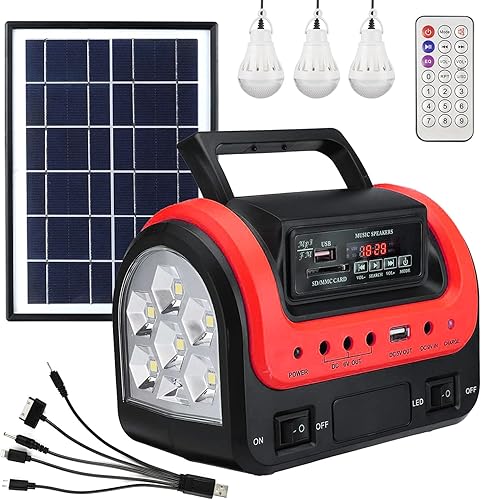
Upusa SDM-0603 Solar Generator Portable Power Station with 10W Panel
As an Amazon Associate we earn from qualifying purchases. Product prices and availability are accurate as of the date/time indicated.
Frequently Asked Questions
Can I charge a solar generator from a wall outlet or car while waiting for sun?
Most models accept AC wall charging and many accept a 12 V car port, but charging speed and supported inputs vary by model; check the label or manual. Wall charging before a storm is the usual way to start an outage with a full battery.
Can I run a sump pump or well pump?
Only if the inverter’s surge rating covers the pump’s starting watts. Pump motors can start at several times their running watts. Read the pump’s label for starting watts, add everything else running, and compare the total with the unit’s surge rating.
Does the inverter drain the battery when nothing is plugged in?
Usually yes, a small amount while the AC output is on. Idle draw varies by model and adds up over a day or two. Check the spec sheet, and switch off AC output when you only need USB or DC ports.
Should I buy a bigger solar generator than my math says?
Round up to the next common size, because batteries lose capacity over the years, cold weather cuts output and you will add loads later. Do not oversize by much: larger units cost more and weigh more, with weight varying by model.
How should I plan for cloudy days?
Use a lower sun-hour value in the Step 4 formula, such as your winter figure from PVWatts, and size for more panel watts or a larger battery. Output on overcast days can fall well below clear-day output, so plan on the battery covering the gap.
{“@context”: “https://schema.org”, “@type”: “FAQPage”, “mainEntity”: [{“@type”: “Question”, “name”: “Can I charge a solar generator from a wall outlet or car while waiting for sun?”, “acceptedAnswer”: {“@type”: “Answer”, “text”: “Most models accept AC wall charging and many accept a 12 V car port, but charging speed and supported inputs vary by model; check the label or manual. Wall charging before a storm is the usual way to start an outage with a full battery.”}}, {“@type”: “Question”, “name”: “Can I run a sump pump or well pump?”, “acceptedAnswer”: {“@type”: “Answer”, “text”: “Only if the inverter’s surge rating covers the pump’s starting watts. Pump motors can start at several times their running watts. Read the pump’s label for starting watts, add everything else running, and compare the total with the unit’s surge rating.”}}, {“@type”: “Question”, “name”: “Does the inverter drain the battery when nothing is plugged in?”, “acceptedAnswer”: {“@type”: “Answer”, “text”: “Usually yes, a small amount while the AC output is on. Idle draw varies by model and adds up over a day or two. Check the spec sheet, and switch off AC output when you only need USB or DC ports.”}}, {“@type”: “Question”, “name”: “Should I buy a bigger solar generator than my math says?”, “acceptedAnswer”: {“@type”: “Answer”, “text”: “Round up to the next common size, because batteries lose capacity over the years, cold weather cuts output and you will add loads later. Do not oversize by much: larger units cost more and weigh more, with weight varying by model.”}}, {“@type”: “Question”, “name”: “How should I plan for cloudy days?”, “acceptedAnswer”: {“@type”: “Answer”, “text”: “Use a lower sun-hour value in the Step 4 formula, such as your winter figure from PVWatts, and size for more panel watts or a larger battery. Output on overcast days can fall well below clear-day output, so plan on the battery covering the gap.”}}]}