Our editorial team weighed Honda's published specifications and how it stacks up against similar products in the generators category. What stands out: Exceptionally Quiet, Reliable Honda Engine, and Compact Size. Where it falls short: Recoil Start Only and Gasoline Only. That puts it at 8.9/10 on our WG Score – an excellent, well-rounded option.
 Reviewed bySarah Watts
The right generator size for RV air conditioner use is about 3,000 to 3,500 running watts for one 13,500 BTU unit, 3,500 to 4,000 watts for a 15,000 BTU unit, and 4,500 watts or more for two units. A soft start can lower those numbers. Use the chart below, then check it against your AC nameplate, altitude and other loads.
Generator size for RV air conditioner: size chart by BTU
Start with this table. The running and surge figures are typical ranges from AC makers and RV guides, and they vary by model. Your AC’s nameplate and the generator’s spec sheet always win over a chart.
| AC setup | Typical running load | Commonly cited start surge | Generator without soft start | Generator with soft start |
|---|---|---|---|---|
| One 11,000 BTU | about 10-13 A (1,200-1,550 W) | about 2,500-3,000 W | 3,000 W class | 2,000-2,400 W inverter often works |
| One 13,500 BTU | about 13-16 A (1,560-1,920 W) | about 2,800-3,500 W | 3,000 W rated, 3,500+ W surge | 2,200 W class if little else runs; 3,000 W for margin |
| One 15,000 BTU | about 14-17 A (1,700-2,050 W) | about 3,000-4,000 W (some sources higher) | 3,500-4,000 W | 3,000 W class, or two 2,200 W inverters in parallel |
| Two 13,500 BTU | about 3,100-3,800 W together | second unit starts while the first runs | 4,500 W or more (4,000 W is marginal) | about 4,000 W with both soft started and staggered |
| Two 15,000 BTU | about 3,400-4,100 W together | same stacking problem | 5,500 W or more | 4,500-5,500 W |
Running watts here are amps times 120 volts. If you want a roundup of models in this class, see our guide to the best generators for an RV air conditioner.
How do you calculate starting watts from the AC nameplate?
Read the label on the AC, usually under the ceiling shroud or on the unit’s data plate. Look for the running amps (often marked RLA or FLA) and the locked rotor amps (LRA).
- Running watts: running amps x 120 V. Example: 14 A x 120 V = 1,680 W.
- Worst-case start: LRA x 120 V. Example: a 55 A LRA x 120 V = 6,600 VA.
- Practical start: use the AC maker’s published figure if there is one. Otherwise use the commonly cited 2,800-3,500 W for 13,500 BTU and 3,000-4,000 W for 15,000 BTU.
This explains why sources disagree so much, from about 3,000 W to over 7,000 W. Some quote the LRA worst case. Others quote what a real generator saw during a start that lasts a fraction of a second. LRA values differ by compressor, so do not assume 55 A applies to your unit.
Common mistake: sizing to running watts only. A generator rated 3,000 W running but only 3,200 W surge can run the AC once started and still trip while starting it. Check both numbers on the generator’s spec sheet.
Can a 2,000-watt or paralleled inverter generator run an RV AC?
Usually not without help. Take a typical 2,200 W inverter model such as the Honda EU2200i, which the manufacturer rates at 1,800 W running and 2,200 W maximum. A 13,500 BTU AC runs at roughly 1,560-1,920 W, which uses all or more of that running rating. Its start surge of about 2,800-3,500 W is above the 2,200 W maximum. Without a soft start, expect an overload shutoff.
With a soft start, owners on RV forums report running 13,500 and even 15,000 BTU units on 2,000-class generators. Treat that as anecdotal, not a manufacturer rating. Some owners also measure running amps above the nameplate figure, and cooling is weaker when the generator is near its limit. See our 2,000-watt generators for RV air conditioners roundup if you are shopping in this class.
Two paralleled units are the stronger option. Two 2,200 W-class inverters have a combined rating around 3,600 W running and 4,400 W maximum, based on the maker’s single-unit ratings. That covers one 13,500 or 15,000 BTU AC with room for a converter and fridge. Check that the parallel kit’s outlet can deliver the amps your RV inlet needs, and whether you need a 30A adapter.
For 15,000 BTU units specifically, our inverter generators for 15,000 BTU air conditioners page narrows the choices.
How much does a soft start change the generator you need?
A soft start device limits the current spike when the compressor starts. Micro-Air, a maker of the EasyStart, and some RV sites claim a cut of 60-70% in start demand. That is a vendor claim, and results depend on your compressor and generator.
- It lowers surge, not running load. A 13,500 BTU AC still needs roughly 1,600-1,900 W once running.
- It helps most with 2,000-2,400 W inverters and with two-AC setups, where you start one unit at a time.
- Cost varies by brand and AC model. Check current retailer pricing, and add installation if you do not wire it yourself.
- Installation touches the AC’s wiring. Turn off the power, follow the kit instructions, or have an RV technician install it.
Decision rule: if you already own a 2,000-2,400 W inverter, a soft start or a second paralleled unit is the logical upgrade. If you are buying new and camp in hot weather or at altitude, buy a 3,000 W or larger rated unit, because margin matters more than surge alone.
How do altitude, heat and other loads cut your real capacity?
Gas engines lose power in thin air. Manufacturer guidance is commonly about 3-4% per 1,000 feet of elevation, so check your manual. Heat also reduces output; many manuals cite roughly 1% per 10°F above about 77°F, though this varies. Meanwhile the AC draws more in hot weather.
Worked example, camping at 6,000 ft:
- AC running: 1,700 W
- Converter and battery charging: 400 W (varies with battery state)
- Fridge on 120 V: 250 W
- Lights, TV, chargers: 250 W
- Total: about 2,600 W
A 3,000 W rated generator loses about 21% at 6,000 ft (6 x 3.5%), leaving about 2,370 W. That is overloaded. Keep continuous load to about 80-90% of derated capacity: 2,600 W / 0.9 = 2,890 W needed after derating, and 2,890 / 0.79 = about 3,660 W rated at sea level. In practice that means a 4,000 W class generator. Fuel-injected models may compensate for altitude, so check the manual.
A microwave adds roughly 1,500 W of input power. Run it only when the AC is off, unless your generator is 4,000 W or more. For comparisons across common sizes, see our guide to the best size generators for an RV.
How long will a tank of fuel run an RV air conditioner?
Use the spec sheet. Makers list runtime at 25% or 50% load. Divide tank size by that burn rate to get gallons per hour. For illustration only: a 3.5 gallon tank listed at 10 hours at half load burns about 0.35 gal/hr. Cost per hour is gallons per hour times your local fuel price.
An AC alone on a 3,000-3,500 W generator usually sits near half load, so expect runtimes near the half-load rating. Inverter models adjust engine speed to the load, which helps on mild days. On dual-fuel models, propane typically lowers rated output, so check the manual before sizing around it. Quiet hours matter too: most campgrounds limit or ban generators overnight.
What should you check before plugging the AC into a generator?
- Identify your RV inlet. A 30A inlet allows up to 3,600 W (30 A x 120 V). A 50A inlet has two 120 V legs. Your generator needs a matching outlet or the correct adapter.
- 50A RV on a 30A generator: use a 30A-to-50A adapter. All loads share one 30A feed, so run one AC at a time.
- Use a properly rated RV cord and adapters. Undersized cords overheat.
- Turn the AC and big loads off before connecting. Start the generator, let it settle, plug in, then start the AC. Stagger two ACs by a minute or more.
- Place the generator outdoors, on level ground, exhaust pointed away from windows, doors and vents. Never run it in a garage, a storage bay or under an awning against the RV.
- Have a working CO alarm inside the RV. Carbon monoxide can build up even with the generator outside.
- Refuel only when it is off and cool. Keep it dry and follow the manual’s grounding instructions.
- Check campground rules for quiet hours, allowed run times and noise limits. Quiet models can help.
If you would rather skip the engine, a large battery system can run an AC for limited hours; see our solar generators for RV air conditioners picks and check the inverter surge rating against the AC start.
Our Top Picks
Ready to shop? These are the top-rated options from our hands-on roundup, Best Generators To Run RV Air Conditioner of 2026.
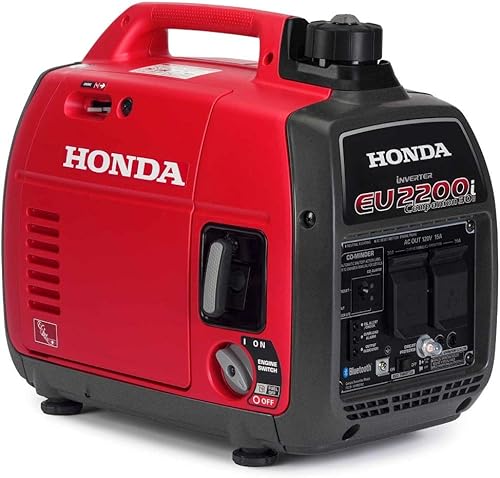
Honda EU2200ITAN1 2200-Watt Super Quiet Portable Inverter Generator with CO-Minder

Honda EU2200i 2200W Super Quiet Portable Inverter Generator with CO-Minder & Bluetooth App

Pulsar PG1202SA 1200W Portable Gas Generator with Handle - Compact Camping Powerhouse
As an Amazon Associate we earn from qualifying purchases. Product prices and availability are accurate as of the date/time indicated.
Frequently Asked Questions
Can a 3,500-watt generator run two RV air conditioners?
Often only marginally. Two 13,500 BTU units run about 3,100-3,800 W together, so a 3,500 W unit is near its limit. With soft starts on both, staggered starts and little else running, it may work at sea level. Without them, plan on 4,500 W or more.
How many watts does a 15,000 BTU RV AC need to start?
Commonly cited figures are about 3,000-4,000 W, and some sources go higher. The worst case is the nameplate LRA times 120 V. For a safe default without a soft start, choose a generator rated 3,500-4,000 W, and check your AC’s spec.
Can a portable power station run an RV air conditioner?
Only a large one, with an inverter that handles the AC’s start surge. A rooftop AC draws about 1,600-2,000 W. A 2,000 Wh station gives roughly one hour at that load after inverter losses, so battery runtime is short.
Why does my generator trip when the AC cycles back on?
The compressor restart creates a surge, and the generator may be overloaded or derated by altitude or heat. Wait a few minutes before restarting so pressure equalizes. A soft start or a larger generator can help.
{“@context”: “https://schema.org”, “@type”: “FAQPage”, “mainEntity”: [{“@type”: “Question”, “name”: “Can a 3,500-watt generator run two RV air conditioners?”, “acceptedAnswer”: {“@type”: “Answer”, “text”: “Often only marginally. Two 13,500 BTU units run about 3,100-3,800 W together, so a 3,500 W unit is near its limit. With soft starts on both, staggered starts and little else running, it may work at sea level. Without them, plan on 4,500 W or more.”}}, {“@type”: “Question”, “name”: “How many watts does a 15,000 BTU RV AC need to start?”, “acceptedAnswer”: {“@type”: “Answer”, “text”: “Commonly cited figures are about 3,000-4,000 W, and some sources go higher. The worst case is the nameplate LRA times 120 V. For a safe default without a soft start, choose a generator rated 3,500-4,000 W, and check your AC’s spec.”}}, {“@type”: “Question”, “name”: “Can a portable power station run an RV air conditioner?”, “acceptedAnswer”: {“@type”: “Answer”, “text”: “Only a large one, with an inverter that handles the AC’s start surge. A rooftop AC draws about 1,600-2,000 W. A 2,000 Wh station gives roughly one hour at that load after inverter losses, so battery runtime is short.”}}, {“@type”: “Question”, “name”: “Why does my generator trip when the AC cycles back on?”, “acceptedAnswer”: {“@type”: “Answer”, “text”: “The compressor restart creates a surge, and the generator may be overloaded or derated by altitude or heat. Wait a few minutes before restarting so pressure equalizes. A soft start or a larger generator can help.”}}]}