

Our editorial team weighed WEN's published specifications and how it stacks up against similar products in the generators category. What stands out: Versatile RV/Transfer-Switch Outlets, Long Runtime, and Wheels & Handles. Where it falls short: Needs Gasoline Storage and Noisier Than Inverter Models. That puts it at 8.2/10 on our WG Score – an excellent, well-rounded option.
 Reviewed byDaniel
Propane is the better gas generator vs propane generator pick for home backup because it stores indefinitely, while gasoline costs less upfront and delivers more power. Here, “gas” means gasoline, and the runtime and cost math below shows where each fuel pays off.
Which fuel fits your situation
“Gas generator” almost always means gasoline. Diesel is a separate fuel, covered in our gasoline vs propane vs diesel generators comparison. Use these rules for the two-way choice.
Choose propane if:
- The generator sits unused for months between outages and you want fuel that is ready on day one.
- You would rather not clean a carburetor after a season of stale fuel.
- You want a fuel that burns cleaner inside the engine.
Choose gasoline if:
- You want the lowest purchase price for a given wattage.
- You need every rated watt from the smallest, lightest unit.
- You run the generator often enough to burn through fuel before it goes stale.
Gasoline vs propane generator side by side
| Feature | Gasoline | Propane |
|---|---|---|
| Rated output | Full nameplate rating | About 10% lower on a typical model (check the manual) |
| Energy per gallon | About 114,000 Btu | About 91,500 Btu |
| Upfront price | Lower | Higher for the same wattage |
| Fuel container | Built-in tank filled from approved cans | Detachable cylinder (a 20 lb cylinder holds about 4.7 gallons) |
| Engine deposits | More carbon and varnish buildup | Cleaner burn, fewer deposits |
| Fuel in an area-wide outage | Stations may be unable to pump | Full cylinders on hand run immediately |
Noise depends more on engine design than on fuel. An inverter model is quieter than an open-frame model on either fuel, and propane is only slightly quieter in like-for-like units. Both fuels produce deadly carbon monoxide, so cleaner burning does not make indoor or garage use safe.
Runtime and cost per hour: a worked example
Take a 3,500 W rated generator. These are assumptions, not measured values: 12% of the fuel’s energy becomes electricity, a full 20 lb propane cylinder holds about 4.7 gallons (roughly 430,000 Btu), a 5-gallon gasoline tank holds 570,000 Btu, and the load is the same on both fuels. Real efficiency varies by model, so use your manual’s runtime chart when it has one.
Fuel burned per hour is load in watts times 28.43 Btu (3.412 Btu per watt-hour divided by 0.12).
| Load | Fuel burned per hour | 20 lb propane | 5 gal gasoline |
|---|---|---|---|
| 875 W (25%) | 24,879 Btu | 17.3 hours | 22.9 hours |
| 1,750 W (50%) | 49,758 Btu | 8.6 hours | 11.5 hours |
| 3,500 W (100%) | 99,516 Btu | 4.3 hours | 5.7 hours |
Real engines burn proportionally more at light loads, so treat the 25% row as a best case. The 12% figure is a single generic assumption, and many real units burn less gasoline than this model implies, so treat these hours as a comparison between fuels rather than a forecast.
Break-even rule. Propane holds about 91,500 Btu per gallon against about 114,000 for gasoline (commonly published approximate values). 91,500 divided by 114,000 is about 0.80, so propane matches gasoline on cost per hour only when its price per gallon is below roughly 0.80 times the gasoline price. At $3.50 gasoline, the break-even propane price is about $2.80 per gallon.
Prices change often, so plug in your local prices before an outage.
Where each fuel falls short
Gasoline goes stale. Untreated gasoline degrades in about 6 months, and a stabilizer stretches that to about 12. Add stabilizer when you buy the fuel, run the engine a few minutes so it reaches the carburetor, and shut off the fuel valve and run the carburetor dry before long storage if your model has one.
Propane gives up watts and convenience. A sealed cylinder has effectively no shelf life, but you take the derate on output, so a 3,500 W gasoline rating may become roughly 3,150 W on propane. Check your manual for the exact figure. Cylinder pressure also falls as the cylinder gets cold, which can hurt starting and output in a deep freeze, and the manual states the low-temperature limit.
Bulk is the hidden cost. Running nonstop for 72 hours at the 1,750 W load above takes about nine 20 lb cylinders or seven 5-gallon gasoline fills. If you only need a few hundred watts for a few hours, a battery unit may avoid both fuels; see gas generator vs power station.
When a dual fuel generator settles the question
A dual fuel generator runs on gasoline or propane, so you do not have to commit. Keep propane cylinders as your sealed, long-term reserve and use gasoline when cylinders run out or when you need full output. Expect a higher price than a gasoline-only unit and a lower rated wattage on the propane setting, which the manual lists.
The gasoline side still needs the stabilizer routine above. Tri-fuel models add natural gas through a hookup kit, and the details are in can a propane generator run on natural gas. Switch fuels only by following the manual’s shutdown steps.
Safe fuel storage for each fuel
Follow the manual or label for how far to place the generator from the house, and keep it away from windows, doors and vents. Install battery or plug-in CO alarms indoors. Let the engine cool before refueling.
Gasoline:
- Store it only in approved, labeled fuel containers.
- Keep containers outside living space, away from the water heater, pilot lights and anything that sparks.
- Check your local fire code for how much you may keep.
Propane:
- Keep cylinders upright and outdoors, never in a basement or living space.
- Brush soapy water on the fittings after connecting; bubbles mean a leak.
- Keep cylinders out of direct sun and hot vehicles. Permanent tanks must follow local code and NFPA 58.
When you compare models, look at rated watts on propane and whether a standard 20 lb cylinder connects directly. Our best propane portable generators roundup is organized around those points.
Our Top Picks
Ready to shop? These are the top-rated options from our related roundup, Best Dual Fuel Generators 4000-7000 Watt of 2026.

Westinghouse iGen4000DFc 4000 Peak Watt Dual Fuel Inverter Generator - Super Quiet RV Ready Remote Start CO Sensor

WEN GN5602X 5600W Portable Generator Electric Start RV-Ready CO Sensor 4500 Running Watts
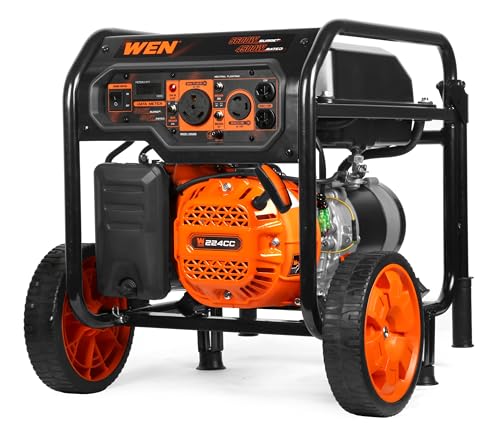
WEN GN5600 5600W Portable Generator RV-Ready Transfer Switch 4500 Running Watts 224cc Engine
As an Amazon Associate we earn from qualifying purchases. Product prices and availability are accurate as of the date/time indicated.
Related reading: Can a Propane Generator Run on Natural Gas? Short Answer · Best Gas Generators 4000-7000 Watts Home Backup Review 2026
Frequently Asked Questions
Does propane run longer than gasoline in cold weather?
No. Per container, propane gives fewer hours than gasoline in the example above, and cylinder pressure falls as the cylinder gets cold. Check your manual for the low-temperature limit.
Is propane or gasoline cheaper to run for a whole-house outage?
It depends on local prices. Propane is cheaper per hour only when its price per gallon is below roughly 0.80 times the gasoline price. Compare current prices before you buy.
Can a gasoline generator be used with a bulk 100 lb tank?
No, not as it comes. A gasoline-only generator cannot burn propane. You need a dual fuel model or a manufacturer-approved conversion kit for your exact model, plus the hose and regulator the manual specifies.
Can I leave propane in the generator for years?
A sealed cylinder has effectively no shelf life, so the fuel itself does not go bad the way gasoline does. Follow your manual for storing the generator with a cylinder connected or disconnected.
Can I convert a gasoline generator to propane?
Only if the manufacturer offers an approved conversion kit for your exact model. Do not improvise a conversion, because a wrong fuel setup can cause leaks, poor running and a voided warranty. Otherwise buy a dual fuel unit.
{“@context”: “https://schema.org”, “@type”: “FAQPage”, “mainEntity”: [{“@type”: “Question”, “name”: “Does propane run longer than gasoline in cold weather?”, “acceptedAnswer”: {“@type”: “Answer”, “text”: “No. Per container, propane gives fewer hours than gasoline in the example above, and cylinder pressure falls as the cylinder gets cold. Check your manual for the low-temperature limit.”}}, {“@type”: “Question”, “name”: “Is propane or gasoline cheaper to run for a whole-house outage?”, “acceptedAnswer”: {“@type”: “Answer”, “text”: “It depends on local prices. Propane is cheaper per hour only when its price per gallon is below roughly 0.80 times the gasoline price. Compare current prices before you buy.”}}, {“@type”: “Question”, “name”: “Can a gasoline generator be used with a bulk 100 lb tank?”, “acceptedAnswer”: {“@type”: “Answer”, “text”: “No, not as it comes. A gasoline-only generator cannot burn propane. You need a dual fuel model or a manufacturer-approved conversion kit for your exact model, plus the hose and regulator the manual specifies.”}}, {“@type”: “Question”, “name”: “Can I leave propane in the generator for years?”, “acceptedAnswer”: {“@type”: “Answer”, “text”: “A sealed cylinder has effectively no shelf life, so the fuel itself does not go bad the way gasoline does. Follow your manual for storing the generator with a cylinder connected or disconnected.”}}, {“@type”: “Question”, “name”: “Can I convert a gasoline generator to propane?”, “acceptedAnswer”: {“@type”: “Answer”, “text”: “Only if the manufacturer offers an approved conversion kit for your exact model. Do not improvise a conversion, because a wrong fuel setup can cause leaks, poor running and a voided warranty. Otherwise buy a dual fuel unit.”}}]}













