Our editorial team weighed EFECOFLOW's published specifications and how it stacks up against similar products in the generators category. What stands out: 56-Minute Full Charge, 4,000-Cycle, 10-Year Battery, and Powers 13 Devices at Once. Where it falls short: Heavy at 27.5 lbs and Solar Panel Sold Separately. That puts it at 8.9/10 on our WG Score – an excellent, well-rounded option.
 Reviewed bySarah Watts
You can build a DIY solar generator by sizing the battery, inverter, MPPT controller and panels to your daily watt-hours, as the 840 Wh example below shows.
Parts you need and what each does
- Battery: stores the energy. LiFePO4 with a built-in BMS (battery management system) is the usual choice for its cycle life and usable depth of discharge; AGM is heavier and lasts fewer cycles. Both are listed on the manufacturer’s datasheet.
- Inverter: turns battery DC into 120 V AC. Pick a pure sine wave model whose continuous watts exceed your running loads and whose surge rating covers motor starts.
- MPPT charge controller: regulates panel power into the battery and prevents overcharging. MPPT harvests more than PWM when panel voltage is higher than battery voltage.
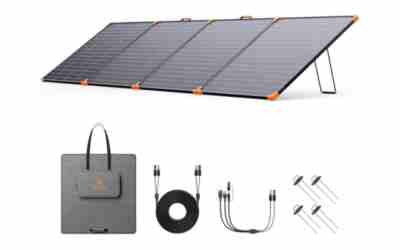
- Solar panels: monocrystalline panels give more watts per square foot than polycrystalline.
- Protection: a DC-rated fuse or breaker on the battery positive, a fuse or breaker on the panel and controller lines, and a battery disconnect switch.
- Cable, lugs and case: properly sized copper cable, crimped lugs, a busbar and a rugged case or cart to hold and secure everything.
How to size a DIY solar generator (worked example)
Start with watts × hours for each load. The loads below are assumptions, so replace them with the label wattage of your own devices.
| Load (in this example) | Watts | Hours/day | Wh |
|---|---|---|---|
| Mini fridge (compressor run time) | 60 | 8 | 480 |
| CPAP | 40 | 8 | 320 |
| LED lights | 10 | 4 | 40 |
| Total | 110 running | — | 840 |
The assumed factors below are rough estimates; use your own datasheet and local sun-hour figures.
- Inverter loss: assuming 85% efficiency, 840 ÷ 0.85 = about 988 Wh drawn from the battery.
- Battery: at an 80% planned depth of discharge, 988 ÷ 0.8 = about 1,235 Wh. A 12.8 V, 100 Ah LiFePO4 battery stores 12.8 × 100 = 1,280 Wh, so one is enough.
- Panels: assuming 4 peak sun hours and 0.75 system efficiency, 988 ÷ (4 × 0.75) = 988 ÷ 3 = about 329 W. Four 100 W panels (400 W) add margin.
- Controller: 400 W ÷ 12.8 V = about 31 A, so a 40 A MPPT controller leaves headroom.
- Inverter: running load is only 110 W, but a 1,000 W inverter covers the fridge compressor’s startup surge and future loads. At full load it draws about 1,000 ÷ 12 = 83 A from the battery.
Step-by-step wiring and assembly
Tools: wire cutters, a hydraulic or heavy-duty lug crimper, a torque wrench, a multimeter and insulated tools.
- Lay out and mount the battery, inverter, controller, busbar and fuses in the case so nothing can shift. Keep battery cables as short as possible.
- Choose cable and fuse from the inverter manual. For a 1,000 W 12 V inverter, expect roughly 1/0 AWG cable and a 125 A fuse (rough estimate). The cable’s ampacity must always exceed the fuse rating.
- Install the main fuse on the battery positive, as close to the terminal as practical, with the disconnect open.
- Wire the inverter through that fuse, using crimped lugs and torquing terminals to the maker’s spec.
- Connect the controller to the battery first, through its own fuse or breaker sized from the controller manual, so it detects battery voltage.
- Check panel voltage. The array’s open-circuit voltage (Voc), corrected upward for cold weather using the panel datasheet, must stay under the controller’s maximum input.
- Connect the panels last, with them covered or the breaker open. To shut down, disconnect in reverse order.
- Test with a small load, then check lugs and cables for heat after a 15-minute run at higher load.
Safety risks and when not to DIY
- Fire: undersized cable, loose lugs or a missing fuse are the main causes. A fault on a battery can deliver far more current than the wire can carry.
- Shock: inverter output is 120 V AC and long panel strings can reach high DC voltage. Treat both as live.
- Battery hazards: never short terminals and remove metal jewelry. Charge LiFePO4 only through a BMS with a compatible profile. Vent lead-acid batteries, which release hydrogen.
- Skip DIY if you cannot crimp heavy cable correctly, want to feed a house panel (that needs a licensed electrician and NEC-compliant equipment), or need a unit with a UL listing.
Is a DIY solar generator cheaper than buying one?
Only your own quotes can answer that. Price every line, then compare against a finished unit with the same usable Wh, continuous inverter watts and battery cycle rating.
| Cost line | DIY (your quote) | Finished unit |
|---|---|---|
| Battery with BMS | Enter quote | Included |
| Inverter | Enter quote | Included |
| MPPT controller | Enter quote | Included |
| Panels | Enter quote | Often sold separately |
| Fuses, breakers, busbar, cable, lugs | Enter quote | Included |
| Case and tools (crimper, torque wrench) | Enter quote | Included |
Count your build time too. DIY gives you custom capacity and repairable parts, but each component carries its own warranty, the assembled unit has no UL listing, and a home insurer may treat it differently from a certified product, so ask before relying on it. A 100 Ah battery plus inverter and case is also heavy to carry, so plan for a cart or wheels.
Our Top Picks
Ready to shop? These are the top-rated options from our related roundup, Best DIY Solar Generators of 2026.

EcoFlow DELTA 3 Portable Power Station: 1024Wh LiFePO4, 56-Min Fast Charge, 1800W Output for Camping, RV & Home Backup

EF ECOFLOW DELTA 2 Max: 2400W 2048Wh LFP Portable Solar Generator, 80% Charge in 43 Min, Home Backup & RV Power

Jackery Explorer 1000 v2 Solar Generator with 200W Panel: 1070Wh LiFePO4, 1500W Output, 1Hr Fast Charge for Camping, RV, Emergencies
As an Amazon Associate we earn from qualifying purchases. Product prices and availability are accurate as of the date/time indicated.
Frequently Asked Questions
Can I run a space heater on a DIY solar generator?
No. A 1,500 W space heater exceeds the example’s 1,000 W inverter and would drain the 1,280 Wh battery in under an hour, so heating needs a much larger build.
Can I use a car battery in a DIY solar generator?
No. Starting batteries are built for short high-current bursts, and repeated deep discharge ruins them quickly. Use a deep-cycle AGM or a LiFePO4 battery instead.
Can I charge a LiFePO4 battery in freezing weather?
No. Charging below 32°F can permanently damage lithium cells. Use a battery with low-temperature charge protection or a heater, or bring the battery indoors to charge.
Can I add a second battery later?
Yes, if it is the same chemistry, voltage and capacity as the first and the BMS supports parallel use. Two 100 Ah batteries double the example’s storage to 2,560 Wh.
{“@context”: “https://schema.org”, “@type”: “FAQPage”, “mainEntity”: [{“@type”: “Question”, “name”: “Can I run a space heater on a DIY solar generator?”, “acceptedAnswer”: {“@type”: “Answer”, “text”: “No. A 1,500 W space heater exceeds the example’s 1,000 W inverter and would drain the 1,280 Wh battery in under an hour, so heating needs a much larger build.”}}, {“@type”: “Question”, “name”: “Can I use a car battery in a DIY solar generator?”, “acceptedAnswer”: {“@type”: “Answer”, “text”: “No. Starting batteries are built for short high-current bursts, and repeated deep discharge ruins them quickly. Use a deep-cycle AGM or a LiFePO4 battery instead.”}}, {“@type”: “Question”, “name”: “Can I charge a LiFePO4 battery in freezing weather?”, “acceptedAnswer”: {“@type”: “Answer”, “text”: “No. Charging below 32°F can permanently damage lithium cells. Use a battery with low-temperature charge protection or a heater, or bring the battery indoors to charge.”}}, {“@type”: “Question”, “name”: “Can I add a second battery later?”, “acceptedAnswer”: {“@type”: “Answer”, “text”: “Yes, if it is the same chemistry, voltage and capacity as the first and the BMS supports parallel use. Two 100 Ah batteries double the example’s storage to 2,560 Wh.”}}]}