

Our editorial team weighed ZOUPW's published specifications and how it stacks up against similar products in the solar panels category. What stands out: 25% Efficiency, Strong Low-Light, Ultralight at 29.5 lbs, and IP68 Waterproof, Shade-Resistant. Where it falls short: High-Voltage Stations Only (38V+) and Not for Permanent/Fixed Install. That puts it at 8.5/10 on our WG Score – an excellent, well-rounded option.
 Reviewed byEthan
Portable solar panels last about 10 to 15 years with normal use, and 25 years is a best case rather than a promise.
How Long Portable Solar Panels Last by Type and Use
Most 10 to 15 year figures come from manufacturer estimates, not independent portable-panel testing. Vendors who quote 25 years for portable panels are also working from estimates, so treat 25 as the upper limit.
| Panel setup | Expected useful life | What limits it |
|---|---|---|
| Folding crystalline panel, ETFE front, weekend or camping use | 10-15 years | Cables, hinges and connectors |
| Folding panel left outside all season | Low end of 10-15 years (rough estimate) | UV, heat and moisture exposure |
| Flexible or marine-style mobile panel | 8-15 years | Bending stress and heat |
| Rigid rack-mounted panel | 20-30+ years | Slow cell aging |
| Budget PET-front panel in strong sun | Measurable loss within 3-5 years | Front-sheet yellowing |
Rigid panels last longer because they have no hinges, no repeated folding and a fixed, supported frame. A folding panel is built for being moved, and that movement is what ages it.
How Much Output Is Left After 5, 10 and 20 Years
Typical degradation is about 0.5% per year. A 2021 NREL study, as cited by panel vendors, found 0.5-0.8% per year, and a database of 107 panels showed a 0.25-0.7% spread. Budget or heavily used panels can lose more.
In this example, a 100 W panel loses 0.5% of its remaining output each year:
- 5 years: 100 × 0.9955 ≈ 97.5 W
- 10 years: 100 × 0.99510 ≈ 95.1 W
- 20 years: 100 × 0.99520 ≈ 90.5 W
Using 1% per year instead, which is closer to rough handling or high-UV use, the same panel gives about 95.1 W at 5 years, 90.4 W at 10 years and 81.8 W at 20 years.
Expect an extra 1-3% drop in the first hours to days of sun from light-induced degradation. It is a one-time loss that is not part of the yearly rate.
What Wears Out Portable Solar Panels First
The cells rarely fail first. In rough order of how often they cause trouble:
- Cables and connectors: repeated plugging, tugging and wrapping fray the cable and loosen the connector.
- Hinges, kickstands and zippers: these mechanical parts break on folding panels before the cells fade.
- Flexing: bending a flexible panel past its rated radius cracks cells and can void the warranty.
- Moisture: water in unlocked or damaged connectors causes corrosion and shorts.
- Heat: monocrystalline output falls 0.30-0.45% per °C above 25°C, so a cell at 65°C runs roughly 12-18% below its rating. A 10-15 mm air gap under a flexible panel reduces heat buildup.
- UV: PET front sheets can yellow in about 18-36 months, while ETFE holds up better.
Quality panels are tested to standards such as IEC 61215, which includes 1,000 hours at 85°C and 85% humidity plus hundreds of thermal cycles from -40°C to +85°C. Passing that does not prove a folding panel survives years of packing and unpacking.
What Portable Solar Panel Warranties Cover
There are two separate warranties, and only the shorter one covers most failures.
- Product warranty: covers defects in materials and workmanship. Flexible panels typically carry 1-5 years, and rigid modules 10-12 years.
- Performance warranty: guarantees a minimum output, typically 80-90% of rated power after 25 years on rigid modules. Flexible panels typically carry 10-25 years.
Do not apply a rooftop panel’s 25-30 year warranty to a folding panel. Read the exact terms for your model.
Fine print to check: whether the performance claim is prorated, whether you need proof of purchase, and whether bending, drops, water in connectors and cable damage are excluded. Cables and connectors are often covered only by the shorter product term.
Care Tips and Signs a Panel Needs Replacing
To extend life, wipe the surface with a soft damp cloth, fold along the factory creases only, lock connectors fully and keep them dry, and store the panel dry and cool with nothing heavy on top. Secure it in wind so it cannot blow over.
Replace the panel when you see any of these:
- Cracked glass, a torn or peeling front sheet, or frayed cables. Stop using it, because of shock and fire risk.
- Melted, discolored or corroded connectors.
- Visible yellowing, delamination or dark burn spots on cells.
- Output that stays well below the rated watts in clear midday sun.
Simple home test: in full midday sun, aim the panel directly at the sun, measure open-circuit voltage and short-circuit current with a multimeter, and compare the watts with the label. Real output is normally below the rating because of heat and angle, so compare readings season to season. A steady drop beyond the rates above points to a failing panel or connector.
Stay within the input voltage and current limits of your power station.
Our Top Picks
Ready to shop? These are the top-rated options from our related roundup, Best Portable Solar Panels of 2026.

Jackery Explorer 2000 v2 Solar Generator with 2x200W Panels: 2042Wh LiFePO4, 2200W Output, 20ms UPS for Home Backup, Camping
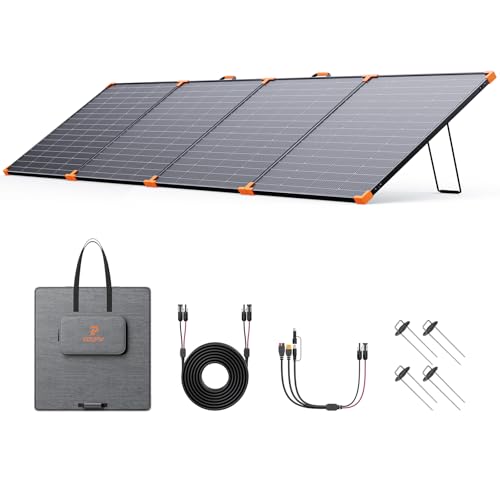
ZOUPW 450W Portable Solar Panel: 25% N-Type 16BB Efficiency, IP68 Waterproof Foldable Charger for EcoFlow Delta, Anker C1000, Jackery, Bluetti RV Off-Grid

Jackery Explorer 1000 v2 Solar Generator with 200W Panel: 1070Wh LiFePO4, 1500W Output, 1Hr Fast Charge for Camping, RV, Emergencies
As an Amazon Associate we earn from qualifying purchases. Product prices and availability are accurate as of the date/time indicated.
Frequently Asked Questions
Can I leave a portable solar panel outside all the time?
Rain-rated panels survive weather, but permanent outdoor exposure speeds UV, heat and connector wear. Bring the panel inside when you are not charging to stay near the top of the 10-15 year range.
Does a panel lose power if I never use it?
Cells do not wear from sitting idle, so a stored panel keeps its output. Age, heat and UV exposure cause degradation, not mileage. Dry storage preserves its condition.
Is low charging speed always a sign the panel is dying?
No. Clouds, a low sun angle, heat, shade, a long thin cable or a power station limit cause most slow charging. Test the panel in full midday sun before blaming it.
Can I repair a broken kickstand or damaged cable?
A broken kickstand or zipper is a cosmetic fix and does not affect output. A damaged cable or connector must be replaced with a matching one, and a cracked panel must be retired.
{“@context”: “https://schema.org”, “@type”: “FAQPage”, “mainEntity”: [{“@type”: “Question”, “name”: “Can I leave a portable solar panel outside all the time?”, “acceptedAnswer”: {“@type”: “Answer”, “text”: “Rain-rated panels survive weather, but permanent outdoor exposure speeds UV, heat and connector wear. Bring the panel inside when you are not charging to stay near the top of the 10-15 year range.”}}, {“@type”: “Question”, “name”: “Does a panel lose power if I never use it?”, “acceptedAnswer”: {“@type”: “Answer”, “text”: “Cells do not wear from sitting idle, so a stored panel keeps its output. Age, heat and UV exposure cause degradation, not mileage. Dry storage preserves its condition.”}}, {“@type”: “Question”, “name”: “Is low charging speed always a sign the panel is dying?”, “acceptedAnswer”: {“@type”: “Answer”, “text”: “No. Clouds, a low sun angle, heat, shade, a long thin cable or a power station limit cause most slow charging. Test the panel in full midday sun before blaming it.”}}, {“@type”: “Question”, “name”: “Can I repair a broken kickstand or damaged cable?”, “acceptedAnswer”: {“@type”: “Answer”, “text”: “A broken kickstand or zipper is a cosmetic fix and does not affect output. A damaged cable or connector must be replaced with a matching one, and a cracked panel must be retired.”}}]}













