

Our editorial team weighed MARBERO's published specifications and how it stacks up against similar products in the generators category. What stands out: Exceptionally Lightweight & Compact, Reliable During Outages/Camping, and Versatile Device Outputs. Where it falls short: Slow Without Direct Sunlight and Faster Drain With Multiple Devices. That puts it at 7.9/10 on our WG Score – a solid, dependable choice.
 Reviewed byDaniel
A solar generator for whole house backup typically needs roughly 10–30 kWh of battery, and an inverter from about 4 kW for essential circuits to 14 kW or more for everything, far beyond typical portable units. The steps below show how to calculate your own size.
Can one solar generator run a whole house?
Not a typical portable one. Most portable units are about 2,000–3,000 W with roughly 2–5 kWh of battery (vendor spec ranges). That covers a refrigerator, lights and electronics, but not central air or an electric dryer. Whole-house backup means a larger, usually installed system with 120/240V split-phase output.
Three separate numbers decide what you need:
- Battery (kWh) sets how long the house runs.
- Inverter (W) sets what can run at the same time, including startup surges.
- Solar input (W) sets how fast you recharge.
Many households size for essential circuits (critical loads) instead of every circuit, which shrinks all three numbers. Anker’s published guidance is about 5–8 kWh for infrequent, brief outages and 10–15 kWh or more for frequent or long ones.
Step 1: Find your daily kWh from your utility bill
- Find the kWh used on your bill. Averaging 12 months is better than one bill, because summer cooling and winter heating swing the number.
- Divide the monthly kWh by the days in that billing period.
- Decide whether you are backing up everything or only critical loads, then remove the loads you would skip.
In this example, a home used 900 kWh in a 30-day period: 900 ÷ 30 = 30 kWh per day. That is the whole-house figure at normal habits and works as an upper bound, because an outage plan that skips the dryer and AC uses less. Your utility’s online account or smart-meter portal may show daily use directly.
Step 2: Add up running and surge watts
Motors need a burst of power to start. Use the running and surge watts from each appliance label or manual. If a label lists only volts and amps, watts = volts × amps. The figures below are typical published values and vary by model.
| Appliance | Running watts | Surge watts |
|---|---|---|
| Refrigerator or deep freezer | 700 | 2,200 |
| Air conditioner (10,000 BTU, window-unit figure) | 1,500 | 4,500 |
| Electric clothes dryer | 5,400 | 6,750 |
| ½ HP sump pump | 1,050 | 2,050 |
The air conditioner row is a window-unit figure. A central AC system usually draws more and is often 240V, so check the nameplate on your own unit and replace these numbers with it.
Method: add the running watts of everything that could run together, add the largest extra startup load of any one device (surge minus running), then add a 20% margin. A 10–20% margin is a common rule of thumb; this example uses 20%.
Critical loads, in this example: refrigerator 700 + sump pump 1,050 + lights and electronics 300 (assumed) = 2,050 W. The largest extra surge is the refrigerator at 2,200 − 700 = 1,500 W. So 2,050 + 1,500 = 3,550 W, and 3,550 × 1.2 = 4,260 W.
Add the air conditioner: running 3,550 W. The largest extra surge is now the AC at 4,500 − 1,500 = 3,000 W. So 3,550 + 3,000 = 6,550 W, and 6,550 × 1.2 = 7,860 W.
Add the dryer too: running 3,550 + 5,400 = 8,950 W, plus 3,000 = 11,950 W, and × 1.2 = 14,340 W. That is why big 240V loads get staggered or skipped.
Inverter size follows these results: about 4.3 kW for critical loads, about 7.9 kW with the air conditioner, and about 14.3 kW with the dryer as well.
Do not size from your main breaker. A 200 A service at 240 V is 200 × 240 = 48,000 W of capacity, not your actual load.
Sizing a solar generator for a whole house: battery, inverter and panels
Battery (kWh)
Build the daily energy line by line. In this example for critical loads: refrigerator 2.0 kWh (assumed; the EnergyGuide label lists yearly kWh, so divide by 365), lights and electronics 300 W × 8 h = 2.4 kWh, sump pump 1,050 W × 1 h = 1.05 kWh. Total: 2.0 + 2.4 + 1.05 = 5.45 kWh per day. Add 20% (rough estimate) for conversion losses and not draining the battery to zero: 5.45 × 1.2 = 6.54 kWh, or about 6.5 kWh per day of backup. Two days without sun is about 13 kWh.
Covering the full 30 kWh per day from Step 1 for even one day sits at the top of the whole-house range, so outage length and load shedding drive the size. For runtime scenarios, see how long a solar generator can power a house.
Inverter (W)
Use the Step 2 results: about 4.3 kW for the critical-loads example, about 7.9 kW once central AC is included. Make sure the continuous rating and the surge rating both clear your number.
Solar input (W)
Array watts = daily Wh ÷ (peak sun hours × 0.75), where 0.75 is a rough real-world derate. With 4 peak sun hours (varies by location and season), the critical-loads example needs 5,450 ÷ (4 × 0.75) = 5,450 ÷ 3 ≈ 1,817 W, about five 400 W panels. At 2 winter sun hours it needs 5,450 ÷ 1.5 ≈ 3,633 W, about ten 400 W panels. A full 30 kWh day needs 30,000 ÷ 3 = 10,000 W, or 25 panels of 400 W, so whole-house systems normally recharge over several days. Also confirm the unit’s maximum solar input in its manual.
Loads that make whole-house backup impractical
Four kinds of loads push the inverter and battery out of reach:
- Central AC: large startup surge and long run times. A soft-start kit can lower the surge, but confirm compatibility with the AC maker and the inverter maker.
- Electric heat: resistance heating strips run continuously and drain a battery quickly. Heat pumps draw less but still run for hours.
- Dryer, range and oven: 240V loads on high-amp breakers. Check the breaker and appliance label, and run them one at a time or not at all.
- Well pump: often 240V with a high startup surge. See what size solar generator a well pump needs.
The practical fix is a critical-loads panel: move the refrigerator, well pump, furnace blower, lights and outlets you need onto one subpanel, and leave the rest off during outages. Staggering is the second tool, for example running laundry only while the AC is off.
120V vs 240V and connecting to the house safely
US homes use split-phase power: two 120V legs that together give 240V. A unit with only 120V outlets cannot run 240V loads such as a well pump, dryer or range. You need a unit with 240V output, or a manufacturer-approved kit for linking units, and the output must match your transfer equipment.
Connect through a transfer switch or a panel interlock, installed by a licensed electrician under NEC Article 702 and local permits. Never feed the house through an outlet or a dryer-style cord, because that energizes utility lines and can injure line workers. For the three safe approaches, see how to connect a solar generator to a house.
Large lithium batteries need ventilation, a spot away from flammable materials, and the temperature limits in the manual or on the label.
What to do if the numbers are too big
- Shrink the job: back up critical loads only, as in the first example.
- Installed home battery: modular systems are sized by an installer, connect to the main panel, and are built for 240V. Cost depends on capacity and installation, so get written quotes.
- Dual fuel generator: for long outages, a gas or propane generator can carry the heavy loads, using the same watt list from Step 2. See how to size a generator for your home.
- Hybrid: a mid-size battery for daily use, with a generator as the backup for long cloudy stretches.
Our Top Picks
Ready to shop? These are the top-rated options from our related roundup, Best Solar Generators For Whole Home Backup of 2026.

DJI Power 1000: 1024Wh LiFePO4 Portable Power Station, 2200W Output, 23dB Silent, Solar Generator for Camping & Home Backup

MARBERO 172Wh Solar Generator with 40W Panel - 200W Portable Power Station for Camping, Emergencies, CPAP & Outdoors
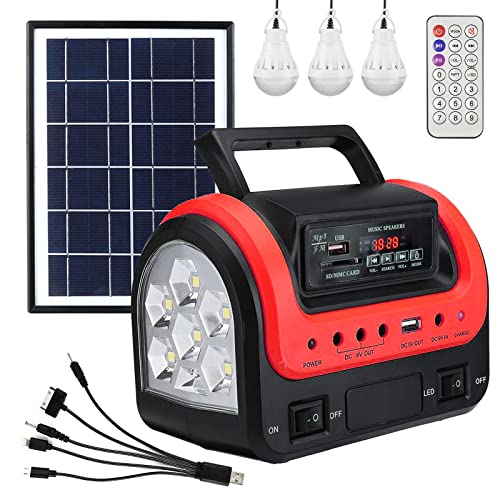
Upusa SDM-0603 Solar Generator Portable Power Station with 10W Panel
As an Amazon Associate we earn from qualifying purchases. Product prices and availability are accurate as of the date/time indicated.
Frequently Asked Questions
Can a solar generator charge an electric car during an outage?
Technically yes, but it is rarely practical. A Level 2 car charger draws more continuous power than most backup systems are built to supply, and even a 120V cord will drain a battery quickly. Check your inverter’s continuous rating before trying it.
Does cold weather affect a large solar generator?
Yes. Many lithium batteries limit or block charging below freezing and lose output in extreme heat or cold. Check the operating and charging temperature ranges in your manual, and keep the unit sheltered and ventilated away from flammable material.
Can it power the house while the panels charge it?
Many models can, but pass-through support varies. Check the manual for simultaneous charging and discharging. Panels only help when their output exceeds what the house is drawing; otherwise the battery makes up the difference.
Will my existing grid-tied solar panels work in an outage?
Not by themselves. Standard grid-tied systems shut down during an outage as a safety requirement. To power the house from panels you need a battery and an inverter set up for backup, wired through approved transfer equipment by an electrician.
{“@context”: “https://schema.org”, “@type”: “FAQPage”, “mainEntity”: [{“@type”: “Question”, “name”: “Can a solar generator charge an electric car during an outage?”, “acceptedAnswer”: {“@type”: “Answer”, “text”: “Technically yes, but it is rarely practical. A Level 2 car charger draws more continuous power than most backup systems are built to supply, and even a 120V cord will drain a battery quickly. Check your inverter’s continuous rating before trying it.”}}, {“@type”: “Question”, “name”: “Does cold weather affect a large solar generator?”, “acceptedAnswer”: {“@type”: “Answer”, “text”: “Yes. Many lithium batteries limit or block charging below freezing and lose output in extreme heat or cold. Check the operating and charging temperature ranges in your manual, and keep the unit sheltered and ventilated away from flammable material.”}}, {“@type”: “Question”, “name”: “Can it power the house while the panels charge it?”, “acceptedAnswer”: {“@type”: “Answer”, “text”: “Many models can, but pass-through support varies. Check the manual for simultaneous charging and discharging. Panels only help when their output exceeds what the house is drawing; otherwise the battery makes up the difference.”}}, {“@type”: “Question”, “name”: “Will my existing grid-tied solar panels work in an outage?”, “acceptedAnswer”: {“@type”: “Answer”, “text”: “Not by themselves. Standard grid-tied systems shut down during an outage as a safety requirement. To power the house from panels you need a battery and an inverter set up for backup, wired through approved transfer equipment by an electrician.”}}]}













