

Our editorial team weighed PulsarProducts's published specifications and how it stacks up against similar products in the generators category. What stands out: Lightweight, Great for Camping, Pure Sine Wave Output, and Parallel-Ready. Where it falls short: Gasoline Only and No Electric Start. That puts it at 8/10 on our WG Score – an excellent, well-rounded option.
 Reviewed byTristan
A 5,000-watt generator can typically run a fridge, sump pump, window AC and lights at once if running watts stay under about 4,000. The sums below show how to check your own list, using labeled example wattages for 2,000, 5,000 and 10,000 W classes.
Running watts vs. starting watts
Running watts are what a device draws continuously. Starting (surge) watts are a spike lasting a few seconds when a motor kicks on, typically about 2 to 4 times the running figure. Lights, TVs and chargers have little or no surge. Refrigerators, sump pumps, air conditioners and compressors do.
A generator has the same two ratings. The rated (continuous) number is what it can hold for hours. The peak (surge) number is only for those short startup moments, and the manual states both.
These are typical example values, not exact figures. Published numbers for the same appliance vary widely, so your nameplate wins.
| Device (example) | Running W | Starting W | Extra start W |
|---|---|---|---|
| 10 LED bulbs | 100 | 100 | 0 |
| TV | 150 | 150 | 0 |
| Refrigerator | 700 | 2,100 | 1,400 |
| 1/2 HP sump pump | 1,050 | 2,150 | 1,100 |
| 10,000 BTU window AC | 1,200 | 1,800 | 600 |
| 1 HP air compressor | 1,600 | 4,500 | 2,900 |
Fridge surge is the most common sizing trap, and our guide on how many watts a generator needs to run a refrigerator covers it in detail.
How to find the watts on your own appliances
Look for the nameplate or label on the back or inside the door. If it lists watts, use that. If it lists only amps, multiply: watts = volts × amps. A 120 V, 9 A label gives 120 × 9 = 1,080 W. A 240 V, 15 A label gives 240 × 15 = 3,600 W.
The label amps describe running or maximum draw, not the startup spike. For a real reading, plug the item into a plug-in watt meter and note the number after it has been running a minute. Some meters also record peak watts, which captures the surge.
For a wider look at the sizing basics, see our page on how many watts a portable generator needs.
Add up your load in five steps
- List only the items that will run at the same time, not everything in the house.
- Write down each item’s running watts from its label or meter.
- Add them to get your total running watts.
- For each motor item, subtract running watts from starting watts to get its extra start watts. Keep only the single largest, because you can start motors one at a time.
- Add that largest extra to the total running watts. The result is your peak watts.
Then compare. Total running watts should stay at or below about 80% of the generator’s rated watts, a common guideline that leaves headroom, not a standard. Peak watts must stay under the surge rating. Your manual’s rated and surge figures are the real limits.
How many things a generator can power at 2,000, 5,000 and 10,000 watts
The generator ratings below are labeled examples, not products. Check the rated and surge watts on the unit you own.
| Example class | Load | Running total | Largest extra start | Peak | Limits |
|---|---|---|---|---|---|
| 2,000 W rated, 2,500 W surge | Fridge, lights, TV | 700 + 100 + 150 = 950 W | 1,400 W (fridge) | 950 + 1,400 = 2,350 W | 80% = 1,600 W. Fits. |
| 5,000 W rated, 6,250 W surge | Fridge, sump pump, window AC, lights, TV | 700 + 1,050 + 1,200 + 100 + 150 = 3,200 W | 1,400 W (fridge) | 3,200 + 1,400 = 4,600 W | 80% = 4,000 W. Fits. |
| 10,000 W rated, 12,500 W surge | Mid-size load plus a second window AC and a compressor | 3,200 + 1,200 + 1,600 = 6,000 W | 2,900 W (compressor) | 6,000 + 2,900 = 8,900 W | 80% = 8,000 W. Fits. |
The mid-size row also shows why order matters. If the fridge, pump and AC all started in the same instant, the peak would be 3,200 + 1,400 + 1,100 + 600 = 6,300 W, just over the 6,250 W example surge rating. Starting them one at a time keeps you at 4,600 W.
The same 6,000 W running total would not fit the 5,000 W class, since it is above that class’s 4,000 W limit. For a size-by-size list, see how many appliances a generator can run by size.
Limits that matter besides total watts
Outlet count does not set capacity, but each outlet and cord has its own ceiling. A standard 120 V, 15 A outlet tops out at 120 × 15 = 1,800 W, and a 20 A outlet at 120 × 20 = 2,400 W. A 5,000 W generator therefore cannot run a 3,000 W load through one household-style outlet.
Extension cords must be rated for the amps they carry and be heavy-gauge for long runs, since a thin cord overheats. Some generators also split their output across receptacle groups with separate breakers, so spread loads across them as the manual describes.
What to do if your total is over capacity
Work through these in order:
- Stagger the starts. Switch on the largest motor first, let it settle, then the next. This only fixes a surge problem.
- Cut loads. If running watts exceed the limit, drop the biggest non-essential first, such as the window AC or compressor, and keep the fridge, sump pump and lights.
- Rotate loads. Run the AC for a stretch, turn it off, then run another heavy item.
- Upsize. If your essentials alone fail the check in the steps above, you need a higher-rated generator.
A tripped breaker or an engine that bogs down means you are over the limit. For small loads such as phones, a laptop and a light, a battery unit is another route, as covered in gas generator vs. power station.
Our Top Picks
Ready to shop? These are the top-rated options from our related roundup, Best Portable Generators For Emergency Power of 2026.

Pulsar 2300W Portable Gas Inverter Generator with USB Outlet and Parallel Capability

Pulsar PG1202SA 1200W Portable Gas Generator with Handle - Compact Camping Powerhouse
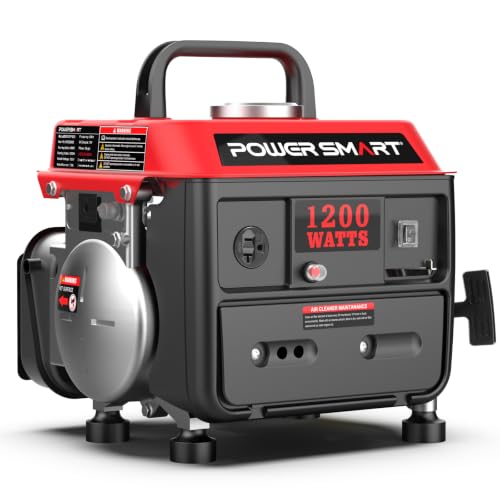
PowerSmart 1200W Portable Gas Generator 900W Rated 2-Stroke 39 lbs for Camping Emergency
As an Amazon Associate we earn from qualifying purchases. Product prices and availability are accurate as of the date/time indicated.
Frequently Asked Questions
Can a 5,000-watt generator run a whole house?
No. A typical US home on a 200 A, 240 V service can demand far more than 5,000 W. It can run chosen essential circuits through a transfer switch or interlock installed by a licensed electrician, as the NEC requires.
Does an inverter generator count watts differently?
No. Inverter and conventional units use the same math, so compare your running and peak totals to the rated and surge numbers in its manual. Inverter output is cleaner for electronics, but it does not raise the wattage limit.
What happens if I overload a generator?
The generator’s breaker trips or the engine bogs down and voltage sags. Sustained overload can damage the generator and appliance motors, so unplug the largest load first.
Does plugging in fewer things make a generator run longer?
Yes. Fuel use falls as load drops, so a lightly loaded generator lasts longer per tank. The manual’s runtime figure is quoted at a stated load, so your real runtime differs from it.
{“@context”: “https://schema.org”, “@type”: “FAQPage”, “mainEntity”: [{“@type”: “Question”, “name”: “Can a 5,000-watt generator run a whole house?”, “acceptedAnswer”: {“@type”: “Answer”, “text”: “No. A typical US home on a 200 A, 240 V service can demand far more than 5,000 W. It can run chosen essential circuits through a transfer switch or interlock installed by a licensed electrician, as the NEC requires.”}}, {“@type”: “Question”, “name”: “Does an inverter generator count watts differently?”, “acceptedAnswer”: {“@type”: “Answer”, “text”: “No. Inverter and conventional units use the same math, so compare your running and peak totals to the rated and surge numbers in its manual. Inverter output is cleaner for electronics, but it does not raise the wattage limit.”}}, {“@type”: “Question”, “name”: “What happens if I overload a generator?”, “acceptedAnswer”: {“@type”: “Answer”, “text”: “The generator’s breaker trips or the engine bogs down and voltage sags. Sustained overload can damage the generator and appliance motors, so unplug the largest load first.”}}, {“@type”: “Question”, “name”: “Does plugging in fewer things make a generator run longer?”, “acceptedAnswer”: {“@type”: “Answer”, “text”: “Yes. Fuel use falls as load drops, so a lightly loaded generator lasts longer per tank. The manual’s runtime figure is quoted at a stated load, so your real runtime differs from it.”}}]}













