

Our editorial team weighed Honda's published specifications and how it stacks up against similar products in the generators category. What stands out: Exceptionally Quiet, Fuel-Saving Eco Mode, and Smartphone App Control. Where it falls short: Premium Price Point and Manual Recoil Start. That puts it at 8.7/10 on our WG Score – an excellent, well-rounded option.
 Reviewed byTristan
Heat pump generator size for a 2-4 ton unit is about 5,800-10,200 starting watts with a soft starter (3,400-6,700 running watts), or 15,100-26,600 starting watts without one, by estimate from typical nameplate values.
How to read the nameplate to calculate running and starting watts
The data label on the outdoor unit (and the air handler) gives you everything you need. The numbers below are estimates built from nameplate amps and 240 volts, so they run slightly high. That is the safe direction.
- Find the compressor RLA (rated load amps). This is the compressor’s normal running current.
- Find the LRA (locked rotor amps). This is the brief surge when the compressor starts across the line, with no soft starter.
- Add the fan motor FLA on the outdoor unit, and the indoor blower amps or watts from the air handler label.
- Running watts (estimate) = (compressor RLA + outdoor fan amps) x 240 V + indoor blower watts.
- Starting watts (estimate) = LRA x 240 V + the fan and blower watts that are already running.
MCA (minimum circuit ampacity) and the maximum breaker size are for wire and breaker sizing, not for generator sizing. Use RLA and LRA for the generator math. If your label lists only MCA, MCA x 240 V is a conservative running figure for the whole outdoor unit.
If you are still building the total load for the house, the general method is in how to size a portable generator.
Heat pump generator size by tonnage (chart)
This chart uses typical nameplate values as assumptions. Your unit will differ, so replace them with your own label numbers. Brand, SEER rating and compressor type all change the amps.
| Size | Compressor RLA / LRA | Outdoor fan + blower (assumed) | Running watts (est.) | Starting watts, no soft starter (est.) | Starting watts, soft starter (est.) |
|---|---|---|---|---|---|
| 2 ton | 11 A / 60 A | 1 A fan + 500 W blower | 3,400 | 15,100 | 5,800 |
| 3 ton | 16 A / 82 A | 1.5 A fan + 700 W blower | 4,900 | 20,700 | 7,900 |
| 4 ton | 22 A / 105 A | 2 A fan + 900 W blower | 6,700 | 26,600 | 10,200 |
Estimate method: running = (RLA + fan amps) x 240 + blower. Starting without a soft starter = LRA x 240 + fan and blower. Starting with a soft starter assumes the surge drops to about 35% of LRA, then adds the fan and blower. Results are rounded to the nearest 100 W. Real soft starter results vary by product and compressor.
Why published sizes disagree
You will see answers from 6,000 W to 20,000 W or more. The low numbers describe what a generator can sometimes start in practice, because the surge lasts only a fraction of a second. The high numbers are the worst-case LRA calculation. To turn that into a decision for a 3-ton unit:
- With a soft starter: choose a generator rated for 8,000 or more starting watts. This matches the 7,900 W estimate in the chart.
- Without a soft starter: the formula gives about 20,700 starting watts, which few portables reach. As a rule of thumb, plan on the 12,000-plus running-watt class and expect it to depend on real starts falling below the worst case. A soft starter is the cheaper fix.
A 5,000-watt generator only works for a 2-ton unit with a soft starter, and only if the generator’s starting rating is above 5,800 W. It is too small for 3 tons and up.
Why you must keep heat strips off a portable generator
Many heat pumps have electric resistance strips in the air handler for aux heat (when it is very cold) and emergency heat (when the outdoor unit is off). Strips are commonly 5, 10 or 15 kW, and the size varies by model. They add far more load than the compressor.
| Example | Normal running (est.) | Emergency heat: strips + blower (est.) | Aux heat: compressor + strips (est.) |
|---|---|---|---|
| 2 ton, 5 kW strips | 3,400 W | 5,500 W | 8,400 W |
| 3 ton, 10 kW strips | 4,900 W | 10,700 W | 14,900 W |
| 4 ton, 15 kW strips | 6,700 W | 15,900 W | 21,700 W |
Estimate method: strip rating plus the blower load (emergency heat) or the running load from the chart above (aux heat). A portable generator that can start a 3-ton compressor will still trip or stall if the strips switch on at 10 kW.
- Have the electrician put the strips on their own breaker, or leave that breaker off during generator use.
- Keep the thermostat out of emergency heat. Ask your HVAC tech whether the thermostat can lock out aux heat.
- Expect a cooler house in deep cold, because the compressor alone may not keep up. Plan a backup such as a safe, vented heater.
To see whether the generator can also carry the furnace fan, refrigerator and lights, use the step-by-step guide to sizing a generator for your home.
What a soft starter does, and do inverter heat pumps need less?
A soft starter (often sold as a hard-start or easy-start kit) limits the compressor’s starting current. In the chart, it cuts the 3-ton starting figure from about 20,700 W to about 7,900 W. Manufacturers claim large reductions, but results depend on the compressor and kit, and an HVAC technician should install it. Check that it is approved for your unit so you do not void the warranty.
Inverter-driven (variable-speed) heat pumps and ductless mini-splits ramp the compressor up gradually, so they have very low inrush. As a rule of thumb, many small mini-split systems run in roughly the 1,000-2,500 W range, but check the rated input on the label of your model. The indoor head draws little, but add its label watts to the total.
- Single-stage ducted unit: size to the starting watts above; a soft starter is the single biggest saving.
- Variable-speed or mini-split: size close to running watts, plus your other loads.
Inverter generators can start mini-splits easily because the surge is small. Large ducted systems usually need a bigger conventional or dual-fuel portable with a 240 V outlet, and units at 3 tons or more may be better served by a standby generator.
How to connect a portable generator to a heat pump safely
A heat pump is hard-wired at 240 V, so you cannot plug it in. Never backfeed through a dryer or wall outlet. It is illegal and dangerous, and it can energize utility lines and injure line workers.
- Hire a licensed electrician to install a manual transfer switch or a listed interlock with a generator inlet, following the NEC and your local code.
- Match the inlet to your generator’s 240 V outlet and use a cord rated for the load. Follow the generator manual for the cord gauge.
- Start the generator first, let it settle, then switch the heat pump circuit on. Do not run the generator in an overload condition, since repeated hard starts can damage both the compressor and the generator.
Run the generator outdoors, away from windows, doors and vents. Follow the manual or label for distance; many manuals say 20 feet. Keep working CO alarms inside. For more, see the portable generator safety guide.
Cold weather and what to look for in a generator
Heat pumps run defrost cycles in winter, which briefly changes the load, and cold starts can be harder on a generator. Size with some spare capacity rather than right at the limit.
Worked example: a 3-ton unit with its own label numbers
Say the label shows a compressor RLA of 16 A and LRA of 82 A, the outdoor fan is 1.5 A, and the air handler blower is 700 W.
- Running (estimate): (16 + 1.5) x 240 + 700 = 4,900 W.
- Starting, no soft starter (estimate): 82 x 240 + 360 + 700 = about 20,700 W.
- Starting, soft starter at 35% of LRA (estimate): 0.35 x 82 x 240 + 360 + 700 = about 7,900 W.
With a soft starter, this unit points to a generator rated for 8,000 or more starting watts and enough running watts to cover 4,900 W plus anything else you add, such as a refrigerator or sump pump.
- Pick a generator whose rated running watts cover the heat pump plus everything else you want on.
- Make sure its starting watts exceed the number from your own nameplate math: roughly 8,000 for a 3-ton and 10,200 for a 4-ton with a soft starter.
- Confirm it has a 240 V outlet that matches your inlet.
Dual-fuel models can burn propane if gasoline runs short, but check the manual for the propane rating, which is often lower than the gasoline rating. When you are ready to compare models, start with our roundup of portable generators for home backup, and filter for the starting watts and 240 V outlet above.
Our Top Picks
Ready to shop? These are the top-rated options from our hands-on roundup, Best 4500 Watt Inverter Generators of 2026.

Honda EU2200iTAN 2200W Super Quiet Portable Inverter Generator with CO-Minder - Ideal for Camping, RV, Home Backup

Westinghouse iGen2800 2800 Peak Watt Super Quiet Lightweight Portable Inverter Generator - Gas Powered, Parallel Ready
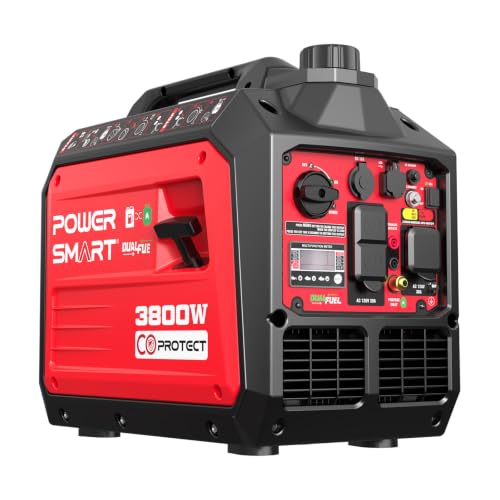
PowerSmart 3800 Watt Dual Fuel Inverter Generator Quiet Portable Gas Propane with CO Sensor RV Ready
As an Amazon Associate we earn from qualifying purchases. Product prices and availability are accurate as of the date/time indicated.
Frequently Asked Questions
Can a 5,000-watt generator run a heat pump?
Only a 2-ton unit with a soft starter, and only if the generator’s starting rating is above 5,800 W. A 2-ton needs about 3,400 running watts by estimate. A 3-ton or larger unit needs a bigger generator, and any heat strips must stay off.
Can I run a heat pump and a furnace blower on one generator?
Often yes, if the totals fit. In many ducted systems the heat pump and furnace share one blower, so it is already counted in the running watts and should not be added twice. Add only separate loads, such as a refrigerator, and keep the heat strips off.
Will a dual-fuel generator on propane start a heat pump?
It can, but propane output is often lower than gasoline output. Use the propane wattage in the manual and compare that figure, not the gasoline rating, with your starting-watt estimate. If it falls short, add a soft starter or move up a size.
Can a mini-split run on a 2,000 W inverter generator?
Many small mini-splits can, because their inrush is low. Check the label’s rated and maximum input watts, add any other loads, and compare the total with the generator’s running rating. Larger multi-zone systems may exceed 2,000 W.
Does a heat pump need a 30 A or 50 A generator inlet?
It depends on your total running load. At 240 V, a 30 A inlet tops out at 7,200 W and a 50 A inlet at 12,000 W. A 3-ton at 4,900 W running may fit on 30 A with few other loads, while a 4-ton at 6,700 W plus extras points to 50 A. Your electrician confirms the sizing.
{“@context”: “https://schema.org”, “@type”: “FAQPage”, “mainEntity”: [{“@type”: “Question”, “name”: “Can a 5,000-watt generator run a heat pump?”, “acceptedAnswer”: {“@type”: “Answer”, “text”: “Only a 2-ton unit with a soft starter, and only if the generator’s starting rating is above 5,800 W. A 2-ton needs about 3,400 running watts by estimate. A 3-ton or larger unit needs a bigger generator, and any heat strips must stay off.”}}, {“@type”: “Question”, “name”: “Can I run a heat pump and a furnace blower on one generator?”, “acceptedAnswer”: {“@type”: “Answer”, “text”: “Often yes, if the totals fit. In many ducted systems the heat pump and furnace share one blower, so it is already counted in the running watts and should not be added twice. Add only separate loads, such as a refrigerator, and keep the heat strips off.”}}, {“@type”: “Question”, “name”: “Will a dual-fuel generator on propane start a heat pump?”, “acceptedAnswer”: {“@type”: “Answer”, “text”: “It can, but propane output is often lower than gasoline output. Use the propane wattage in the manual and compare that figure, not the gasoline rating, with your starting-watt estimate. If it falls short, add a soft starter or move up a size.”}}, {“@type”: “Question”, “name”: “Can a mini-split run on a 2,000 W inverter generator?”, “acceptedAnswer”: {“@type”: “Answer”, “text”: “Many small mini-splits can, because their inrush is low. Check the label’s rated and maximum input watts, add any other loads, and compare the total with the generator’s running rating. Larger multi-zone systems may exceed 2,000 W.”}}, {“@type”: “Question”, “name”: “Does a heat pump need a 30 A or 50 A generator inlet?”, “acceptedAnswer”: {“@type”: “Answer”, “text”: “It depends on your total running load. At 240 V, a 30 A inlet tops out at 7,200 W and a 50 A inlet at 12,000 W. A 3-ton at 4,900 W running may fit on 30 A with few other loads, while a 4-ton at 6,700 W plus extras points to 50 A. Your electrician confirms the sizing.”}}]}













