

Our editorial team weighed Honda's published specifications and how it stacks up against similar products in the generators category. What stands out: Exceptionally Quiet, CO-Minder Safety Tech, and Portable & Lightweight. Where it falls short: Recoil Start Only and 3.2h Runtime at Full Load. That puts it at 8.9/10 on our WG Score – an excellent, well-rounded option.
 Reviewed byEthan
Plan on about 1,000 watts for tent and car camping and 3,500–4,000 running watts for a 30-amp RV. Add up the gear you run at once, then size up for starting surge and headroom.
Generator size by type of camping
The rooftop air conditioner is what separates a small unit from a big one. Without it, camping loads are small. The ranges below are rough starting points; your own gear sets the final number.
| Setup | Typical running load | Generator or station output to look for |
|---|---|---|
| Tent or car camping (phones, lights, fan, small cooler) | about 100–500 W | about 1,000 W |
| Van or small trailer, no AC | about 500–1,500 W | about 2,000 W |
| 30-amp RV with one AC | about 2,500–3,300 W | 3,500–4,000 running W, 4,500–5,000 starting W |
| 50-amp RV, multiple loads or ACs | about 5,000 W and up | 5,500–12,000 W |
The RV ceilings come from the service rating: 120 V × 30 A = 3,600 W, and 240 V × 50 A = 12,000 W. A generator cannot usefully exceed what the RV’s wiring can pass.
How to add up running and starting watts
Use this worksheet for any trip.
- List every device you might run at the same time.
- Write down each device’s running watts.
- Add the running watts for the total.
- Find the device with the biggest start surge (usually a compressor or motor) and subtract its running watts from its starting watts.
- Add that difference to the running total to get the peak you need.
- Divide the running total by 0.8 (the same as multiplying by 1.25) so the generator runs near 75–80% of its rating, the range one manufacturer cites as its efficient and durable zone.
Tent example
In this example: two phones 20 W, lantern 10 W, laptop charger 65 W, fan 30 W, small electric cooler 60 W running and 180 W starting.
- Running total: 20 + 10 + 65 + 30 + 60 = 185 W
- Peak: 185 + (180 − 60) = 305 W
- With headroom: 185 × 1.25 = about 231 W
That is far below a 1,000 W unit, so the table’s figure leaves room for extra gear.
Sizing for an RV with an air conditioner
A rooftop AC typically needs roughly 2,200–3,000 W to start and 1,200–1,500 W to run, and it often sets your generator size. Exact numbers depend on the unit, so use your own label. For model-specific cases, see how much generator you need to run an RV AC.
In this example for a 30-amp RV: AC 1,400 W running and 2,800 W starting, fridge 150 W, lights and chargers 200 W, coffee maker 800 W.
- Running total: 1,400 + 150 + 200 + 800 = 2,550 W
- Peak: 2,550 + (2,800 − 1,400) = 3,950 W
- With headroom: 2,550 × 1.25 = about 3,190 W
A unit rated around 3,500 running and 4,000 or more starting watts fits this case. Skipping the coffee maker while the AC runs would drop the need considerably.
Finding the watts for your own gear
Check the nameplate or label on each device, or its manual. If only amps are listed, multiply amps × volts (120 V for most US plug-in items) to get watts. Appliance wattage varies by model, so treat any cheat-sheet number as an estimate.
Motor loads such as compressors can draw two to three times their running watts at startup, which is why the worksheet tracks surge separately. A soft-start device installed on an AC can reduce that surge, which may let you use a smaller generator; the effect depends on the AC and kit. The same method applies to household sizing in our generator wattage sizing guide.
Power station or inverter generator: watts and watt-hours
A generator is rated in watts and runs as long as it has fuel. A power station has both a watt limit and a fixed watt-hour (Wh) battery. Check both against your calculation.
Runtime formula: Wh × 0.85 ÷ load in watts. The 0.85 is a rough estimate for conversion losses; the real figure varies by model.
Using the tent example: a 500 Wh station gives 500 × 0.85 = 425 Wh, and 425 ÷ 185 W = about 2.3 hours at full load. Most loads cycle, so real runtime is often longer.
- Power station fits: phones, lights, fans, CPAP, laptops, and a small cooler, with quiet operation and no exhaust.
- Inverter generator fits: multi-day trips without recharging, and anything near or above the station’s output limit.
- RV air conditioner: needs a generator or a station whose output covers the start surge.
Altitude, quiet hours and where to put it
High elevation and heat cut engine output, roughly 3–4% per 1,000 ft of altitude as a rough estimate, so add margin if you camp in the mountains. Check your manual for the exact derating.
Many campgrounds limit generator hours or noise, and some ban them, so confirm the rules before you go. Run the generator outdoors only, on level ground, with the exhaust pointed away from tents and vehicles at the distance your manual specifies, and keep a battery-powered CO alarm in your sleeping space.
Our Top Picks
Ready to shop? These are the top-rated options from our related roundup, Best Inverter Generators For RV Air Conditioner of 2026.

Honda EU2200i 2200W Super Quiet Portable Inverter Generator with CO-Minder & Bluetooth App
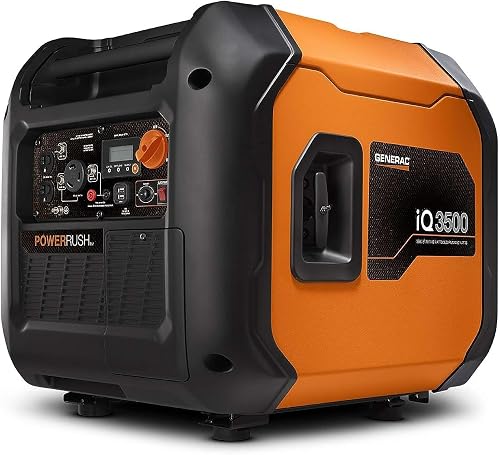
Generac iQ3500 3500W Portable Inverter Generator - Quiet, Lightweight, Electric Start, CARB Compliant for Camping & Jobsites

maXpeedingrods MXR4000GT 4000W Dual Fuel Inverter Generator with Bluetooth App Control
As an Amazon Associate we earn from qualifying purchases. Product prices and availability are accurate as of the date/time indicated.
Frequently Asked Questions
Can a 2,000-watt generator run an RV air conditioner?
Usually not. A rooftop AC can need 2,200–3,000 W to start, which exceeds a 2,000 W unit’s surge. Adding a soft-start kit may help, but confirm the AC’s starting watts on its label first.
Can I charge a power station with a generator while camping?
Yes. Plug the station’s AC charger into the generator, and make sure the charger’s input draw is within the generator’s output. Running both this way is a common way to refill batteries on longer trips.
Will a CPAP need a big generator?
No. A CPAP draws far less than most camp gear, and its label lists the exact watts. Add it to your running total, and a small power station will normally cover a night, especially with the humidifier off.
What should I do if my generator keeps overloading?
Unplug everything, restart the generator, then add loads one at a time, largest first. If it trips again before you reach your full list, your total exceeds its rating and you need to drop a load or step up a size.
{“@context”: “https://schema.org”, “@type”: “FAQPage”, “mainEntity”: [{“@type”: “Question”, “name”: “Can a 2,000-watt generator run an RV air conditioner?”, “acceptedAnswer”: {“@type”: “Answer”, “text”: “Usually not. A rooftop AC can need 2,200–3,000 W to start, which exceeds a 2,000 W unit’s surge. Adding a soft-start kit may help, but confirm the AC’s starting watts on its label first.”}}, {“@type”: “Question”, “name”: “Can I charge a power station with a generator while camping?”, “acceptedAnswer”: {“@type”: “Answer”, “text”: “Yes. Plug the station’s AC charger into the generator, and make sure the charger’s input draw is within the generator’s output. Running both this way is a common way to refill batteries on longer trips.”}}, {“@type”: “Question”, “name”: “Will a CPAP need a big generator?”, “acceptedAnswer”: {“@type”: “Answer”, “text”: “No. A CPAP draws far less than most camp gear, and its label lists the exact watts. Add it to your running total, and a small power station will normally cover a night, especially with the humidifier off.”}}, {“@type”: “Question”, “name”: “What should I do if my generator keeps overloading?”, “acceptedAnswer”: {“@type”: “Answer”, “text”: “Unplug everything, restart the generator, then add loads one at a time, largest first. If it trips again before you reach your full list, your total exceeds its rating and you need to drop a load or step up a size.”}}]}













