

Our editorial team weighed 's published specifications and how it stacks up against similar products in the generators category. What stands out: Exceptionally Quiet at 52dBA, 12-Hour Runtime, and Lightweight & Portable. Where it falls short: Small 0.98-Gallon Tank and Parallel Cord Sold Separately. That puts it at 8.5/10 on our WG Score – an excellent, well-rounded option.
 Reviewed byTristan
A healthy generator should use less than about 10% of its crankcase capacity in oil between oil changes, and many need no topping off at all. That 10% is an editorial rule of thumb, not a manufacturer spec, so your owner’s manual sets the real limit.
Oil capacity versus oil consumption
Capacity is how much oil fills the crankcase. Consumption is how much the engine burns or leaks between changes. You need capacity to do an oil change and consumption to judge engine health.
| Generator class | Typical oil capacity |
|---|---|
| 2,000-3,000 W portable or inverter | 0.4-0.6 qt (about 13-19 oz) |
| 5,000-8,000 W portable | 0.6-1.0 qt (about 19-32 oz) |
| 10,000-15,000 W portable | 1.2-2.0 qt (about 38-64 oz) |
| 22 kW home standby (Generac) | about 1.7 qt (about 54 oz) |
These are approximate class figures from retailer and maker guides. Your exact number is in the specifications page of your owner’s manual, so use that instead of the class range.
What generator oil consumption is normal
On a healthy engine, the dipstick should still read full after a typical outage run. If your manual lists a maximum acceptable oil use, that limit overrides everything below.
When the manual gives no figure, use this practical flag (our rule of thumb, not a manufacturer spec): needing to add more than about 10% of crankcase capacity over one oil-change interval is a reason to investigate.
Small sumps leave less margin. A small inverter generator has little oil to spare, so a few ounces lost can be a large share of the total and can trigger the low-oil shutoff.
How to check and top off the oil level
- Park the generator on level ground. A slope gives a false reading.
- Shut the engine off and let it cool so you do not burn yourself on hot oil or exhaust parts.
- Wait a few minutes so oil drains back into the sump.
- Pull the dipstick or fill cap and wipe it clean.
- Reinsert it exactly as the manual says. Some models want it screwed in, others want it resting on the opening, and the wrong method reads wrong.
- Read the level against the full mark. If it is low, add oil in small amounts, wait a minute, and recheck.
Measure each top-off in ounces with a small cup and write it down. You will need that number for the calculation below. Check before every run, not just at change time.
Worked example: oil used over a run
Method: fill to the full mark before the run, run the engine, refill to full, and record the ounces you added. Then divide by hours run and compare the total with capacity.
Typical values for this example: a 5,000 W generator holding 0.8 qt, run for 40 hours. Both cases use that same 40-hour interval. The 10% flag is an editorial rule of thumb.
- Capacity: 0.8 qt x 32 oz = 25.6 oz
- Case A: 1 oz added. 1 / 40 = 0.025 oz per hour, and 1 / 25.6 = about 4% of capacity, under the 10% flag.
- Case B: 4 oz added. 4 / 40 = 0.1 oz per hour, and 4 / 25.6 = about 16% of capacity, over the flag. Have the engine inspected before more heavy use.
What raises oil use and what a problem looks like
Several conditions push oil use up:
- Hours at or near full output, which add heat. Sizing the unit properly keeps the engine out of that zone; see how much generator wattage you need.
- High ambient temperatures.
- Engine age and wear.
- Oil thinner than the manual specifies.
- Running while tilted or on a slope.
Signs of a real problem are blue-gray exhaust smoke, oil streaks on the engine or ground, oil soaking the air filter, a fouled spark plug, or a level that keeps dropping between checks.
Leaks from a loose drain plug or a bad gasket are cheap fixes. Smoke with steady oil loss usually points to worn rings or valve seals, which means a dealer repair.
Oil change timing, oil grade and the low-oil shutoff
Typical change schedule, with your manual taking priority:
- First change: after the first 20-30 hours on a new portable unit (Generac guidance).
- Then every 100 hours (Generac). One retailer guide uses 50 hours for 2,000-3,000 W units.
- At least once a year, even if you never reach the hour limit.
For oil grade, use the viscosity and API service rating the manual lists. Many air-cooled units call for SAE 10W-30 in moderate weather. Manuals often switch to 5W-30 or synthetic for cold starts, and the temperature chart in yours decides.
The low-oil shutoff stops the engine when the level falls too low. It protects the engine but does not replace checking. If the unit quits and will not restart, check the level before anything else.
Oil use versus fuel use
People often mix these up. Oil is measured in ounces across many hours, while fuel is measured in gallons per hour, and fuel use rises sharply with load. For running cost, see how much it costs to run a generator.
Our Top Picks
Ready to shop? These are the top-rated options from our related roundup, Best Gasoline Generators Home Use of 2026.

Honda EU2200iTAN 2200W Super Quiet Portable Inverter Generator with CO-Minder - Ideal for Camping, RV, Home Backup

Westinghouse iGen2800 2800 Peak Watt Super Quiet Lightweight Portable Inverter Generator - Gas Powered, Parallel Ready
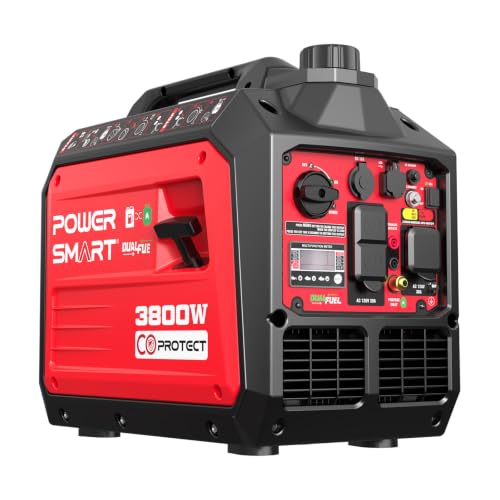
PowerSmart 3800 Watt Dual Fuel Inverter Generator Quiet Portable Gas Propane with CO Sensor RV Ready
As an Amazon Associate we earn from qualifying purchases. Product prices and availability are accurate as of the date/time indicated.
Frequently Asked Questions
Can I mix synthetic and conventional oil in a generator?
Yes, for a top-off. Synthetic and conventional oils are compatible. Make sure the viscosity grade and API rating match what the manual specifies, and switch fully to one type at your next oil change.
Can I use regular car motor oil in my generator?
Yes, if it matches the viscosity grade and API service rating in your manual. Most small four-stroke generators use standard automotive-type four-stroke oil. Never use two-stroke oil in a four-stroke crankcase.
Is a slightly overfilled crankcase okay?
No. Drain it back to the full mark. Too much oil can cause smoking, hard starting and crankcase pressure. Drain a small amount at a time, with the generator level and cool, then recheck.
Should I check an RV generator’s oil after driving?
Yes. Owners report that bumps and tilt can push oil toward the air filter while driving. Park level, let the generator cool, check the dipstick, and look at the air filter for oil.
{“@context”: “https://schema.org”, “@type”: “FAQPage”, “mainEntity”: [{“@type”: “Question”, “name”: “Can I mix synthetic and conventional oil in a generator?”, “acceptedAnswer”: {“@type”: “Answer”, “text”: “Yes, for a top-off. Synthetic and conventional oils are compatible. Make sure the viscosity grade and API rating match what the manual specifies, and switch fully to one type at your next oil change.”}}, {“@type”: “Question”, “name”: “Can I use regular car motor oil in my generator?”, “acceptedAnswer”: {“@type”: “Answer”, “text”: “Yes, if it matches the viscosity grade and API service rating in your manual. Most small four-stroke generators use standard automotive-type four-stroke oil. Never use two-stroke oil in a four-stroke crankcase.”}}, {“@type”: “Question”, “name”: “Is a slightly overfilled crankcase okay?”, “acceptedAnswer”: {“@type”: “Answer”, “text”: “No. Drain it back to the full mark. Too much oil can cause smoking, hard starting and crankcase pressure. Drain a small amount at a time, with the generator level and cool, then recheck.”}}, {“@type”: “Question”, “name”: “Should I check an RV generator’s oil after driving?”, “acceptedAnswer”: {“@type”: “Answer”, “text”: “Yes. Owners report that bumps and tilt can push oil toward the air filter while driving. Park level, let the generator cool, check the dipstick, and look at the air filter for oil.”}}]}













