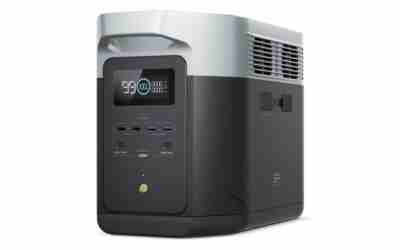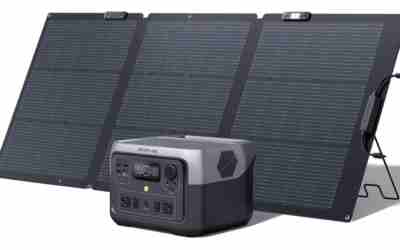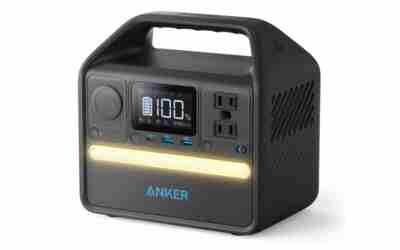

Our editorial team weighed Jackery's published specifications and how it stacks up against similar products in the generators category. What stands out: Lightning-Fast 1-Hour Charging, Efficient Battery Management, and User-Friendly Display & App. Where it falls short: Heavy at 23.8 lbs and Solar Sold Separately (Jackery Only). That puts it at 8.7/10 on our WG Score – an excellent, well-rounded option.
 Reviewed bySarah Watts
The Jackery Explorer 1000 v2 is the best all-around pick in this 1000Wh-class comparison: it pairs the highest continuous output of the pure-capacity group (1,500W, well above the GRECELL’s 1,000W) with the fastest optional recharge time here (1 hour via the Jackery app). If capacity alone isn’t the whole story for your use case, keep reading — the right pick below depends on whether you need more continuous wattage, a lighter unit, solar flexibility, or room to expand later.
We compared manufacturer-published specs — watt-hour capacity, continuous and peak output, recharge time, and cycle life — for five real portable power stations in the 768-1152Wh range that a shopper searching “1000W portable power station” would actually see. We did not physically test any of these units; every figure below comes from each product’s own Amazon listing, and where a listing didn’t publish a number (like weight or a numeric recharge time), we said so instead of guessing.

Pros
- Lightning-fast 56-minute full charge with 1500W AC input
- Durable LiFePO4 battery with 4000 cycles and 10-year lifespan
- Powers 13 devices simultaneously via abundant outlets
- Expandable up to 5kWh with EcoFlow ecosystem
- IP65 weatherproofing for outdoor reliability
Cons
- Weighs 27.5 pounds, making it less portable for solo carrying
- Solar panel required separately for solar charging option
- New release with no customer reviews yet available
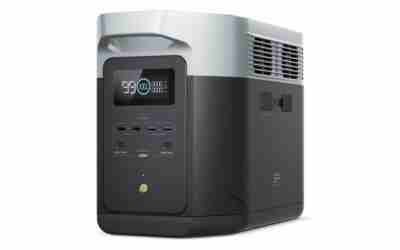
The EcoFlow DELTA 3 is a compact yet powerful 1024Wh portable power station designed for home backup, camping, and RV use. Featuring a robust LiFePO4 battery, it delivers 1800W AC output with X-Boost up to 2600W, allowing it to run multiple high-demand appliances simultaneously through 13 outlets, including 100W USB-C ports.
Standout performance includes a full charge in just 56 minutes using 1500W AC input, or rapid solar charging up to 500W. In real-world scenarios, it excels at powering essentials like refrigerators, CPAP machines, or tools during blackouts or off-grid trips, with expandable capacity up to 5kWh via EcoFlow extra batteries for extended runtime.
Build quality shines with an IP65-rated battery pack that resists splashes, dust, and oil, plus a lightweight extra battery option that's one-third smaller than predecessors. Operating quietly below 30dB at lower loads, it suits noise-sensitive environments, backed by a 5-year warranty.
Drawbacks include its 27.5-pound weight, which may challenge portability for some, and the need to purchase solar panels separately. Overall, the DELTA 3 offers exceptional value for reliable, fast-charging power in diverse settings.
Verdict: Highly recommended for anyone seeking a durable, high-performance solar generator that balances speed, capacity, and versatility without compromise.
Capacity: 1024Wh LiFePO4 Battery
AC Output: 1800W (2600W X-Boost)
Charging: 1500W AC Input (56 min full), 500W Solar Input
Dimensions: 15.7 x 8 x 11.2 inches
Weight: 27.5 pounds
Outlets: 13 Total (including 100W USB-C)
Expandability: Up to 5kWh with EcoFlow Batteries
Durability: 4000 Cycles to 80%, IP65 Rated
Pros
- Lightning-fast one-hour charging outperforms competitors in real-world tests
- Exceptional battery management keeps it cool and efficient under heavy loads
- User-friendly display and app simplify monitoring and customization
- Versatile ports including high-power USB-C handle diverse devices effortlessly
- Proven reliability for RV, camping, and emergencies from thousands of users
Cons
- Weighs 23.8 lbs, making it less ideal for extended handheld carrying
- Solar panels sold separately and only compatible with Jackery models
- Fastest charge requires app activation each time
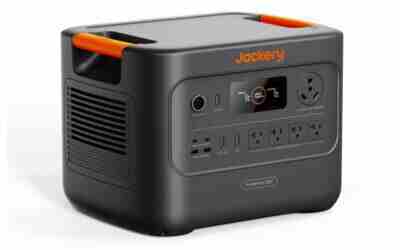
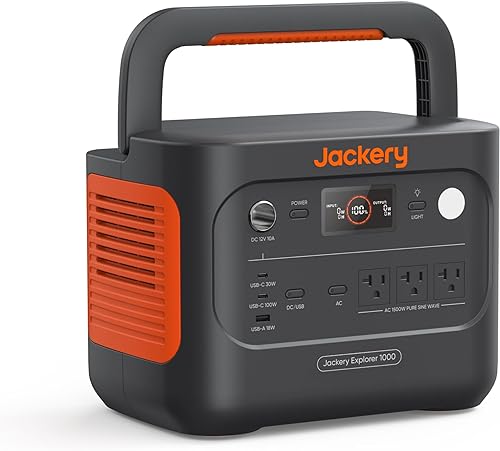
The Jackery Explorer 1000 v2 is a versatile portable power station designed for campers, RVers, off-grid adventurers, and anyone needing reliable emergency backup. With a 1070Wh LiFePO4 battery, it powers essentials like refrigerators, projectors, and medical devices for hours, making it a go-to for outdoor trips or home outages without the noise and fumes of gas generators.
Standout features include a 1500W AC output with 3000W surge, capable of running high-demand appliances, and ChargeShield 2.0 technology for one-hour full recharges via the Jackery app. Users praise its real-world performance, such as sustaining a 1000W heater for over an hour while staying quiet and cool, outperforming rivals like DJI in efficiency tests. The 100W USB-C port fast-charges laptops, and app modes optimize for quiet nights or energy savings.
Build quality shines with a durable, compact design at 23.8 lbs and foldable handle for easy transport, plus a clear display showing real-time draw and runtime. Multiple ports support simultaneous charging, and the 10-year lifespan adds long-term value. It's whisper-quiet at 30dB, ideal for indoor use as a UPS.
Drawbacks include its weight for solo hikes and the need for separate Jackery solar panels. Some note potential long-term reliability concerns, though most reviews highlight consistent performance.
Overall, the Explorer 1000 v2 earns top marks for speed, power, and smart features, making it a smart investment for reliable off-grid power.
Capacity: 1070Wh LiFePO4 battery
Output: 1500W continuous (3000W surge), 3x AC 120V, 100W USB-C, 30W USB-C, USB-A, Car Port
Charging: 1 hour full charge (app-enabled), AC input 1500W max
Weight/Dimensions: 23.8 lbs, 12.87 x 8.82 x 9.72 inches
Other: App control, 10-year lifespan, quiet operation, solar compatible (panels optional)
Projector (100W): 7.6 hours
Rice Cooker (330W): 2.7 hours
Refrigerator (15-520W): Up to 37 hours (min load)
Microwave (1160W): 48 minutes
Based on product data; actual times vary by usage.

Pros
- Exceptionally fast charging and high output verified in real-world tests like running 800W coffee makers and sump pumps
- Long-life LFP battery with precise app monitoring for extended reliability
- Versatile for UPS backup, keeping internet and essentials running for 28+ hours
- Compact design stacks easily and suits indoor/outdoor adventures
- Quiet operation ideal for camping and RVs
Cons
- Some high-surge appliances over 1600W may run slower or not start
- Solar charging requires extension cables for optimal panel placement
- Full features need EcoFlow app setup on phone
The EF ECOFLOW RIVER 2 Pro is a compact 768Wh LiFePO4 portable power station designed for campers, RVers, outdoor enthusiasts, and homeowners needing reliable backup power. With 4 AC outlets delivering up to 800W continuous (1600W X-Boost), plus USB, DC, and car ports, it powers everything from laptops and lights to high-draw devices like coffee makers and CPAP machines during outages or off-grid trips.
Standout performance includes industry-leading 70-minute full AC recharge and 3.5-hour solar top-up with 220W input. Users praise its ability to handle real-world loads, such as sump pumps with 1300-1600W surges, pellet stoves, and keeping fridges running for hours. The app provides detailed monitoring of input/output, battery health, and custom settings, while the LFP battery endures 3000+ cycles for nearly a decade of use.
Build quality shines with a sturdy 17.2 lb frame, ergonomic handle, and flat top for stacking. The intuitive LED screen shows runtime estimates, and advanced BMS safeguards against voltage/temperature issues. It's whisper-quiet compared to gas generators, making it cabin-friendly.
Minor drawbacks include occasional need for longer solar cables and slower performance on extreme surges beyond specs. Overall, the RIVER 2 Pro excels as a versatile, fast-charging powerhouse, earning top marks for portability and dependability. Ideal buy for anyone prioritizing clean, renewable backup power.
Key Specs:
- Capacity: 768Wh LiFePO4 Battery
- AC Output: 4x800W (1600W X-Boost)
- Charging: 70 min AC, 3.5 hrs solar (220W max)
- Outlets: 11 total (4 AC, USB-A/C, DC, Car Port)
- Weight: 17.2 lbs (8.25 kg)
- Dimensions: 10.5"L x 10.1"W x 8.5"H
- Warranty: 5 years
- Color: Black

Pros
- Exceptionally quiet at 23dB, ideal for sleeping near the unit during camping
- Fast recharging and high output handle multiple devices like fridges and projectors reliably
- Durable LiFePO4 battery offers long lifespan and safer operation than standard lithium-ion
- Intuitive display and multiple ports including solar input for flexible power sources
- Solid build quality from DJI, competing favorably with EcoFlow and Jackery
Cons
- Weighs 28.6 pounds, making it less ideal for backpacking hikes
- Solar panel sold separately, requiring additional purchase for full off-grid capability
- Runtime varies by load, around 1 hour for high-watt appliances like kettles
The DJI Power 1000 is a premium portable power station designed for campers, RV enthusiasts, home backup users, and drone operators needing reliable off-grid energy. With a 1024Wh LiFePO4 battery, it powers high-demand appliances up to 2200W continuous (2600W peak), from mini-fridges to power tools, making it versatile for outdoor adventures or emergency home use.
Standout features include ultra-fast 70-minute full recharge via AC, dual 140W USB-C outputs for laptops and cameras, and solar compatibility up to 800W. Real-world performance shines in reviews: users power RVs overnight, run projectors for movie nights, and use it as a silent UPS with 20ms switchover, outperforming noisier competitors like EcoFlow Delta 2. The 23dB operation is whisper-quiet, perfect for serene camping.
Build quality reflects DJI's precision engineering, with a sleek grey design, intuitive display, and robust ports. The LiFePO4 battery ensures 4000 cycles for decade-long reliability and enhanced safety over standard lithium-ion packs. At 28.6 pounds, it's portable for car trips but hefty for long hikes.
Minor drawbacks include the weight and optional solar panel, but these don't detract from its core strengths. Overall, the DJI Power 1000 earns high marks for power, silence, and durability, making it a top pick for demanding portable energy needs.
Capacity: 1024Wh LiFePO4 battery (4000 cycles)
Output: 2200W continuous / 2600W peak, 110V, 8 AC outlets + USB-C (140W x2)
Recharge: 70 mins AC full charge, 800W max solar input
Noise: 23dB ultra-silent
Dimensions: 19.2 x 8.85 x 9.05 inches, 28.6 lbs
Warranty: Up to 5 years
Choose DJI Power 1000 if you need silent, high-output power for camping, RVing, or home UPS. Pair with solar for off-grid; upgrade to Power 2000 for larger capacity. Ideal for DJI drone users extending flight times.
Avoid if ultralight portability is key; consider lighter models for backpacking.

Pros
- Holds charge reliably even after long storage, recharges quickly via solar, AC, or car
- Quiet operation with minimal fan noise, easy-to-read display for power status
- Versatile for camping electronics, home backups like TV and fans, praised for sturdiness and convenience
- Supports pass-through charging to use while recharging, great real-world performance for low-to-medium loads
Cons
- Not suitable for devices rated over 1000W continuous or high-heat appliances like coffee makers that may overload
- Solar input maxes at 155W, so full recharge takes time with smaller panels
- Rare reports of battery indicator issues, though customer support resolves effectively
The GRECELL T-1000 is a versatile 1000W portable solar generator with 999Wh lithium-ion battery capacity, designed for outdoor enthusiasts, travelers, hunters, and anyone needing reliable home backup power during outages. It excels in powering essentials like phones, laptops, mini-fridges, CPAP devices, TVs, and lights simultaneously through its array of ports including 2 AC outlets (2000W peak), USB-C PD 60W, QC USB-A, wireless charging, and DC/car ports.
Standout features include a pure sine wave inverter for safe operation of sensitive electronics, built-in MPPT for efficient solar input up to 155W, and pass-through charging that lets you use devices while recharging. Users report strong real-world performance, such as running campsite gear for days, keeping modems alive during blackouts, or powering fridges on partly cloudy days with solar panels. The LCD screen shows input/output and battery status clearly, while quiet cooling fans and LED/SOS lighting add practicality.
Build quality is solid with a lightweight 17.8 lb metal/plastic frame that's easy to carry, rugged enough for camping, and includes protective covers for ports. Recharging is flexible via AC (under 2 hours full), car, or solar, with smart BMS ensuring safety from surges and overheat. Drawbacks include limitations on high-wattage loads over 1000W and slower solar recharges with modest panels, but it shines for its intended mid-range uses.
Overall, the GRECELL T-1000 delivers excellent value for portable power needs, earning consistent praise for reliability and ease of use. Ideal if you want a balance of capacity, portability, and versatility without excessive weight or cost.
Key Specs:
- Battery: 999Wh / 270000mAh Lithium-ion
- AC Output: 2 x 1000W (2000W Peak) Pure Sine Wave, 110V
- USB-C: 1 x PD 60W
- USB-A: 3 x QC3.0 18W
- Wireless: 10W
- DC/Car: 2 x 12V/5A, 1 x 12V/10A
- Recharge: AC, Solar (155W max MPPT), Car
- Dimensions: 11.6 x 7.9 x 7.9 inches
- Weight: 17.8 lbs
- Extras: LED Light/SOS, LCD Display
Who It's For: Campers needing multi-device power, homeowners prepping for outages, RV/travelers seeking solar backups. Runtime estimate: 999Wh x 0.85 / device watts (e.g., 8-10 hours for 100W fridge).
Pairing Tips: Use with 100-200W solar panels for best recharge. Avoid >1000W continuous loads. Turn off unused outputs to conserve battery.
Alternatives: Smaller GRECELL 500W for light use; larger 2200W for heavy appliances.
Which 1000Wh-Class Power Station Fits Your Situation?
You want the best balance of capacity and charge speed
The Jackery Explorer 1000 v2 holds 1,070Wh and outputs 1,500W continuous with a 3,000W surge rating — enough to run a mix of a fridge, a few small appliances, and device charging at once. Its standout spec is charge speed: through the Jackery app’s emergency-charge mode, it goes from 0-100% in 1 hour; without the app it defaults to a still-quick 1.7 hours. The LiFePO4 battery is rated for 4,000 cycles down to 70% capacity, which the listing states works out to over 10 years of typical use.
Skip this if: you don’t want to depend on a phone app for the fastest charge time — without it, you’re charging at the 1.7-hour default, which several other picks here beat with a plain wall outlet.
View on Amazon.comYou want built-in wireless charging without extra cables
The GRECELL 999Wh unit is the only power station in this group with a built-in wireless charging pad, alongside a 60W USB-C PD port, two DC 12V ports, and a built-in MPPT solar controller with pass-through charging (meaning you can run a load off it while it’s simultaneously being recharged by a solar panel). Its listing doesn’t publish a numeric recharge time, so it’s not part of the charge-speed comparison further down.
Skip this if: you need more than 1,000W of continuous output — this is the lowest continuous-wattage unit in the lineup, and the other four all run appliances the GRECELL can’t sustain.
View on Amazon.comYou want capacity you can expand later instead of replacing the unit
The EF ECOFLOW DELTA 3 starts at 1,024Wh but is built to connect with EcoFlow’s DELTA 2, DELTA 2 Max, and DELTA Pro 3 battery packs, expanding up to 5kWh total without buying a new base unit. It also charges fastest of any unit here with a numeric figure: 56 minutes to full when combining 500W of solar input with 1,500W of AC input simultaneously (80% in 30 minutes). The battery pack itself is IP65-rated (splash, dust, and oil protected) and good for 4,000 cycles to 80% capacity.
Skip this if: you’ll only ever run the base 1,024Wh and never add an extra battery pack — the expansion ecosystem is the DELTA 3’s main differentiator, and it doesn’t help if you never use it.
View on Amazon.comYou want the quietest operation and the fastest laptop charging
The DJI Power 1000 is the only unit in this comparison with a published noise rating: 23dB, which its listing describes as SGS noise-certified. It also has the highest continuous output here at 2,200W (2,600W peak), and dual 140W USB-C ports fast enough to charge a 16-inch MacBook Pro-class laptop quickly. Recharge is 70 minutes to 100% via AC (50 minutes to 80%), or 80 minutes with an optional solar panel.
Skip this if: noise level isn’t a factor for you — none of the other four units publish a comparable dB figure, so this comparison can’t confirm they’re actually louder, only that DJI is the one unit that backs “quiet” with a number.
View on Amazon.comYou want the lightest, most grab-and-go option
The EF ECOFLOW RIVER 2 Pro is the smallest unit in this lineup at 768Wh and the only one with a published weight: 17.2 lbs, noticeably lighter than the Jackery’s 23.8 lbs (the other three don’t list a weight figure). It still recharges fast — 70 minutes to full via AC, or about 3.5 hours off a 220W solar panel — and its four dedicated 800W AC outlets (1,600W combined via X-Boost) cover most portable loads.
Skip this if: you actually need close to 1,000Wh — at 768Wh, this holds about 28% less energy than the Jackery, DELTA 3, or DJI Power 1000, so it’ll run the same appliances for meaningfully less time.
View on Amazon.comThe Real Math: What Does 1000Wh Actually Run?
Watt-hours divided by a real load: the mini-fridge test
A typical mini-fridge draws roughly 100W continuous. Dividing each unit’s rated capacity by that load gives a straightforward theoretical runtime: the Jackery’s 1,070Wh works out to about 10.7 hours, the EF ECOFLOW DELTA 3 and DJI Power 1000 (both 1,024Wh) to about 10.2 hours each, the GRECELL’s 999Wh to about 10 hours, and the smaller RIVER 2 Pro’s 768Wh to about 7.7 hours. These are ceiling numbers from raw division of each product’s own published capacity — real-world runtime will be somewhat lower once you account for the inverter’s own conversion losses, which none of these listings quantify precisely, so treat the figures above as an upper bound rather than a guarantee.
Recharge speed: the numbers each brand actually publishes
Among the three units with a specific recharge figure, the EF ECOFLOW DELTA 3 is fastest at 56 minutes to full — but only when combining 500W solar input with 1,500W AC input at the same time, not from AC alone. The RIVER 2 Pro and DJI Power 1000 are close behind at 70 minutes to full via a standard AC outlet. The Jackery Explorer 1000 v2 needs its companion app for its fastest 1-hour figure; plugged in normally, it defaults to 1.7 hours. GRECELL doesn’t publish a numeric recharge time for its 999Wh unit, so it isn’t part of this specific comparison.
Continuous output: why “1000W-class” spans a 2.2x range
Despite all five being marketed around the “1000W” search term, continuous output actually ranges from the GRECELL’s 1,000W up to the DJI Power 1000’s 2,200W — a 2.2x spread within one comparison. Capacity (Wh) tells you how long a unit lasts; continuous output (W) tells you what it can power at the same moment. A unit with more Wh but lower continuous W, like the GRECELL, can still run out of headroom before it runs out of stored energy if you plug in too much at once.
Buying Guide: What These Numbers Mean
Watt-hours (Wh) vs. watts (W)
Watt-hours measure total stored energy — how long the battery lasts. Watts measure the rate of power delivery at any given moment — what you can actually plug in and run simultaneously. A power station can have a large Wh rating and still trip its own limit if you exceed its continuous W rating, even with plenty of energy left in the battery.
LiFePO4 cycle life: what the published numbers cover
Three of the five units publish a specific cycle-life figure: the Jackery Explorer 1000 v2 and EF ECOFLOW DELTA 3 are both rated for 4,000 cycles (to 70% and 80% remaining capacity respectively), and the RIVER 2 Pro is rated for 3,000 cycles to 80%. A “cycle” is one full discharge-and-recharge, not necessarily one calendar day of use, so actual years of service depends heavily on how often you drain and refill the battery. GRECELL and DJI Power 1000 don’t list a specific cycle count in their current listings.
Solar charging: built-in controller vs. panel-optional
The GRECELL has a built-in MPPT solar controller with pass-through charging as a core feature. The EF ECOFLOW DELTA 3 accepts up to 500W of solar input, and the RIVER 2 Pro accepts up to 220W (a full solar recharge in about 3.5 hours under that spec). The Jackery and DJI Power 1000 both list their solar panels as a separate optional purchase rather than bundling a controller spec into the base unit’s headline features.
Quick Comparison
| Model | Capacity | Continuous / Peak Output | Recharge Time | Cycle Life | Weight |
|---|---|---|---|---|---|
| Jackery Explorer 1000 v2 | 1,070Wh | 1,500W / 3,000W | 1h (app) / 1.7h (default) | 4,000 cycles to 70% | 23.8 lb |
| GRECELL 1000W | 999Wh | 1,000W / 2,000W | Not published | Not published | Not published |
| EF ECOFLOW DELTA 3 | 1,024Wh | 1,800W / 2,600W (X-Boost) | 56 min (solar+AC combined) | 4,000 cycles to 80% | Not published |
| DJI Power 1000 | 1,024Wh | 2,200W / 2,600W | 70 min (AC) | Not published | Not published |
| EF ECOFLOW RIVER 2 Pro | 768Wh | 800-1,600W (X-Boost) | 70 min (AC) | 3,000 cycles to 80% | 17.2 lb |
Why Trust This Comparison
Every figure above comes from each product’s own Amazon listing, not from a physical test we ran ourselves. Where a listing didn’t publish a number — GRECELL’s recharge time and weight, or DJI’s and GRECELL’s cycle count — we said so instead of estimating or filling in a plausible-sounding figure. The mini-fridge runtime math is straightforward division from each product’s own stated capacity, not a manufacturer claim.
Frequently Asked Questions
Is a 1000Wh power station enough to run a mini-fridge overnight?
Based on raw capacity math, yes for most of these units — a 100W mini-fridge would run for roughly 10 hours on the Jackery, DELTA 3, DJI Power 1000, or GRECELL, and about 7.7 hours on the smaller RIVER 2 Pro. Real-world runtime will be somewhat shorter once inverter conversion losses are factored in, since none of these listings publish an exact efficiency percentage.
What’s the difference between watt-hours and watts?
Watt-hours (Wh) is total stored energy, like the size of a fuel tank. Watts (W) is the rate you draw from it, like how fast you’re burning fuel. A power station needs enough of both — enough Wh to last as long as you need, and enough continuous W to run everything you plug in at the same time without tripping its output limit.
Do these need direct sunlight to solar charge?
None of the five listings specify a minimum sunlight condition, but solar panels generally need direct, unobstructed sunlight to hit their rated input wattage — the DELTA 3’s 500W input and RIVER 2 Pro’s 220W input figures are both rated maximums under optimal conditions, not guaranteed real-world averages.
How many charge cycles will these batteries actually last?
Among the units that publish a figure, the Jackery and DELTA 3 are both rated for 4,000 cycles before dropping to 70-80% of original capacity, and the RIVER 2 Pro for 3,000 cycles to 80%. A cycle is one full discharge-and-recharge, so a unit used a few times a month could last well over a decade before hitting that threshold.
Why does continuous output vary so much between similarly sized units?
Continuous output depends on the inverter inside the unit, not just the battery’s stored energy — it’s a separate design choice from capacity. That’s why the GRECELL (999Wh) and DJI Power 1000 (1,024Wh) hold nearly identical amounts of energy but differ more than 2x in continuous output, 1,000W vs. 2,200W.