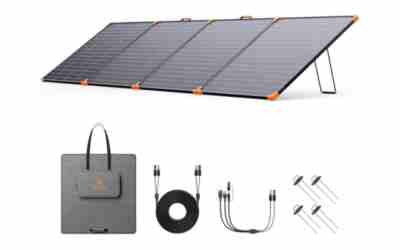
Our editorial team weighed EFECOFLOW's published specifications and how it stacks up against similar products in the generators category. What stands out: 3,000+ Cycle Battery Lifespan, Rapid Multi-Source Charging, and 1000W Output. Where it falls short: Ships in Separate Packages and Heavy at 28.6 lbs. That puts it at 8.5/10 on our WG Score – an excellent, well-rounded option.
 Reviewed byDaniel
Yes, you can charge a Tesla with a power station, but it adds only about 3 to 4 miles of range per usable kWh.
What a power station needs to charge a Tesla
The car needs a steady AC supply through its charge cable, not a DC or USB port. Three things decide whether it works:
- AC outlet: the Tesla Mobile Connector with a standard 120V NEMA 5-15 adapter is the simplest route. A 240V adapter such as NEMA 14-50 works only if the station has a matching 240V outlet.
- Continuous output: 120V at 12A is about 1.4 kW (12 × 120 = 1,440 W). The station must hold that continuously, not just as a surge rating. If it cannot, lower the charge amps on the car’s touchscreen below the station’s limit.
- Clean power: a pure sine wave inverter and a properly grounded outlet are the safe choice. Confirm both in the station’s manual.
Plug the connector straight into the station. Do not use an extension cord, a power strip or an adapter that is not rated for the load. Run the station outdoors or in a ventilated space, never inside the car.
How many miles does a power station add to a Tesla?
Teslas typically use roughly 250 to 330 Wh per mile, depending on model, speed, weather and terrain. That works out to about 3 to 4 miles per kWh (1,000 ÷ 300 ≈ 3.3; 1,000 ÷ 250 = 4). Treat it as a rough estimate, not a spec.
The table uses usable kWh, meaning the energy the station can actually deliver at its outlet, not the label capacity. Inverter and charger losses mean a unit’s usable figure is lower than its nameplate Wh. Time assumes a steady 1.4 kW draw.
| Usable kWh at the outlet | Estimated miles added | Time at 1.4 kW |
|---|---|---|
| 1 | 3 to 4 | about 43 minutes |
| 2 | 6 to 8 | about 1.4 hours |
| 3.6 | 11 to 14 | about 2.6 hours |
| 5 | 15 to 20 | about 3.6 hours |
A Tesla battery holds tens of kWh, so even the 5 kWh row is a small fraction of a full charge. If the station delivers less than 1.4 kW, divide the usable kWh by the lower wattage to get the time. At 8A (about 960 W) the same 2 kWh takes roughly 2.1 hours.
Why the Tesla won’t charge or the station shuts off
Charging from a station fails more often than it works on small units. In one published test, two stations of about 2,000 Wh reportedly did not charge an EV. Check these causes in order, cheapest first:
- Amps set too high. Lower the charge current on the touchscreen to 8 to 12A. This fixes most overload trips.
- Inrush or surge. The charger’s start-up draw can trip a station whose continuous rating is only just enough. Pick a lower amp setting and restart.
- Grounding checks. The car may refuse a source it cannot verify as grounded. Try the station’s grounded outlet with the correct adapter, and do not use cheater plugs.
- Output too small. If the station cannot supply even 8A, stop. Replacing the unit or using another charging source is the only fix.
Running a station down to empty for EV charging also wears its battery faster than light household use. Some makers restrict or void warranty coverage for EV charging, so check the station and EVSE manuals before you try.
What size power station do you need for emergency range?
Pick the range you need, then work backward at 3 to 4 miles per usable kWh. Divide miles by 4 for the low end and by 3 for the high end.
- 10 miles: about 2.5 to 3.3 usable kWh.
- 20 miles: about 5 to 6.7 usable kWh.
These sizes need 1.4 kW or more of continuous 120V output as well. Anything smaller adds only a mile or two, which rarely justifies the setup.
For regular use, a Tesla Mobile Connector on a wall outlet, public charging, or a home battery or large solar generator sized for 240V is more practical. Treat a portable station as a last-resort top-up to reach a charger.
Our Top Picks
Ready to shop? These are the top-rated options from our related roundup, Best Overall Portable Power Stations of 2026.

Anker SOLIX C1000 Gen 2 Portable Power Station: 2000W Solar Generator, 1024Wh LiFePO4, 49-Min Fast Charge for Camping, Home Backup

EcoFlow River 2 Max 512Wh LiFePO4 Solar Generator + 160W Panel: 1000W Output, 60Min AC Charge, 3000+ Cycles for Camping & Backup

EnginStar R300 300W Portable Power Station 296Wh 80000mAh Pure Sine Wave AC for Camping CPAP Emergencies
As an Amazon Associate we earn from qualifying purchases. Product prices and availability are accurate as of the date/time indicated.
Frequently Asked Questions
Can I charge a Tesla from the 12V car port or USB-C port on a power station?
No. Those ports are low-power DC outputs, and the Tesla charge cable needs AC from a wall-style outlet. Only the station’s AC inverter outlet can feed the Mobile Connector.
Can a gas inverter generator charge a Tesla the same way?
Yes, if its continuous rating covers 1.4 kW for a 120V connection at 12A. A 2,000W inverter generator meets that, and you must run it outdoors with a grounded outlet.
Can I use a 240V adapter on a station with only 120V outlets?
No. A NEMA 14-50 adapter only passes through 240V; it does not convert 120V. Without a true 240V outlet on the station, you are limited to the 120V adapter.
What happens if the station runs out of power mid-charge?
The inverter shuts off and the charging session stops. The car keeps the energy already added, and you can resume once the station is recharged or swapped.
{“@context”: “https://schema.org”, “@type”: “FAQPage”, “mainEntity”: [{“@type”: “Question”, “name”: “Can I charge a Tesla from the 12V car port or USB-C port on a power station?”, “acceptedAnswer”: {“@type”: “Answer”, “text”: “No. Those ports are low-power DC outputs, and the Tesla charge cable needs AC from a wall-style outlet. Only the station’s AC inverter outlet can feed the Mobile Connector.”}}, {“@type”: “Question”, “name”: “Can a gas inverter generator charge a Tesla the same way?”, “acceptedAnswer”: {“@type”: “Answer”, “text”: “Yes, if its continuous rating covers 1.4 kW for a 120V connection at 12A. A 2,000W inverter generator meets that, and you must run it outdoors with a grounded outlet.”}}, {“@type”: “Question”, “name”: “Can I use a 240V adapter on a station with only 120V outlets?”, “acceptedAnswer”: {“@type”: “Answer”, “text”: “No. A NEMA 14-50 adapter only passes through 240V; it does not convert 120V. Without a true 240V outlet on the station, you are limited to the 120V adapter.”}}, {“@type”: “Question”, “name”: “What happens if the station runs out of power mid-charge?”, “acceptedAnswer”: {“@type”: “Answer”, “text”: “The inverter shuts off and the charging session stops. The car keeps the energy already added, and you can resume once the station is recharged or swapped.”}}]}