

Our editorial team weighed PulsarProducts's published specifications and how it stacks up against similar products in the generators category. What stands out: Lightweight at 37.5 lbs, 5-Hour Runtime, and Versatile Outlets. Where it falls short: Needs Gas/Oil Mix and Manual Recoil Start. That puts it at 7.8/10 on our WG Score – a solid, dependable choice.
 Reviewed byTristan
Portable generator runtime is typically 8 to 12 hours on one tank at 50% load, and it can run for days if you refuel on schedule. Your tank size and load set the exact figure, and the formula below shows how to calculate it for your unit.
What sets portable generator runtime
Four things decide how many hours one fill lasts:
- Tank capacity: the gallons the tank holds, listed on the spec sheet. More fuel on board means more hours at the same burn rate.
- Load: the watts you are drawing compared with the generator’s running-watt rating. A higher load burns fuel faster.
- Engine type: a conventional engine holds a fixed speed whatever you plug in. An inverter generator can slow its engine when the load is light, so it burns less fuel at part load.
- Fuel type: gasoline, propane or the dual-fuel option. Each has its own runtime figure and often its own output rating in the manual.
This is why no single hour count is correct for every generator. The 8 to 12 hour range is a common advertised figure at half load, not a promise for your model.
How to estimate runtime from the spec sheet
Most spec sheets list runtime at 50% load plus the tank size. Use them to find the burn rate, then reuse that rate for any tank or can of fuel.
- Find the tank capacity in gallons and the published hours at 50% load.
- Divide gallons by hours to get the burn rate in gallons per hour.
- Divide the fuel you have by that burn rate to get hours.
Worked example (illustrative numbers, not a specific model): a 7-gallon tank rated for 10 hours at 50% load burns 7 ÷ 10 = 0.7 gal/hr. A 5-gallon can of gasoline then adds 5 ÷ 0.7 = about 7.1 hours.
Full load burns roughly twice as much as half load, which is a rule of thumb rather than an exact figure. Here is that same 7-gallon tank at different burn rates:
| Burn rate (gal/hr) | Runtime on 7 gallons |
|---|---|
| 0.5 | 14 hours |
| 0.7 (50% load in the example) | 10 hours |
| 1.0 | 7 hours |
| 1.4 (about full load, estimate) | 5 hours |
Treat advertised hours as a best case measured under test conditions. Real appliances cycle on and off, so your actual burn rate will move around.
How long a portable generator can run nonstop
Mechanically, a portable generator can run around the clock as long as you stop to add fuel and oil. The limit is the maintenance schedule, not a built-in timer.
Check the oil on the schedule in your manual. As one example, Generac’s support guidance is to shut down and check the oil every 8 hours of continuous running, or when the unit runs out of fuel. Other brands set their own intervals, so use the one in your manual. Check the oil each time you add fuel and keep it at the upper dipstick mark.
The oil change interval is also given in running hours, so continuous use reaches it in days, not months.
A 24-hour and 3-day fuel plan
Using the 0.7 gal/hr example from above, here is what nonstop running costs in fuel.
- 24 hours: 24 × 0.7 = 16.8 gallons.
- 3 days (72 hours): 72 × 0.7 = 50.4 gallons, about 50 gallons.
Build the schedule around the 8-hour oil check so each stop doubles as a refuel. For 24 hours, that is three 8-hour runs, each burning 5.6 gallons. Start with the 7-gallon tank full. Top it back up to full after the first and second runs, adding 5.6 gallons each time, which is 11.2 gallons in total. After the third run, the tank ends the day with 1.4 gallons left.
The 3-day total is the trap. Fifty gallons of gasoline is a lot of fuel to store, and local rules may limit how much you can keep. If you cannot store the full amount, the only fix is a lower burn rate, so decide what to power before the outage and plan refills around the fuel you can store.
How to refuel during a long outage
Refueling is where most outage fires start, so follow the same order every time:
- Unplug or switch off the loads, then shut the generator off.
- Wait until the engine and muffler have cooled. The manual gives the cooldown time for your model.
- Check the oil and top it up to the upper dipstick mark.
- Move the fuel can away from the generator and away from anything that can spark.
- Fill the tank slowly and stop below the fill neck, then wipe up any spill.
- Close the can, move it away, and restart the unit.
Store fuel only in containers approved for it, outdoors and away from ignition sources, and never fill a hot generator. The carbon monoxide rules for placement and alarms are covered in our portable generator safety guide.
Ways to extend portable generator runtime
- Cut the load: run only what you need. Skipping a few large appliances lowers the burn rate more than any engine setting, and the table above shows the effect.
- Stagger big loads: run the well pump, microwave or space heater at different times so the generator never carries them together.
- Use eco mode: switch it on if your inverter model has one, and check the manual for loads that should stay off it.
- Use propane on a dual-fuel unit: it lets you swap in a cylinder when gasoline runs low. Many dual-fuel manuals list a lower output rating on propane, so recheck your load against that number.
For very light loads like phones, lights and a router, a battery-based unit uses a different watt-hour calculation. Our solar generator runtime chart covers that math.
Our Top Picks
Ready to shop? These are the top-rated options from our related roundup, Best Portable Generators For Power Outage of 2026.

Westinghouse iGen4000DFc 4000 Peak Watt Dual Fuel Inverter Generator - Super Quiet RV Ready Remote Start CO Sensor

Pulsar PG1202SA 1200W Portable Gas Generator with Handle - Compact Camping Powerhouse
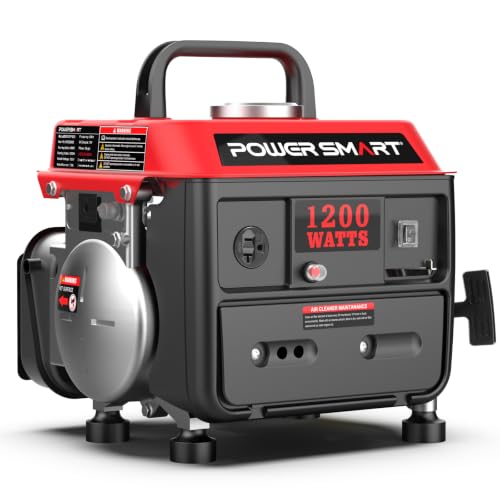
PowerSmart 1200W Portable Gas Generator 900W Rated 2-Stroke 39 lbs for Camping Emergency
As an Amazon Associate we earn from qualifying purchases. Product prices and availability are accurate as of the date/time indicated.
Frequently Asked Questions
Can I run it all night with eco mode?
Possibly, if your model is an inverter unit with an eco mode. It slows the engine at light load to save fuel. Check that the tank holds enough for the night at your burn rate, and follow the oil-check interval in your manual.
Is a 5-gallon can enough for 24 hours?
Usually not. In the example above, 24 hours at 0.7 gal/hr takes 16.8 gallons, and a 5-gallon can adds only about 7 hours. Use your own burn rate from the spec sheet to check.
Will a 20 lb propane cylinder last as long as a full gas tank?
Not automatically. Divide the cylinder’s usable propane by the propane burn rate in your manual, then compare that to your gasoline hours. The two figures are listed separately because the fuels burn differently.
{“@context”: “https://schema.org”, “@type”: “FAQPage”, “mainEntity”: [{“@type”: “Question”, “name”: “Can I run it all night with eco mode?”, “acceptedAnswer”: {“@type”: “Answer”, “text”: “Possibly, if your model is an inverter unit with an eco mode. It slows the engine at light load to save fuel. Check that the tank holds enough for the night at your burn rate, and follow the oil-check interval in your manual.”}}, {“@type”: “Question”, “name”: “Is a 5-gallon can enough for 24 hours?”, “acceptedAnswer”: {“@type”: “Answer”, “text”: “Usually not. In the example above, 24 hours at 0.7 gal/hr takes 16.8 gallons, and a 5-gallon can adds only about 7 hours. Use your own burn rate from the spec sheet to check.”}}, {“@type”: “Question”, “name”: “Will a 20 lb propane cylinder last as long as a full gas tank?”, “acceptedAnswer”: {“@type”: “Answer”, “text”: “Not automatically. Divide the cylinder’s usable propane by the propane burn rate in your manual, then compare that to your gasoline hours. The two figures are listed separately because the fuels burn differently.”}}]}













