

Our editorial team weighed Honda's published specifications and how it stacks up against similar products in the generators category. What stands out: Exceptionally Quiet, Fuel-Saving Eco Mode, and Smartphone App Control. Where it falls short: Premium Price Point and Manual Recoil Start. That puts it at 8.7/10 on our WG Score – an excellent, well-rounded option.
 Reviewed byEthan
A generator typically uses 0.33 to 0.83 gallons of gas per hour at half load, depending on size: about 0.33 for a 3,000-watt unit and 0.83 for a 7,500-watt unit, or roughly 8 to 20 gallons per day. These are calculated planning estimates, not measured data.
Generator gas use per hour by size and load
The chart shows typical gasoline burn for conventional open-frame portable generators. The values are calculated planning estimates using the factors in the formula section below, not measured data or manufacturer ratings, so your model’s manual or spec sheet takes priority.
| Rated watts | 25% load (gal/hr) | 50% load (gal/hr) | 100% load (gal/hr) | 24 hours at 50% (gal) |
|---|---|---|---|---|
| 3,000 | 0.23 | 0.33 | 0.48 | 7.9 |
| 5,000 | 0.38 | 0.55 | 0.80 | 13.2 |
| 7,500 | 0.56 | 0.83 | 1.20 | 19.8 |
| 10,000 | 0.75 | 1.10 | 1.60 | 26.4 |
How load percentage changes fuel use
Fuel burn falls as load drops, but not in proportion. Going from full load to half load on a 3,000-watt generator cuts output by 50% yet cuts fuel by only about 31% (0.48 to 0.33 gal/hr).
The engine still has to spin at a set speed and overcome its own friction, so a lightly loaded generator wastes a bigger share of its fuel. That is why an oversized generator running a small load is expensive per kilowatt-hour.
Idling still burns gas
An engine with nothing plugged in keeps burning fuel. If you only need power for a few minutes at a time, shut it off between uses rather than leaving it running.
Formula to estimate how long a tank lasts
Use this to get your own number instead of relying on a chart:
- Add up the running watts of everything you will power and divide by 1,000 to get kilowatts.
- Multiply by the gas used per kilowatt-hour: about 0.30 gal/kWh near 25% load, 0.22 near 50%, and 0.16 at full load. Interpolate in between.
- Divide your tank size in gallons by the result to get hours of runtime.
Shortcut: if the manual lists a tank size and a runtime at 50% load, gallons per hour at half load is tank gallons divided by rated hours. A 3.4-gallon tank rated for 10 hours gives 3.4 ÷ 10 = 0.34 gal/hr, which matches the 0.33 in the chart. Lighter loads will run longer.
Worked outage example
Typical running loads: refrigerator 150 W, furnace fan 600 W, lights 100 W, modem and chargers 100 W. Total is 950 W, or 0.95 kW. On a 3,000-watt generator that is about 32% load, where the factor is about 0.28 gal/kWh.
- Hourly burn: 0.95 kW × 0.28 = about 0.27 gal/hr
- Per day: 0.27 × 24 = about 6.5 gallons
- One 3.4-gallon tank: 3.4 ÷ 0.27 = about 12.6 hours
Refrigerators and fans draw a surge when they start, so check starting watts against the generator’s rating. To turn gallons into dollars, see how much it costs to run a generator.
Do inverter generators use less gas?
At light loads, yes. An inverter generator lowers engine speed when demand is low, while a conventional unit holds a fixed speed. That is why inverter models are usually rated at 25% load instead of 50% or 100%.
Published figures for 2,000-watt inverter units fall around 0.1 to 0.2 gal/hr. A 500-watt load on one of these burns far less than the same load on a 3,000-watt open-frame unit, which uses about 0.23 gal/hr at 25% load.
The advantage shrinks as the load approaches the rated output. For a closer comparison, read do inverter generators use less gas.
Propane, natural gas and diesel compared with gasoline
Other fuels burn at different rates because each holds a different amount of energy per unit.
- Propane: a 6 kW generator uses about 1.4 to 1.5 gallons per hour, more gallons than gasoline for similar output.
- Natural gas: a 7 kW unit uses about 115 to 120 cubic feet per hour.
- Diesel: a 20 kW unit uses about 1.6 gal/hr at full load, and a 100 kW unit about 7.4 gal/hr.
A Generac 10 kW home standby unit uses about 0.97 gal/hr of liquid propane at half load. These are manufacturer or reference figures for specific sizes, so use your model’s fuel consumption table.
Ways to cut fuel use
- Match the generator to the load. A 950 W load is only about 13% of a 7,500-watt unit, which wastes fuel.
- Turn on eco or economy mode if your model has one.
- Stagger heavy loads instead of running them together.
- Run the generator in blocks, such as a few hours at a time, and let the refrigerator hold its temperature between runs.
For tiny loads like a phone and modem, a battery unit burns no fuel at all. See gas generator vs power station for where each makes sense.
How much gas to store for a 3-day outage
Using the worked example, 0.27 gal/hr × 72 hours is about 19.4 gallons, so plan on about 20 gallons if the generator runs nonstop. Running 12 hours a day instead cuts that to about 10 gallons (0.27 × 12 × 3 = 9.7).
- Store gas only in approved containers, away from living areas and ignition sources.
- Total quantity limits come from local fire code, so check with your fire department.
- Gasoline goes stale in about 3 to 6 months; use a stabilizer as directed on its label and rotate the supply.
- Shut the engine off and let it cool before refueling, since hot parts can ignite vapor.
Run the generator outdoors, with exhaust directed away from the house, and follow the manual or label for placement distances.
Our Top Picks
Ready to shop? These are the top-rated options from our related roundup, Best Gasoline Generators Home Use of 2026.

Honda EU2200iTAN 2200W Super Quiet Portable Inverter Generator with CO-Minder - Ideal for Camping, RV, Home Backup

Westinghouse iGen2800 2800 Peak Watt Super Quiet Lightweight Portable Inverter Generator - Gas Powered, Parallel Ready
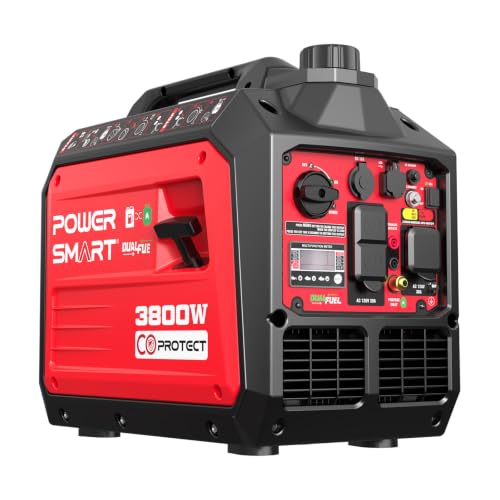
PowerSmart 3800 Watt Dual Fuel Inverter Generator Quiet Portable Gas Propane with CO Sensor RV Ready
As an Amazon Associate we earn from qualifying purchases. Product prices and availability are accurate as of the date/time indicated.
Frequently Asked Questions
Can I run a generator overnight on one tank?
Yes, if the load is light. A 3.4-gallon tank at 0.27 gal/hr lasts about 12.6 hours, which covers an 8-hour night. Check the fuel level before bed, and never refuel while the engine is hot.
How long does a 5-gallon can last on a 5,000 W unit?
At half load the chart shows about 0.55 gal/hr, so 5 gallons lasts roughly 9 hours. At 25% load (0.38 gal/hr) it lasts about 13 hours.
Can I run it 12 hours on and 12 hours off?
Yes, if your manual allows it. For a 5,000 W unit at half load, 12 hours of running uses about 6.6 gallons (0.55 × 12), half of a nonstop day.
Can I run a generator on E15?
Only if your manual says it is approved. Use the fuel grade and ethanol limit the manufacturer specifies, and stabilize stored gas.
{“@context”: “https://schema.org”, “@type”: “FAQPage”, “mainEntity”: [{“@type”: “Question”, “name”: “Can I run a generator overnight on one tank?”, “acceptedAnswer”: {“@type”: “Answer”, “text”: “Yes, if the load is light. A 3.4-gallon tank at 0.27 gal/hr lasts about 12.6 hours, which covers an 8-hour night. Check the fuel level before bed, and never refuel while the engine is hot.”}}, {“@type”: “Question”, “name”: “How long does a 5-gallon can last on a 5,000 W unit?”, “acceptedAnswer”: {“@type”: “Answer”, “text”: “At half load the chart shows about 0.55 gal/hr, so 5 gallons lasts roughly 9 hours. At 25% load (0.38 gal/hr) it lasts about 13 hours.”}}, {“@type”: “Question”, “name”: “Can I run it 12 hours on and 12 hours off?”, “acceptedAnswer”: {“@type”: “Answer”, “text”: “Yes, if your manual allows it. For a 5,000 W unit at half load, 12 hours of running uses about 6.6 gallons (0.55 × 12), half of a nonstop day.”}}, {“@type”: “Question”, “name”: “Can I run a generator on E15?”, “acceptedAnswer”: {“@type”: “Answer”, “text”: “Only if your manual says it is approved. Use the fuel grade and ethanol limit the manufacturer specifies, and stabilize stored gas.”}}]}













