

Our editorial team weighed 's published specifications and how it stacks up against similar products in the generators category. What stands out: Dual Fuel Flexibility, Quiet at 62dBA, and Clean Inverter Power. Where it falls short: Mixed Reliability Ratings and May Be Insufficient for Whole-Home. That puts it at 8/10 on our WG Score – an excellent, well-rounded option.
 Reviewed byTristan
Generac propane consumption depends on engine size and load. A 26kW Guardian standby burns about 2.06 gallons per hour at half load and 3.63 at full load, based on the figures listed for that model. Other sizes and portables use different amounts, so this guide shows how to read your own spec sheet. Below are the 26kW numbers, a conversion formula for any model, tank run times, and a worked 72-hour outage example.
Generac propane consumption: gallons per hour on a standby unit
Generac publishes fuel consumption at 50% and 100% load on each standby spec sheet. For the 26kW Guardian, the commonly quoted figures are below. Confirm them on the current sheet for your exact model number, because specs can change between model years.
| 26 kW standby | Propane vapor (ft³/hr) | Propane (gal/hr) |
|---|---|---|
| 50% load (13 kW output) | 75 | 2.06 |
| 100% load (26 kW output) | 132 | 3.63 |
I have not listed figures for other sizes, such as 10, 14, 18 or 22 kW units. Each model has its own sheet, and a number scaled from the 26kW unit could mislead you. Look up your model’s sheet and use the conversion formula further down.
Efficiency check using the 26kW figures: at half load the unit makes 13 kW of electricity while burning 2.06 gallons an hour. That works out to about 6.3 kilowatt-hours per gallon. At full load it is 26 kW on 3.63 gallons an hour, or about 7.2 kilowatt-hours per gallon. The unit is more efficient at higher load. This applies to the 26kW model only, so do not apply it to other engines without their own data.
How much propane does a Generac portable generator use?
Many Generac portables, including most GP and iQ inverter models, run on gasoline only. Only dual fuel or propane-rated models can use a cylinder or tank. Confirm yours before buying fuel.
There is no single rule that fits every portable. The reliable source is the runtime chart in your owner’s manual, which lists propane consumption at set loads. Use that first.
Rough estimate only: if a portable were as efficient as the 26kW standby at half load (about 6 kWh per gallon), a 4 kW load would use around two-thirds of a gallon an hour. Small portable engines are usually less efficient than a large standby, so real use will likely be higher. Treat this as a best case, not a spec.
A 20 lb cylinder holds about 4.7 gallons of propane (20 lb divided by about 4.24 lb per gallon). Run time is simply 4.7 divided by your burn rate in gallons per hour. These are illustrative burn rates, not measured ones:
- At 0.5 gal/hr: about 9 hours.
- At 1 gal/hr: about 4.7 hours.
- At 2.06 gal/hr: about 2.3 hours, matching the tank table below.
If you are shopping for a model that runs on propane, see our roundups of the best Generac portable generators and the best propane portable generators.
How do I convert gal/hr to gallons per day and a 72-hour outage?
Use this formula. Spec sheets often list cubic feet per hour, so convert first.
- Gallons per hour = ft³/hr ÷ 36.3 (one gallon of liquid propane makes about 36.3 ft³ of vapor).
- Gallons per day = gal/hr × 24.
- Outage total = gal/hr × hours of run time.
Worked example, worst case: a 26kW unit at 50% load burns 2.06 gal/hr. That is about 49 gallons a day and about 148 gallons over 72 hours.
Worked example, typical home (hypothetical): suppose you run only a furnace blower (about 0.6 kW), a refrigerator (about 0.7 kW), a well pump (about 1.5 kW) and some lights and electronics (about 0.5 kW). That totals roughly 3.3 kW, about an eighth of a 26kW unit’s rating. Spec sheets do not list fuel use at such a light load, so assume a burn rate of 1.2 gal/hr. This is an assumption, chosen to sit below the 2.06 gal/hr half-load figure, not a published number. At 1.2 gal/hr you would use about 29 gallons a day and about 86 gallons over 72 hours. At an illustrative $3.00 per gallon, that is roughly $259. Your appliance wattages and local price will differ, so plug in your own. Our guide on what it costs to run a generator covers fuel cost in more detail.
Common mistake: using the generator’s nameplate rating as your load. Add up what you actually run. A few essential circuits may total only a few kilowatts, though motor startup surges are higher.
How long will a propane tank run a Generac generator?
The table uses two burn rates: 2.06 gal/hr (the 26kW at half load) and the hypothetical 1.2 gal/hr from the home example above. Cylinder sizes are labeled by propane weight, so a 20 lb cylinder holds about 4.7 gallons and a 100 lb cylinder about 23.6 gallons, at 4.24 lb per gallon. Large tanks are filled to 80% at most, so their usable gallons are 80% of the tank’s water capacity.
| Tank | Usable gallons | Run time at 2.06 gal/hr | Run time at 1.2 gal/hr |
|---|---|---|---|
| 20 lb cylinder | about 4.7 | about 2.3 hours | about 3.9 hours |
| 100 lb cylinder | about 23.6 | about 11.5 hours | about 20 hours |
| 250 gal tank | 200 | about 4 days | about 7 days |
| 500 gal tank | 400 | about 8 days | about 14 days |
| 1,000 gal tank | 800 | about 16 days | about 28 days |
These are full-tank, run-to-empty numbers. In practice, order a refill when the gauge reads 20 to 30%, since regulators and vaporization get weak near empty. Small cylinders also vaporize slowly, so they may not keep up with a large standby unit even if the gallons add up. For sizing a standby install, see what size propane tank a Generac generator needs.
What changes propane use: load, cold, altitude and exercise runs
- Load: the biggest factor. Fuel use rises with load, but not in a straight line. Light loads are less efficient per kilowatt, which is why half load is more than half the fuel of full load (2.06 versus 3.63 gal/hr on the 26kW).
- Cold weather: propane must boil into vapor, and the tank surface supplies the heat. Small tanks at low fill levels struggle most in freezing temperatures. The generator may not burn more fuel, but the tank may not deliver enough. Larger and fuller tanks vaporize better. Ask your propane supplier for the tank’s BTU/hr vaporization rate at your winter low.
- Altitude: thin air reduces engine power, and manufacturers publish derating guidance for it. Check your owner’s manual. Expect some loss of output rather than a big jump in fuel use.
- Exercise cycle: standby units run a self-test about once a week, often for around 12 minutes with no house load. That uses a small amount of fuel, likely under a gallon per run for a mid-size unit. Check your manual for the schedule.
- Fuel setup: a unit set up for natural gas and converted to propane, or an undersized regulator, can cause poor running. Have a licensed gas fitter verify the pressure.
Propane vs natural gas vs gasoline: how much energy per gallon?
Propane holds about 91,500 BTU per gallon. Gasoline holds roughly 114,000 to 120,000 BTU per gallon. Natural gas is sold by volume, at about 1,030 BTU per cubic foot, so it is compared by cubic feet.
Check the 26kW numbers: 132 ft³/hr of propane vapor at about 2,500 BTU/ft³ is roughly 330,000 BTU/hr. To deliver the same energy, natural gas at 1,030 BTU/ft³ would take roughly 320 ft³/hr. That is an energy equivalence, not a spec figure, so read the natural gas row on your model’s sheet for the actual number. The point is that natural gas just takes more cubic feet to deliver similar energy.
Propane therefore does not make a Generac more or less efficient than natural gas. The choice is about supply. Propane needs a tank you must refill, while natural gas comes through a utility line that can fail in some disasters. Gasoline spoils in storage and is hard to keep in bulk. To compare propane-fueled home backup options, see our best propane home standby generators roundup.
How do I find my exact figure and run propane safely?
Checklist for your model:
- Find the model number on the generator’s data plate.
- Search for that model’s spec sheet on Generac’s site.
- Look for the fuel consumption table. Note LP (propane) at 50% and 100% load.
- If it lists ft³/hr, divide by 36.3 for gallons.
- Multiply by your estimated run hours, then add 20% as a reserve.
Safety:
- Never fill a tank beyond 80%. Propane expands with heat.
- Install a standby generator with the clearances from windows, doors and vents that the manual and local code require. NFPA 37 and NFPA 54 apply in many areas, and your jurisdiction may differ.
- Use a licensed gas fitter for the gas line and a licensed electrician for the transfer switch. Read our generator transfer switch guide before the electrician visits.
- Run portables outdoors only, well away from the house, never in a garage. Carbon monoxide kills quickly. Install battery-backed CO alarms indoors.
- Store cylinders upright and outdoors. Check fittings with soapy water, and see whether it is safe to use propane inside for what is and is not allowed.
Our Top Picks
Ready to shop? These are the top-rated options from our hands-on roundup, Best Generac Generators of 2026.

Generac GP3300i 3300W Portable Inverter Generator - Quiet, Lightweight Gas PowerRush Tech for Camping, RV, Home Backup
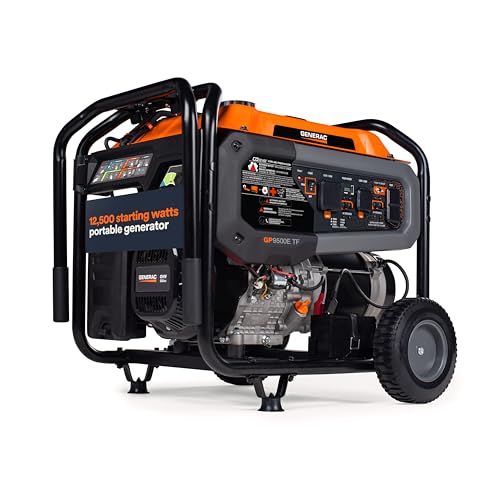
Generac GP9500E Tri-Fuel Portable Generator: 12,500 Starting Watts, Electric Start, Gas/Propane/NG, Quiet, Long Runtime

Generac iQ5200 5200W Dual-Fuel Inverter Generator - Quiet, Portable, CA Compliant
As an Amazon Associate we earn from qualifying purchases. Product prices and availability are accurate as of the date/time indicated.
Related: For a closer look at exact burn rates at different loads, check out our guide to hourly propane consumption.
Frequently Asked Questions
Can I run a Generac on propane and natural gas?
Some Generac standby models are designed to run on either fuel, but only one fuel at a time. Check your owner’s manual or spec sheet to see whether your model supports both. Do not connect two fuel supplies at once. Have a licensed gas fitter handle the hookup.
Does a Generac need a conversion kit for LP?
It depends on the model. Some units ship ready for either fuel and need a fuel-selection change, while others may need a kit or factory-specified parts. Your manual or a Generac dealer can tell you what your model number requires. Have a licensed technician do the work and check gas pressure afterward.
Can a 20 lb cylinder run a Generac portable?
Only if the portable is dual fuel or propane-rated. A 20 lb cylinder holds about 4.7 gallons, so run time is 4.7 divided by your burn rate in gal/hr. At 1 gal/hr that is about 4.7 hours, and lighter loads last longer. Check your manual’s runtime chart for real figures.
Why does my Generac spec sheet list ft³/hr instead of gallons?
Propane is burned as vapor, and spec sheets often report vapor volume. Divide ft³/hr by 36.3 to get gallons of liquid propane per hour. For example, 75 ft³/hr is about 2.07 gal/hr, which matches the roughly 2.06 figure quoted for the 26kW at half load.
{“@context”: “https://schema.org”, “@type”: “FAQPage”, “mainEntity”: [{“@type”: “Question”, “name”: “Can I run a Generac on propane and natural gas?”, “acceptedAnswer”: {“@type”: “Answer”, “text”: “Some Generac standby models are designed to run on either fuel, but only one fuel at a time. Check your owner’s manual or spec sheet to see whether your model supports both. Do not connect two fuel supplies at once. Have a licensed gas fitter handle the hookup.”}}, {“@type”: “Question”, “name”: “Does a Generac need a conversion kit for LP?”, “acceptedAnswer”: {“@type”: “Answer”, “text”: “It depends on the model. Some units ship ready for either fuel and need a fuel-selection change, while others may need a kit or factory-specified parts. Your manual or a Generac dealer can tell you what your model number requires. Have a licensed technician do the work and check gas pressure afterward.”}}, {“@type”: “Question”, “name”: “Can a 20 lb cylinder run a Generac portable?”, “acceptedAnswer”: {“@type”: “Answer”, “text”: “Only if the portable is dual fuel or propane-rated. A 20 lb cylinder holds about 4.7 gallons, so run time is 4.7 divided by your burn rate in gal/hr. At 1 gal/hr that is about 4.7 hours, and lighter loads last longer. Check your manual’s runtime chart for real figures.”}}, {“@type”: “Question”, “name”: “Why does my Generac spec sheet list ft³/hr instead of gallons?”, “acceptedAnswer”: {“@type”: “Answer”, “text”: “Propane is burned as vapor, and spec sheets often report vapor volume. Divide ft³/hr by 36.3 to get gallons of liquid propane per hour. For example, 75 ft³/hr is about 2.07 gal/hr, which matches the roughly 2.06 figure quoted for the 26kW at half load.”}}]}













