

Our editorial team weighed Generac's published specifications and how it stacks up against similar products in the generators category. What stands out: Exceptionally Quiet at Full Load, Reliable Starts, Clean Power, and Fuel-Efficient, Long Runtime. Where it falls short: Rare Minor Fuel Leaks and May Bog Under Heavy Simultaneous Loads. That puts it at 8.2/10 on our WG Score – an excellent, well-rounded option.
 Reviewed bySarah Watts
A Generac standby generator uses roughly 0.7 to 4 gallons of propane per hour, depending on size and load. The only figures used here that come from a spec sheet are for the 26 kW unit: about 2.0–2.2 gal/hr at half load and 3.6–4.0 gal/hr at full load. Smaller-unit numbers in this guide are scaled estimates (est.), so confirm your model’s exact fuel use on its Generac spec sheet.
Generac propane use per hour by generator size
Generac publishes fuel use for each model in its spec sheets at generac.com, and those numbers should win over anything here. The table below is a planning estimate. It starts from the 26 kW figures above and scales them by rated output. Only the 26 kW row reflects published values. I have not listed values for specific models such as the Guardian 22 kW or 24 kW because they should be read directly from the current spec sheet.
| Rated size | 25% load (est. gal/hr) | 50% load (est. gal/hr) | 100% load (est. gal/hr) |
|---|---|---|---|
| 9 kW | 0.4 | 0.7 | 1.3 |
| 11 kW | 0.5 | 0.9 | 1.6 |
| 16 kW | 0.8 | 1.3 | 2.3 |
| 22 kW | 1.1 | 1.8 | 3.2 |
| 26 kW | about 1.3 (est.) | 2.0–2.2 | 3.6–4.0 |
How the estimates are built: I drew a straight line between the 26 kW half-load and full-load midpoints (about 2.1 and 3.8 gal/hr). That line implies roughly 0.4 gal/hr at zero load and about 3.4 gal/hr more as load goes from 0% to 100%. For any size:
gal/hr ≈ (rated kW ÷ 26) × (0.4 + 3.4 × load fraction)
Example for a 22 kW unit at 25% load: (22 ÷ 26) × (0.4 + 3.4 × 0.25) = 0.846 × 1.25 = about 1.1 gal/hr. The 25% column is an extrapolation below the published points, so treat it as the roughest number in the table.
A rough per-kilowatt check: at full load, the 26 kW figures work out to about 0.14–0.15 gal per kW (3.6–4.0 ÷ 26). At half load they work out to about 0.15–0.17 gal per kW of actual draw (2.0–2.2 ÷ 13). At light loads the per-kW number climbs because the engine has fixed overhead. So a flat “0.16 gal per kW” is only a very rough approximation near half load, and the interpolation above is more consistent across loads.
Liquid-cooled and larger commercial-style units can differ from air-cooled home units, and the same model uses different amounts on propane and natural gas. If you are still choosing a unit, see our roundup of the best Generac generators. When you compare models there, check each listing for propane (LP) compatibility and look up its published LP fuel use on the spec sheet. Not every Generac model runs on propane.
Why load changes how much propane a Generac burns
A generator engine burns fuel even when nothing is plugged in. Fuel use rises as load rises, but not in a straight line. Half load does not mean half the fuel of full load, because the engine has a baseline burn just to keep running and keep the alternator producing power.
The 26 kW spec-sheet figures show this. Half-load use (2.0–2.2 gal/hr) is about 55% of full-load use (3.6–4.0 gal/hr), not 50%. Engine speed also varies by design. Many Generac air-cooled units run at 3,600 rpm, while larger liquid-cooled units typically run at 1,800 rpm, so check your model’s spec sheet rather than assuming one baseline.
Half load is the usual planning figure. Most homes in an outage draw roughly 30–50% of the generator’s rating, with the furnace blower, refrigerator, lights, and a few outlets. That is a general estimate, not a published number.
Two things push your number up:
- Big motor loads such as a central air conditioner, well pump, or electric dryer.
- Running at high load for long stretches, such as electric heat or an EV charger.
Oversizing is not free either. A bigger unit generally burns more at light load than a smaller one, so a 26 kW unit powering a 3 kW load will likely use more propane than a 9 kW unit powering the same load.
Estimate your own load and hourly fuel use
Spec-sheet tables assume a percentage of load. You need to know what your house actually draws. Here is a quick way to get there.
- List what you will run: refrigerator, furnace blower, lights, well pump, sump pump, internet gear, a few outlets.
- Find the running watts on each label or manual. Add them up.
- Convert to kilowatts (divide by 1,000).
- Divide by your generator’s rating to get load fraction, then use the interpolation formula above, or read between the 25% and 50% columns of the table.
Worked example (light load, 22 kW unit): refrigerator 700 W, furnace blower 600 W, lights and electronics 500 W, well pump 1,000 W. That totals about 2.8 kW. With some margin, call it 3–4 kW, which is 14–18% of 22 kW. The formula gives (22 ÷ 26) × (0.4 + 3.4 × 0.14) = about 0.7 gal/hr at 3 kW, and about 0.9 gal/hr at 4 kW. So expect roughly 0.7–0.9 gal/hr. That sits just below the table’s 25% figure of 1.1, as it should.
Worked example (40% load, 22 kW): 0.40 × 22 = 8.8 kW. The formula gives 0.846 × (0.4 + 3.4 × 0.40) = about 1.5 gal/hr, or about 36 gallons per 24 hours.
Motors need extra power for a moment at startup, so the generator and transfer switch must handle surges. Our generator transfer switch guide covers how loads are connected and managed.
How long a propane tank runs a Generac
Tanks are filled to no more than 80% of their rated capacity (the standard NFPA 58 limit), so a 250-gallon tank holds about 200 gallons when full, and its gauge reads about 80%. The table shows total propane in a freshly filled tank and ignores any reserve.
| Tank | Approx. propane when filled | Hours at 1.0 gal/hr | Hours at 2.0 gal/hr |
|---|---|---|---|
| 20 lb cylinder | about 3.8 gal | about 4 | about 2 |
| 100 lb cylinder | about 19 gal | about 19 | about 9–10 |
| 250 gal tank | about 200 gal | about 200 | about 100 |
| 500 gal tank | about 400 gal | about 400 | about 200 |
Do not plan to run a tank to empty. Pressure drops as the tank gets low, and your supplier needs time to deliver. A practical rule of thumb (not a Generac or NFPA requirement) is to schedule a refill when the tank gauge reads about 30%. The gauge shows percent of the tank’s rated capacity, not percent of what was filled. So 30% on a 500-gallon tank is about 150 gallons left, and on a 250-gallon tank about 75 gallons.
Example: a 500-gallon tank filled to 400 gallons and refilled at the 30% gauge reading gives about 250 gallons of working fuel (400 − 150). At about 2 gal/hr, that is roughly 125 hours, a little over 5 days. At 1.4 gal/hr, it is about 178 hours, or about 7 days. Running down to empty would stretch this to about 200 hours at 2 gal/hr, but that leaves no margin.
Cold can matter too. Propane must boil into vapor, and cold weather and low tank levels can slow that down. Small cylinders often cannot supply a large standby unit in winter. For standby setups, see our picks for propane home standby generators.
Convert gallons per hour to BTU and cubic feet
Spec sheets often list fuel in cubic feet per hour or BTU per hour, not gallons. Propane holds about 91,500 BTU per gallon, and one gallon of liquid makes roughly 36 cubic feet of vapor.
- BTU/hr ÷ 91,500 = gal/hr
- gal/hr × 36 = approximate ft³/hr of propane vapor
Example: 2.06 gal/hr is about 188,500 BTU/hr, or about 74 ft³/hr of vapor.
Propane vs. natural gas: natural gas holds roughly 1,000 BTU per cubic foot, so one gallon of propane equals about 91 ft³ of natural gas in energy. The same Generac can burn a little more energy on natural gas, and output ratings can differ between fuels. Check the sheet for the exact fuel you use.
Gas line and regulator sizing depends on these BTU numbers. That work belongs to a licensed installer and local code, not a guess from a chart.
Cost per hour and the weekly exercise cycle
Cost is gallons multiplied by your local price per gallon. Prices swing by region and season, so use your last delivery bill. For illustration only, assume $3.00 per gallon.
Cost formula:
- Cost per hour = gal/hr × price per gallon
- Total cost = gal/hr × hours × price per gallon
Using the assumed price:
- 1.0 gal/hr: $3.00 per hour, $72 per day
- 1.4 gal/hr: $4.20 per hour, about $101 per day
- 2.0 gal/hr: $6.00 per hour, $144 per day
Three-day outage example: a 22 kW unit at about 1.4 gal/hr for 72 hours uses roughly 100 gallons. That is about $300 at the assumed price and fits comfortably in a 250-gallon tank.
A seven-day outage at the same load needs about 235 gallons. That is more than the 200 gallons in a freshly filled 250-gallon tank, so plan on a refill or a larger tank. For broader numbers, read how much it costs to run a generator.
Weekly exercise cycle: Generac standby units commonly run a short self-test of roughly 5–12 minutes. Check your manual for the exact length and whether it runs under load. If no-load burn is a few tenths of a gallon per hour (an estimate, not a published figure), each test uses well under a tenth of a gallon. Over a year that likely adds up to only a few gallons, but confirm with your manual.
Ways to cut propane use and stay safe
You can lower hourly burn without going dark.
- Shed big loads. Skip the dryer, electric oven, and air conditioner, or run them one at a time.
- Use a load management module if your system supports one, so large loads cycle instead of stacking.
- Size correctly. A unit far larger than your needs wastes fuel at light loads.
- Keep the unit serviced. Dirty air filters and old oil can raise fuel use and wear.
- Check tank level before storm season and keep it above a safe reserve.
Safety: install standby generators outdoors, with clearances from windows, doors, and vents as set in the manual and local code. Carbon monoxide kills, so never run a generator in a garage or enclosed space, and keep working CO alarms inside the home. Have a licensed professional install gas lines and tanks and leak-test every connection. Never fill a tank beyond 80%.
Our Top Picks
Ready to shop? These are the top-rated options from our hands-on roundup, Best Generac Generators of 2026.

Generac GP3300i 3300W Portable Inverter Generator - Quiet, Lightweight Gas PowerRush Tech for Camping, RV, Home Backup
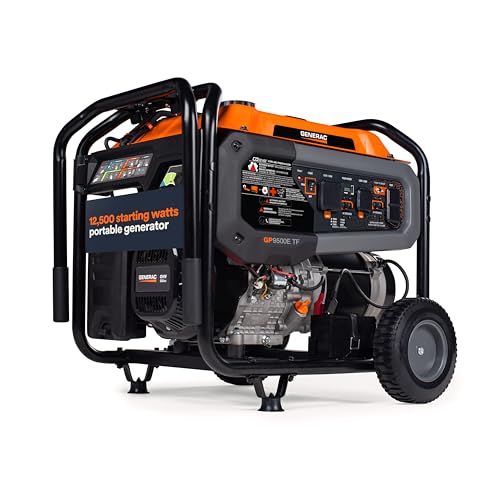
Generac GP9500E Tri-Fuel Portable Generator: 12,500 Starting Watts, Electric Start, Gas/Propane/NG, Quiet, Long Runtime

Generac iQ5200 5200W Dual-Fuel Inverter Generator - Quiet, Portable, CA Compliant
As an Amazon Associate we earn from qualifying purchases. Product prices and availability are accurate as of the date/time indicated.
Related: For a full breakdown of runtime across loads and tank sizes, see our complete Generac propane usage guide.
Frequently Asked Questions
Can a 20 lb grill tank run a Generac standby generator?
Not for long, and often not at all. A 20 lb cylinder holds about 3.8 gallons when filled, which is only a couple of hours at half load on a large unit. Cold weather can also limit how fast small cylinders vaporize propane.
What size propane tank do I need for a week-long outage?
At about 1.4 gal/hr, a week needs roughly 235 gallons, more than the 200 gallons in a freshly filled 250-gallon tank. A 500-gallon tank (about 400 gallons filled) covers it, even if you refill at a 30% gauge reading, which leaves about 250 working gallons. Lighter loads near 1 gal/hr need about 170 gallons, so calculate with your own load.
Does cold weather increase how much propane a Generac uses?
I have no published figure for how much cold changes engine fuel burn, so check your manual. The bigger concern is supply: propane vaporizes more slowly in low temperatures and at low tank levels, which can starve a large unit. Keep the tank well above reserve and sized for winter.
Is propane or natural gas cheaper to run a Generac?
Natural gas is often cheaper per hour where it is available, but the answer depends on local rates. Compare cost per BTU: propane has about 91,500 BTU per gallon, natural gas about 1,000 BTU per cubic foot. A Generac may also burn slightly more energy on natural gas.
{“@context”: “https://schema.org”, “@type”: “FAQPage”, “mainEntity”: [{“@type”: “Question”, “name”: “Can a 20 lb grill tank run a Generac standby generator?”, “acceptedAnswer”: {“@type”: “Answer”, “text”: “Not for long, and often not at all. A 20 lb cylinder holds about 3.8 gallons when filled, which is only a couple of hours at half load on a large unit. Cold weather can also limit how fast small cylinders vaporize propane.”}}, {“@type”: “Question”, “name”: “What size propane tank do I need for a week-long outage?”, “acceptedAnswer”: {“@type”: “Answer”, “text”: “At about 1.4 gal/hr, a week needs roughly 235 gallons, more than the 200 gallons in a freshly filled 250-gallon tank. A 500-gallon tank (about 400 gallons filled) covers it, even if you refill at a 30% gauge reading, which leaves about 250 working gallons. Lighter loads near 1 gal/hr need about 170 gallons, so calculate with your own load.”}}, {“@type”: “Question”, “name”: “Does cold weather increase how much propane a Generac uses?”, “acceptedAnswer”: {“@type”: “Answer”, “text”: “I have no published figure for how much cold changes engine fuel burn, so check your manual. The bigger concern is supply: propane vaporizes more slowly in low temperatures and at low tank levels, which can starve a large unit. Keep the tank well above reserve and sized for winter.”}}, {“@type”: “Question”, “name”: “Is propane or natural gas cheaper to run a Generac?”, “acceptedAnswer”: {“@type”: “Answer”, “text”: “Natural gas is often cheaper per hour where it is available, but the answer depends on local rates. Compare cost per BTU: propane has about 91,500 BTU per gallon, natural gas about 1,000 BTU per cubic foot. A Generac may also burn slightly more energy on natural gas.”}}]}













