

Our editorial team weighed 's published specifications and how it stacks up against similar products in the generators category. What stands out: Exceptionally Quiet, Lightweight & Durable, and Electric Start. Where it falls short: Needs Gasoline Refueling and Occasional Battery Maintenance. That puts it at 8.2/10 on our WG Score – an excellent, well-rounded option.
 Reviewed byEthan
How a simple generator works comes down to one idea: a gas engine spins magnets past copper coils, and that motion pushes electric current through the wires. A regulator keeps the voltage steady, and the outlets deliver about 120 volts of 60 Hz AC power. Here are the steps, the parts, and the safety rules.
How a simple generator works, step by step
A portable generator does not store electricity. It makes power the moment something is plugged in, by converting fuel into motion and motion into current.
- Fuel enters the engine. Gasoline, propane, or diesel (depending on the model) is mixed with air and burned.
- The engine turns a shaft. Small combustion blasts push a piston, which spins a crankshaft.
- The shaft spins the alternator’s rotor. The rotor is a magnet, usually an electromagnet on portable units.
- The magnetic field sweeps past stationary copper coils (the stator). This induces alternating current in the coils.
- The voltage regulator (AVR) adjusts the rotor’s magnetic strength so output stays near 120 V as the load changes.
- Power reaches the outlets through a breaker panel, ready for whatever you plug in.
Picture a horizontal line: engine on the left, alternator bolted to its shaft in the middle, control panel with outlets on the right. Fuel goes in one end, and electricity comes out the other.
How do magnets and coils make 120V, 60 Hz power?
The science is electromagnetic induction, which Michael Faraday demonstrated in 1831. When a conductor like copper wire moves through a magnetic field, a voltage appears in the wire. A generator is essentially an electric motor run in reverse: a motor uses electricity to make motion, and a generator uses motion to make electricity.
Why the output is AC
As a magnet turns, its north pole passes a coil, then its south pole does. Each pass pushes current the opposite way, so the current reverses direction repeatedly. That is alternating current (AC). A simple classroom generator with a split-ring commutator flips the connections to keep the current one-directional (DC), but a portable generator’s alternator has no commutator, so it outputs AC directly.
Where 60 Hz comes from
US household power cycles 60 times per second. The frequency depends on rotor speed and the number of magnetic poles. A two-pole alternator needs about 3,600 rpm for 60 Hz, and a four-pole design needs about 1,800 rpm. Which one your unit uses depends on the model, so check the manual rather than assuming.
The 120 V figure comes from how the coils are wound and how strong the magnetic field is. The regulator controls that field strength, and many larger units can also supply 240 V.
What are the main parts and what does each do?
| Part | Job |
|---|---|
| Engine | Burns fuel and spins the shaft |
| Fuel system | Tank, fuel valve, and carburetor or fuel injection that meter fuel and air |
| Rotor | The spinning magnet (usually an electromagnet) on the shaft |
| Stator | Fixed copper windings where current is induced |
| AVR (voltage regulator) | Adjusts the magnetic field to hold voltage steady |
| Governor | Adjusts the throttle to hold engine speed as load changes |
| Control panel and outlets | Breakers, receptacles, and often an hour meter or oil alert |
| Starter and battery | Recoil pull cord or electric start to turn the engine over |
Some designs use a brush-and-slip-ring system to feed current to the rotor, and others are brushless. Brushless units generally need less upkeep, but it varies by model.
When a generator will not start, the cause is usually the fuel system, not the electrical end. Our generator won’t start troubleshooting checklist walks through it.
Why does engine speed matter, and what does the governor do?
Engine speed sets the AC frequency, so the generator has to hold it nearly constant. Plugging in a heavy appliance puts a drag on the rotor, like pedaling a bicycle uphill. Without correction, the engine would slow, and frequency and voltage would sag.
The governor senses the slowdown and opens the throttle to burn more fuel. When the load drops, it closes the throttle again. That is why a generator revs up when a refrigerator compressor kicks on, and why it burns less fuel at light loads.
Worked example: running vs. starting watts
Motors need a surge to start. These numbers are typical examples, so check the nameplate on your own appliances.
- Refrigerator: about 700 running watts, about 2,200 starting watts
- Lights and a phone charger: about 200 running watts
- Total running load: 700 + 200 = 900 W
- Surge: only the fridge’s extra 1,500 W (2,200 − 700) adds on top at startup, giving about 2,400 W peak
A generator rated for at least 2,400 starting watts handles this, and it should not run near its limit continuously. For a whole-house version of this math, see how to size a generator for your home.
How is an inverter generator different from a conventional one?
A conventional generator ties engine speed directly to the 60 Hz output, so it runs at a fixed speed whenever it is on. An inverter generator makes raw AC, converts it to DC, then electronically rebuilds clean 60 Hz AC. Because the output no longer depends on engine speed, the engine can idle down at light loads.
| Conventional | Inverter | |
|---|---|---|
| Engine speed | Fixed to hold frequency | Varies with load |
| Power quality | Voltage can wobble more | Cleaner, steadier output (check the rated distortion) |
| Noise and fuel use | Louder, uses more fuel at light loads | Quieter, often more efficient at light loads |
| Price per watt | Usually lower | Usually higher |
| Large outputs | Common at 5,000 W and up | Mostly smaller units, though larger ones exist |
Choose conventional if you want the most watts for the money to run tools, well pumps, or a furnace. It loses on noise and on sensitive electronics. Choose inverter if you are powering laptops, TVs, medical-adjacent gear, or camping on a quiet site. It loses on price and top-end output. See our best inverter generators roundup or the best quiet portable generators.
What safety rules apply to every generator?
Engine exhaust contains carbon monoxide (CO), which you cannot see or smell and which kills. Portable generators are linked to roughly 100 deaths a year in the US, mostly from CO, according to consumer-safety reporting that cites CPSC data.
- Run it outside only. Never in a garage, basement, shed, or under a covered porch. Opening a window or garage door does not make it safe.
- Keep it 20 feet from the house (CPSC guidance), exhaust pointed away from doors, windows, and vents. Some manuals say as little as 5 feet; follow the farther distance.
- Install battery-powered CO alarms inside, and consider a model with automatic CO shutoff.
- Never backfeed. Plugging a generator into a wall outlet can electrocute utility workers and damage your home’s wiring. Use a properly installed transfer switch or interlock, and follow local code.
- Ground it per the manual. Some models need a ground rod and some do not, so follow your manual.
- Let it cool before refueling, store fuel in approved containers away from ignition sources, and keep the unit dry.
Use rated cords, sized for the load; our guide to choosing the right extension cord for your generator explains how. For more rules, read the portable generator safety rules.
Can you build a simple generator, and what should you buy?
Yes, as a demonstration. Spinning a magnet inside a coil of wire and connecting an LED shows induction. Bicycle dynamos (a few watts) and hand-crank USB chargers (around 20 W) work the same way. A homemade version will not safely run a refrigerator or house circuits.
For real backup power, match the generator to your loads. If you want fuel-free, quiet power for small devices, a battery-based option may fit better, but it works differently since it stores energy. If your goal is outage coverage for essentials, see the best portable generators for home backup.
Our Top Picks
Ready to shop? These are the top-rated options from our hands-on roundup, Best Power Inverter Generators of 2026.
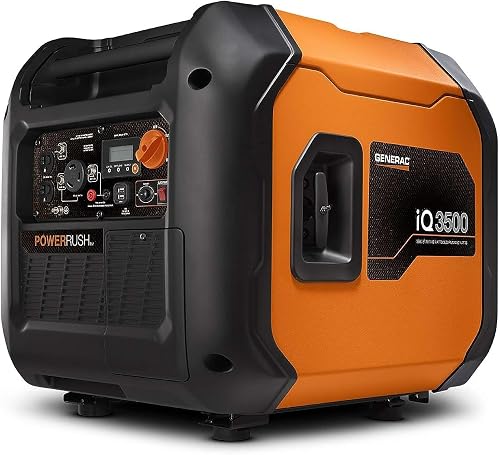
Generac iQ3500 3500W Portable Inverter Generator - Quiet, Lightweight, Electric Start, CARB Compliant for Camping & Jobsites

maXpeedingrods MXR4000GT 4000W Dual Fuel Inverter Generator with Bluetooth App Control
As an Amazon Associate we earn from qualifying purchases. Product prices and availability are accurate as of the date/time indicated.
Frequently Asked Questions
What is the difference between a generator and an alternator?
An alternator specifically produces AC, using a spinning magnetic rotor inside fixed coils. “Generator” can mean the whole machine, including the engine, alternator, regulator, and outlets. Portable generators use an alternator, while DC generators use a commutator.
How does a generator make electricity without a battery?
It makes power on demand through induction. Spinning magnets move past coils, which pushes current through the wires. A battery is only used on some models to run an electric starter. Once running, the engine supplies the energy.
Why does a generator get louder when I plug something in?
The added load slows the engine slightly. The governor senses this and opens the throttle to hold speed and frequency steady. On inverter models, the engine speeds up as needed for the load, so noise changes more gradually.
Do I need a transfer switch to power my house?
If you want to feed house circuits, yes. A transfer switch or interlock, installed to local electrical code (usually by a licensed electrician), isolates the home from the grid. Without one, plug appliances directly into the generator with rated cords instead.
{“@context”: “https://schema.org”, “@type”: “FAQPage”, “mainEntity”: [{“@type”: “Question”, “name”: “What is the difference between a generator and an alternator?”, “acceptedAnswer”: {“@type”: “Answer”, “text”: “An alternator specifically produces AC, using a spinning magnetic rotor inside fixed coils. “Generator” can mean the whole machine, including the engine, alternator, regulator, and outlets. Portable generators use an alternator, while DC generators use a commutator.”}}, {“@type”: “Question”, “name”: “How does a generator make electricity without a battery?”, “acceptedAnswer”: {“@type”: “Answer”, “text”: “It makes power on demand through induction. Spinning magnets move past coils, which pushes current through the wires. A battery is only used on some models to run an electric starter. Once running, the engine supplies the energy.”}}, {“@type”: “Question”, “name”: “Why does a generator get louder when I plug something in?”, “acceptedAnswer”: {“@type”: “Answer”, “text”: “The added load slows the engine slightly. The governor senses this and opens the throttle to hold speed and frequency steady. On inverter models, the engine speeds up as needed for the load, so noise changes more gradually.”}}, {“@type”: “Question”, “name”: “Do I need a transfer switch to power my house?”, “acceptedAnswer”: {“@type”: “Answer”, “text”: “If you want to feed house circuits, yes. A transfer switch or interlock, installed to local electrical code (usually by a licensed electrician), isolates the home from the grid. Without one, plug appliances directly into the generator with rated cords instead.”}}]}













