

Our editorial team weighed PowerSmart's published specifications and how it stacks up against similar products in the generators category. What stands out: Compact, Under 40 lbs, AC & DC Outlets, and EPA Compliant. Where it falls short: Needs Manual Gas-Oil Mixing and 76dB Noise Level. That puts it at 7.7/10 on our WG Score – a solid, dependable choice.
 Reviewed bySarah Watts
Yes, a generator can be too big, but not in a way that harms your devices. Appliances only draw the power they need, so extra capacity is harmless to them. The real costs of a generator being too big are a higher purchase price, wasted fuel at light loads, and wet stacking in diesel engines.
Will a bigger generator damage my electronics or appliances?
No. A generator’s wattage rating is a ceiling, not a push. A 7,500-watt unit feeding a 100-watt lamp supplies 100 watts, the same as a 2,000-watt unit would. Your devices pull only what they need, just as they do from a wall outlet on a utility service that can deliver far more.
Some retailers claim an oversized unit can burn out appliances. That is a weak claim. What actually affects electronics is power quality: stable voltage (about 120 V per leg) and stable frequency (60 Hz). That depends on the generator’s design, not its size.
- Conventional open-frame generators can have more voltage and frequency swing and more waveform distortion. Check the manufacturer’s stated total harmonic distortion (THD) if you will power laptops or other sensitive electronics.
- Inverter generators produce cleaner power, and many list THD at or below about 3%. That is a model-specific spec, so confirm it on the data sheet.
Size has no bearing on either one. If you are worried about sensitive electronics, choose the generator type, not a smaller size.
What are the real downsides of an oversized generator?
Oversizing is not free. Here is what you actually pay for:
- Purchase price. Cost rises with output. A larger unit costs more per unit, and its extras (bigger engine, bigger tank, heavier frame) add to the bill.
- Fuel at light load. An engine sized for 7,000 watts burns more fuel just to idle and spin than a 2,500-watt engine does. Fuel burn does not fall in proportion to load.
- Weight, noise and storage. Larger portables are heavier to move, usually louder, and harder to store. Lifting a heavy unit into a truck or over steps is an injury risk, so plan for a second person or a ramp.
- Standby installation. For permanently installed units, a larger generator can require a bigger gas line, a larger transfer switch and a bigger pad. Those costs vary by installer and local code.
- Maintenance. A bigger engine can take more oil and larger filters and parts, so routine service costs more.
None of this is a reason to undersize. It is a reason to avoid buying far more than your loads justify.
What is wet stacking, and at what load does it matter?
Wet stacking happens when a diesel engine runs at light load for long periods. The cylinders never get hot enough to burn all the fuel, so unburned fuel and soot collect in the exhaust system. You may see black, oily residue at the exhaust. Over time it can foul injectors and reduce performance.
The thresholds depend on the source and the engine:
- Generac says a diesel engine that regularly delivers less than about 30% of its rated output may not reach its best operating temperature.
- NFPA 110, the standard for emergency and standby power systems, calls for periodic exercise at 30% or more of nameplate rating. Confirm the exact wording in the current edition.
- Other technical sources put the risk range higher, anywhere from about 30% up to 50-75% of rated load, depending on engine design.
- Kohler notes that some newer diesel generators can run at 30% or more of rated capacity as little as once a year. Follow your own model’s manual.
Does it affect gasoline, propane and natural gas units? Not in the same way. Spark-ignited engines mainly lose efficiency at light load rather than building up wet-stacking residue. They still waste fuel, and a manual may call for periodic loaded runs, so read yours. Inverter generators are the least affected, because their engine speed rises and falls with demand.
If you own a diesel that runs light, ask a service technician about a load bank test. Don’t improvise.
How much more fuel does a bigger generator burn at light load?
There is no universal number. Fuel use depends on the engine, the load and whether the unit has variable-speed control. Any figure that isn’t tied to a specific model is a guess.
To get a real answer for a unit you are considering:
- Open the owner’s manual or data sheet and find the fuel consumption or runtime chart. Manufacturers usually list runtime per tank, or gallons per hour, at 25%, 50% and full load.
- Compare two candidate models at your expected load, not at their rated output.
- Divide tank size by gallons per hour (or use the stated runtime) to see how long each runs on a full tank at your load.
Conventional fixed-speed generators run the engine at constant speed (typically 3,600 rpm for portables) regardless of load, so the runtime gain at light load is small. Inverter generators with an economy mode can throttle down and often list much longer runtimes at 25% load than at full load. That is why they are the usual answer for people who run small loads for long hours. See our roundup of the best inverter generators for options.
How do I size a generator correctly? A worked example
Use this three-step rule: add up running watts, add the single largest starting surge, then add about 20% margin. Many installers also aim to keep continuous load near 80-85% of the rated running watts, which is the same idea.
- List what you will run at the same time and find each item’s running watts on its label or manual.
- Find the extra starting watts for motor loads (refrigerator, sump pump, furnace blower, well pump). Only the largest single surge matters, because motors rarely all start at the same instant.
- Add 20% to the running total for margin, aging, and future additions.
Here is an illustrative example. The wattages are typical, so use your own labels.
| Item | Running watts | Starting watts |
|---|---|---|
| Refrigerator | 700 | 2,100 |
| Sump pump (1/2 hp) | 800 | 2,400 |
| Furnace blower | 600 | 1,800 |
| Lights, router, chargers | 250 | 250 |
| Total running | 2,350 |
- Largest extra surge: sump pump, 2,400 − 800 = 1,600 W.
- Peak demand: 2,350 + 1,600 = 3,950 W briefly.
- With 20% margin on running load: 2,350 × 1.2 = 2,820 W running.
A unit rated near 3,000-3,500 running watts with at least 4,000 starting watts fits. A 9,000-watt unit would run it, but it would idle at about 26% load and cost much more. For the full method, including whole-home calculations, see our guide on how to size a generator for your home.
Load percentage guide: when oversizing helps and when it hurts
Use this table as a rule of thumb. Exact behavior varies by model, so treat your manual as the final word.
| Load (% of rated running watts) | Gasoline / propane (conventional) | Diesel | Inverter generator |
|---|---|---|---|
| Under 30% | Works, but wastes fuel | Wet-stacking risk if sustained | Efficient in economy mode |
| 30-50% | Fine, moderately inefficient | Acceptable for many; some sources want more | Efficient |
| 50-80% | Good range | Good range | Good range |
| 80-100% | Fine for short periods; keep continuous load near 80-85% | Fine, per rating | Fine; check continuous rating |
| Over 100% | Overload, tripped breaker or shutdown | Overload | Overload protection trips |
A bit bigger is smart when:
- You expect to add loads later (a freezer, window AC, well pump).
- You have large motor loads whose surge is close to the limit of a smaller unit.
- You will run at altitude or in high heat. Output derates with both, by an amount that varies by model.
Go smaller or switch type when you will mostly run a fridge, router and lights. A 2,000-3,000 watt inverter generator suits that job. For short outages and quiet, fumes-free indoor-safe operation, a battery option like those in our best solar generators for home backup avoids the light-load problem completely.
Common mistakes and safety rules when sizing
- Sizing from the nameplate of every appliance in the house. You only need what runs at once. Decide which circuits are essential first.
- Adding every starting surge together. Add only the largest one beyond running watts.
- Ignoring the 20% margin. Running at full rated output continuously stresses the engine and leaves nothing for growth.
- Buying huge "just in case." Pick the margin, not a size class.
Safety rules that apply at any size:
- Never run a generator indoors, in a garage, or near doors, windows or vents. Carbon monoxide is deadly. Install battery-backed CO alarms.
- Never backfeed a house through a wall outlet. Use a properly installed transfer switch or interlock, installed by a licensed electrician under NEC and local code.
- Have a licensed electrician size standby units and transfer switches and pull permits.
- Keep continuous loads within the rated running watts.
Read our portable generator safety rules before your first run. If your sizing lands in the mid-range, compare options in the best portable generators for home backup.
Our Top Picks
Ready to shop? These are the top-rated options from our hands-on roundup, Best Mid Size Generators For Home Backup of 2026.

Honda EU2200iTAN 2200W Super Quiet Portable Inverter Generator with CO-Minder - Ideal for Camping, RV, Home Backup

Westinghouse iGen2800 2800 Peak Watt Super Quiet Lightweight Portable Inverter Generator - Gas Powered, Parallel Ready
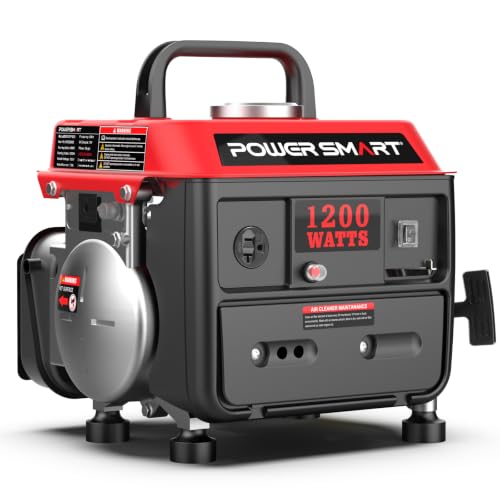
PowerSmart 1200W Portable Gas Generator 900W Rated 2-Stroke 39 lbs for Camping Emergency
As an Amazon Associate we earn from qualifying purchases. Product prices and availability are accurate as of the date/time indicated.
Frequently Asked Questions
Is it better to oversize or undersize a generator?
Slightly oversizing is better. An undersized generator trips its breaker or shuts down under load and can wear out early. A unit 20-25% above your calculated running load is a sound target. Going far beyond that mostly adds cost and fuel waste.
What size whole-house generator do I need for a 2,000 sq ft home?
Square footage alone does not decide it. Needs depend on your central AC, electric heat, well pump and appliances. A licensed electrician should run a load calculation. Many homes choose a unit sized for essential circuits rather than every circuit.
Can I run a small load, like a refrigerator, on a large generator?
Yes, it works and causes no electrical harm. You will burn more fuel per watt delivered than with a smaller unit. A diesel in this situation may wet-stack if the load stays low for long, so match the unit to the job.
Does the 20% margin apply to starting watts too?
Apply the margin to the running total, then confirm the generator’s starting watts cover your running load plus the largest single motor surge. Starting watts are brief peaks, so you don’t need to pad them by a full 20%.
{“@context”: “https://schema.org”, “@type”: “FAQPage”, “mainEntity”: [{“@type”: “Question”, “name”: “Is it better to oversize or undersize a generator?”, “acceptedAnswer”: {“@type”: “Answer”, “text”: “Slightly oversizing is better. An undersized generator trips its breaker or shuts down under load and can wear out early. A unit 20-25% above your calculated running load is a sound target. Going far beyond that mostly adds cost and fuel waste.”}}, {“@type”: “Question”, “name”: “What size whole-house generator do I need for a 2,000 sq ft home?”, “acceptedAnswer”: {“@type”: “Answer”, “text”: “Square footage alone does not decide it. Needs depend on your central AC, electric heat, well pump and appliances. A licensed electrician should run a load calculation. Many homes choose a unit sized for essential circuits rather than every circuit.”}}, {“@type”: “Question”, “name”: “Can I run a small load, like a refrigerator, on a large generator?”, “acceptedAnswer”: {“@type”: “Answer”, “text”: “Yes, it works and causes no electrical harm. You will burn more fuel per watt delivered than with a smaller unit. A diesel in this situation may wet-stack if the load stays low for long, so match the unit to the job.”}}, {“@type”: “Question”, “name”: “Does the 20% margin apply to starting watts too?”, “acceptedAnswer”: {“@type”: “Answer”, “text”: “Apply the margin to the running total, then confirm the generator’s starting watts cover your running load plus the largest single motor surge. Starting watts are brief peaks, so you don’t need to pad them by a full 20%.”}}]}













