Our editorial team weighed DJI's published specifications and how it stacks up against similar products in the generators category. What stands out: Exceptionally Quiet at 23dB, Fast Recharging, High Output, and Durable, Safer LiFePO4 Battery. Where it falls short: Heavy at 28.6 lbs and Solar Panel Sold Separately. That puts it at 8.1/10 on our WG Score – an excellent, well-rounded option.
 Reviewed byTristan
Most campers need 100 to 200 watts of solar panel, and 200 to 300 watts if you run a 12V fridge. The right solar panel size for camping comes from your daily watt-hours, the peak sun hours where you camp, and about 30% for losses. This guide gives the formula, a worked example and a power station compatibility check.
How many watts of solar panel do most campers need?
Most weekend campers land between 100W and 200W. Phones, lights and a small fan fit under 100W. A compressor fridge or laptop pushes you to 200-300W. A week in an RV or a basecamp with several people usually calls for 400W or more. These ranges assume 4-6 peak sun hours and a panel aimed at the sun.
| Trip type | Typical daily use | Panel size | Power station to pair |
|---|---|---|---|
| Weekend tent: phones, lights, fan | 100-200 Wh | 60-100W | 250-500 Wh |
| Car camping with laptop and camera | 250-400 Wh | 100-200W | 500-1,000 Wh |
| Car or van camping with 12V fridge | 500-900 Wh | 200-300W | 700-1,500 Wh |
| Week-long RV or family basecamp | 1,000+ Wh | 400W+ | 1,500+ Wh |
These are planning estimates, not manufacturer specs. Your own devices and weather change them, so run the math below. If you want a ready-made panel and battery kit, see our roundup of the best solar generators for camping.
How do you calculate solar panel size from daily watt-hours?
Use this formula: daily Wh x 1.3 ÷ peak sun hours = panel watts needed. The 1.3 factor covers charge conversion, heat, cable loss and imperfect panel angle all in one. It assumes about 77% of the rating reaches your battery, so don’t add other loss factors on top.
- List every device. Multiply its watts by the hours you use it. A 5W lantern for 4 hours is 20 Wh.
- Add the totals to get daily watt-hours.
- Multiply by 1.3. Use 1.5 if the panel will sit flat, in partial shade, or you won’t reposition it.
- Divide by peak sun hours for your region and season (see the next section).
Worked example: car camping with a fridge
Say a 60W fridge runs about 8 hours a day in compressor time (480 Wh), plus two phone charges and LED lights (60 Wh). That is 540 Wh per day.
- 540 Wh x 1.3 = 702 Wh
- 702 Wh ÷ 5 sun hours = about 140W
- At 3 sun hours (fall, hazy sky): 702 ÷ 3 = about 234W
A 150W panel just covers the sunny case with no margin, so a 200W panel is the safer pick. Fridge draw varies by model and outdoor temperature, so check your fridge’s amp-hour or watt-hour spec.
A light-load example
The minimum practical panel is about 60-100W, even when the math says less. Two phones (30 Wh), lights (20 Wh) and a fan (40 Wh) total 90 Wh. At 4 sun hours the formula gives 90 x 1.3 ÷ 4 = about 30W. Panels that small are rare and slow, so buy 100W. It refills the battery faster in short sun windows and covers a cloudy day.
How many peak sun hours should you assume in the US?
One peak sun hour equals 1,000 watts of sunlight per square meter for one hour. It is not the same as daylight hours. The National Renewable Energy Laboratory (NREL) publishes solar resource data, and its PVWatts calculator gives monthly figures for any US location. The ranges below are approximate for a panel tilted toward the sun.
| Region | Summer | Spring/fall | Winter |
|---|---|---|---|
| Southwest (AZ, NM, inland CA) | 6-8 | 5-6 | 4-5 |
| Mountain West (CO, UT, ID) | 5.5-7 | 4.5-5.5 | 3-4 |
| Southeast and Gulf Coast | 5-6 | 4.5-5 | 3.5-4 |
| Midwest and Northeast | 4.5-5.5 | 3.5-4.5 | 2-3 |
| Pacific Northwest | 5-6 | 3-4 | 1-2 |
Default rule: plan on 4 peak sun hours for summer trips and 3 for spring, fall or mountain trips with long shadows. If you only check one number, check your campsite month in PVWatts.
How much power do camping devices use per day?
These are typical figures. Your device label or manual is the real source, and watts x hours always beats a guess.
| Device | Typical use | Approx. daily Wh |
|---|---|---|
| Smartphone | One full charge | 10-15 per phone |
| LED lantern or string lights | 5W for 4 hours | 20 |
| 12V camp fan | 5-10W for 8 hours | 40-80 |
| Laptop | One full charge | 40-70 |
| 12V compressor fridge | Runs on a cycle, 24 hours | 300-600 (varies by size and heat) |
| CPAP, no humidifier | 8 hours at night | 30-60 |
| CPAP, heated humidifier | 8 hours at night | 100-250 (model dependent) |
Fridges are the biggest swing factor. A fridge in a shaded, ventilated spot cycles less than one in a hot car. For medical gear like a CPAP, size with extra margin and see our guide to solar generators for CPAP camping.
Will the panel work with your power station’s solar input?
Matching wattage is only half the job. Check these four limits in your power station’s manual before buying any panel.
- Max input watts. Many stations cap solar input at 100-500W. A bigger panel won’t hurt if voltage and amps are in range, but the extra watts are wasted.
- Voltage window. Your panel’s open-circuit voltage (Voc) must stay below the station’s maximum input voltage. Voc rises in cold weather, so leave a margin of roughly 10% for freezing mornings.
- Max input amps. Two panels wired in series add voltage. Two wired in parallel add amps. Pick the wiring that keeps both numbers inside the limits.
- Connector type. Common types are MC4, XT60, Anderson and 8mm DC (DC7909). Use the right adapter cable, and confirm polarity before plugging in.
Most power stations have an MPPT controller built in, so you do not need a separate one. A bare 12V battery does need a charge controller. MPPT is more efficient than PWM, especially in cold or partial sun. Add a fuse or breaker and correctly sized wire on any 12V battery setup.
For panels matched to popular stations, see our guide to the best solar panels for portable power stations.
Safety: Keep connectors dry, route cables away from walkways, and don’t charge lithium batteries below freezing unless the manual allows it. Keep batteries out of hot, sealed vehicles.
Is 100W, 200W or 400W realistic, and what slows charging?
Rated watts are lab numbers. Real output is often 50-80% of the rating, depending on sun, angle and heat. A 200W panel commonly delivers 100-160W on a good day.
Charge-time example
A 200W panel at about 65% real output gives roughly 130W. That 65% already covers sun, angle and heat, so the 1.3 factor from the sizing formula is not applied again. The only extra loss here is the station’s own charging efficiency, which this example assumes is about 85% (check your station’s spec). Refilling a 500 Wh station from empty then takes about 500 ÷ (130 x 0.85) = 4-5 hours of strong sun. Under 3 sun hours, expect a second day. A 100W panel takes about twice as long.
- 100W: Good for phones, lights, fans and topping up a small station. It is too slow for a fridge.
- 200W: The best fit for most car campers and fridge users.
- 400W: Realistic only if your station accepts that input and you have room to set up and carry it. Folding panels help with packing.
What slows charging
- Shade. Even a small shadow across one cell can cut output sharply.
- Angle. Face the panel at the sun and re-aim every 1-2 hours. A flat panel loses a lot, especially in fall and winter.
- Heat. Hot panels lose efficiency. Leave airflow behind them.
- Clouds. Heavy overcast can drop output to a small fraction of rating. Thin cloud costs less.
Quick rule and common sizing mistakes
Rough shortcut: for a full refill in one good sun day, panel watts ≈ power station Wh ÷ 3. It assumes about 4 peak sun hours and the formula’s roughly 77% efficiency, which works out to about 3 effective hours of full-rated output. A 500 Wh station wants about 170W, and a 1,000 Wh station wants about 330W. In weaker sun (3 hours, about 2.3 effective), divide by 2.3 instead. If you will use the station daily, use the formula above.
- Counting rated watts as real output. Budget for 50-80%.
- Ignoring the station’s input cap. A 400W panel on a 200W-limited station gives you a 200W setup.
- Skipping losses. Heat, cable loss, angle and charge conversion all cost energy, which is why the formula uses 1.3.
- Parking the panel in camp shade. Run a longer cable and put the panel in the sun, not the truck bed in the trees.
- Assuming summer sun in October. Re-run the numbers for the month you travel.
To compare panel size with actual refill times on specific units, read our portable power station panel size vs refill time guide.
Our Top Picks
Ready to shop? These are the top-rated options from our hands-on roundup, Best Portable Power Stations Solar Panel of 2026.

DJI Power 1000: 1024Wh LiFePO4 Portable Power Station, 2200W Output, 23dB Silent, Solar Generator for Camping & Home Backup

MARBERO 172Wh Solar Generator with 40W Panel - 200W Portable Power Station for Camping, Emergencies, CPAP & Outdoors
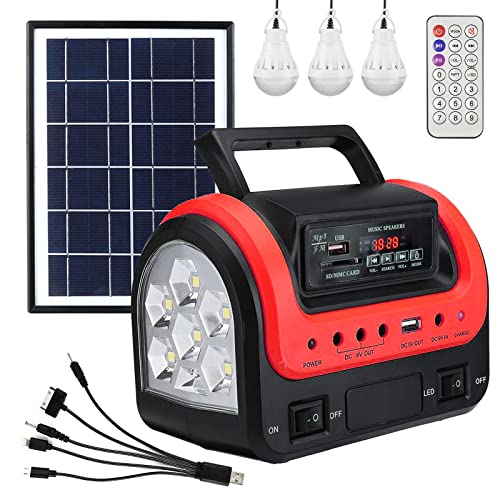
Upusa SDM-0603 Solar Generator Portable Power Station with 10W Panel
As an Amazon Associate we earn from qualifying purchases. Product prices and availability are accurate as of the date/time indicated.
Related reading: The Best Solar Panels for Generators of 2026 · What Size Solar Generator to Run a Well Pump
Frequently Asked Questions
How many solar panels can I connect in series?
As many as keep the combined Voc, plus about 10% for cold mornings, under your station’s maximum input voltage. Voltages add in series while amps stay the same, and total watts must stay within the input cap. Use matching panels, because a mismatched pair performs at the weaker one’s level.
Can I charge a power station from solar and the car at once?
Only some models can. Many accept one input at a time or limit the combined input, so check your manual. Car charging is often slower than expected, and the engine should run so you don’t drain the starter battery.
Do I need a solar panel for a 3-day trip with a 500 Wh station?
It depends on your loads. Phones, lights and a fan use roughly 100-200 Wh a day, so 3 days is 300-600 Wh. That is near or above the station’s usable capacity, so a 100W panel for top-ups is smart. With a fridge using 500+ Wh a day, the station lasts under a day, so plan on a 200-300W panel.
Do solar panels work on cloudy days when camping?
They still produce power, but much less. Plan for extra battery capacity or a larger panel if the forecast is gray.
{“@context”: “https://schema.org”, “@type”: “FAQPage”, “mainEntity”: [{“@type”: “Question”, “name”: “How many solar panels can I connect in series?”, “acceptedAnswer”: {“@type”: “Answer”, “text”: “As many as keep the combined Voc, plus about 10% for cold mornings, under your station’s maximum input voltage. Voltages add in series while amps stay the same, and total watts must stay within the input cap. Use matching panels, because a mismatched pair performs at the weaker one’s level.”}}, {“@type”: “Question”, “name”: “Can I charge a power station from solar and the car at once?”, “acceptedAnswer”: {“@type”: “Answer”, “text”: “Only some models can. Many accept one input at a time or limit the combined input, so check your manual. Car charging is often slower than expected, and the engine should run so you don’t drain the starter battery.”}}, {“@type”: “Question”, “name”: “Do I need a solar panel for a 3-day trip with a 500 Wh station?”, “acceptedAnswer”: {“@type”: “Answer”, “text”: “It depends on your loads. Phones, lights and a fan use roughly 100-200 Wh a day, so 3 days is 300-600 Wh. That is near or above the station’s usable capacity, so a 100W panel for top-ups is smart. With a fridge using 500+ Wh a day, the station lasts under a day, so plan on a 200-300W panel.”}}, {“@type”: “Question”, “name”: “Do solar panels work on cloudy days when camping?”, “acceptedAnswer”: {“@type”: “Answer”, “text”: “They still produce power, but much less. Plan for extra battery capacity or a larger panel if the forecast is gray.”}}]}