

Our editorial team weighed maXpeedingrods's published specifications and how it stacks up against similar products in the generators category. What stands out: Lightweight (~52 lbs), Multiple Outlets, and Includes Parallel Cables & Cover. Where it falls short: No Electric Start and Tank Size Not Specified. That puts it at 7.7/10 on our WG Score – a solid, dependable choice.
 Reviewed byEthan
PowerSmart 3600 generator fuel capacity is 1.6 gallons on the 3,600-running-watt model and 1.3 gallons on the 3,200-running-watt model.
PowerSmart 3600 generator fuel capacity by model
PowerSmart sells more than one generator marketed as 3600W, so the tank size depends on which one you own. Retail listings describe two common versions, and listings for the same name sometimes disagree. Treat the figures below as listing data and confirm them against your owner’s manual or data plate, which is the final word.
| Version | Running watts | Peak or surge watts | Engine | Fuel tank |
|---|---|---|---|---|
| 3,600-running-watt model (DL5040C-type) | 3,600 | 4,400 | 223cc 4-stroke OHV | 1.6 gal |
| 3,200-running-watt model (3,600 surge) | 3,200 | 3,600 | 149cc | 1.3 gal |
The difference is how the 3,600 is used. On the 3,600-running-watt model it is the running rating, which is what the generator can hold continuously. On the smaller unit, 3,600 is only the short-term surge rating, and the generator runs at 3,200 watts. In these listings the larger engine comes with the larger tank, a difference of 0.3 gallons.
Decision rule: read the running watts on the label. If it says 3,600 running, expect a 1.6-gallon tank. If it says 3,200 running with 3,600 surge, expect 1.3 gallons.
How long a PowerSmart 3600 runs on a full tank
Runtime depends on load, so tank size alone does not tell you how long the generator runs. The hours below are manufacturer claims from retail listings, not independent tests, and they assume the listed load. Dividing tank size by hours gives the fuel burn per hour.
| Load | 1.6-gal model: hours | Gallons per hour | 1.3-gal model: hours | Gallons per hour |
|---|---|---|---|---|
| 25% (900 W / 800 W) | 7.5 | 0.21 | 7.8 | 0.17 |
| 50% (1,800 W / 1,600 W) | 5.5 | 0.29 | 4.5 | 0.29 |
| 100% (3,600 W / 3,200 W) | 4.0 | 0.40 | 3.1 | 0.42 |
Read the table by load. A 25% load is 900 W on the 3,600-running-watt model and 800 W on the 3,200-running-watt model. At full load the 1.6-gallon tank lasts about 4 hours and the 1.3-gallon tank about 3.1 hours, so heavy use means refueling every few hours.
At half load both models burn 0.29 gallons per hour, which is why the smaller tank gives fewer hours (4.5 against 5.5). Fuel quality, altitude, temperature and engine age all move the real number, so check your manual for its own runtime figures.
How much gas to store for an outage
A rule of thumb for the 1.6-gallon, 3,600-running-watt model is about 0.29 gallons per hour at half load, plus a 10% reserve. The reserve is added once, at the end.
Worked example, 12 hours at 50% load:
- Load: 1,800 W, which is 50% of 3,600 W.
- Burn rate: 1.6 gal ÷ 5.5 h = 0.29 gal per hour.
- Fuel for 12 hours: 0.29 × 12 = 3.5 gallons.
- Reserve: 3.5 × 0.10 = 0.35 gallons.
- Total to have on hand: 3.5 + 0.35 = about 3.9 gallons.
That is about 2.4 tankfuls, so plan on refueling at least twice during the 12 hours. A single 5-gallon can covers it. The 3,200-running-watt model also burns 0.29 gallons per hour at its 1,600 W half load, so the same math applies to it.
A full day at the same load is 0.29 × 24 = 7.0 gallons, plus the 0.7-gallon reserve, for 7.7 gallons. That takes two 5-gallon cans.
What goes in the tank and how to store it
Both versions run on regular unleaded gasoline. The 223cc and 149cc engines in the listings are 4-stroke, so you do not mix oil into the gas. Oil goes in the crankcase separately. Check the manual for the minimum octane and the ethanol limit for your model.
Keep stored gasoline in approved fuel containers, away from ignition sources such as water heaters and pilot lights. Local fire codes can limit how much you may keep at home, so check yours before stocking up for a long outage. Fuel that sits in a can or tank for months can go stale, so rotate your supply and follow the manual for draining or running the carburetor dry before storing the generator for a season.
For fuel that will sit, add a stabilizer made for small engines and follow its mixing directions. This guide to using fuel stabilizer in a small generator engine explains what to look for on the label and how it is typically mixed. Mix it into the can before you fill the tank so the treated fuel reaches the carburetor.
Confirm your model and avoid number mix-ups
- Find the data plate or label on the frame or near the control panel. It lists the model number, rated running watts and surge watts.
- Search that model number on the manufacturer’s site or the retailer page where you bought it, or open the printed manual. The manual lists the fuel tank capacity and fuel recommendations.
- Compare the running watts on the label to the table at the top. Ignore the biggest number on the box, because that is usually the peak or surge rating.
Most wrong answers come from a few repeat mistakes:
- Assuming 3,600 means running watts without reading the label.
- Using the 4-hour or 7.5-hour figure without checking the load it applies to.
- Borrowing specs from the Generac GP3600, which is a different brand and a separate generator.
- Planning fuel from tank size alone, which leaves you short at high load.
- Leaving untreated gas in the tank over a long off-season.
If the label and the listing disagree, go with the label. For a tank question, the printed manual for your exact model number settles it.
Our Top Picks
Ready to shop? These are the top-rated options from our hands-on roundup, Best Mid-size Gas Generators Camping RV of 2026.

Honda EU2200i 2200W Super Quiet Portable Inverter Generator with CO-Minder & Bluetooth App
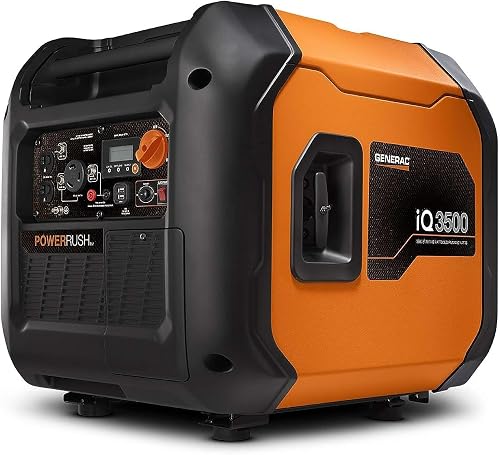
Generac iQ3500 3500W Portable Inverter Generator - Quiet, Lightweight, Electric Start, CARB Compliant for Camping & Jobsites
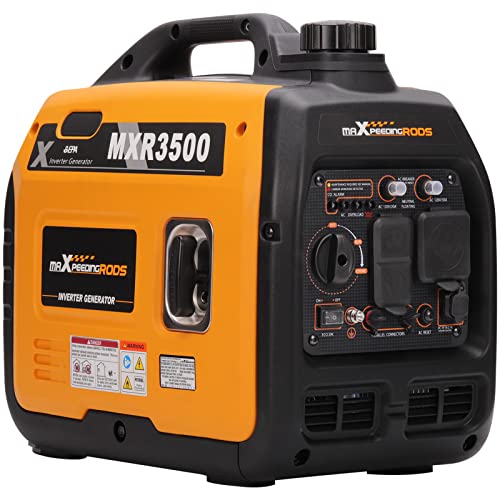
MaXpeedingrods 3500 Watt Portable Inverter Generator Gas Powered EPA Compliant
As an Amazon Associate we earn from qualifying purchases. Product prices and availability are accurate as of the date/time indicated.
Frequently Asked Questions
Can a full tank run a 900 W load overnight?
Not quite on the 1.6-gallon model. At 25% load it runs about 7.5 hours, so an 8-hour night needs a small top-up. Decision rule: if hours needed exceed the table hours for your load, plan a refill.
Is the 1.3-gallon model less efficient than the 1.6-gallon model?
No. Both burn 0.29 gallons per hour at half load. The 1.3-gallon model simply has a smaller tank, so it gets 4.5 hours at half load against 5.5. Decision rule: compare gallons per hour, not total hours.
Is 1.6 gallons too small for a 12-hour outage?
One tank will not cover it. At 1,800 W the generator needs about 3.9 gallons including the reserve, or roughly 2.4 tankfuls. Decision rule: if the outage is longer than one tank’s hours, stock fuel in cans and refuel in stages.
Does a bigger tank mean I can power more?
No. The tank sets how long the generator runs, while the running watts on the label set what it can power. The 3,600-running-watt model has both the larger tank and the higher rating. Decision rule: size the load by running watts, then size the fuel by hours.
Can I use the 3,600 surge number to size my load?
Use it only for short startup spikes. A 3,200-running-watt model should carry a steady load under 3,200 watts. Decision rule: keep your steady load below the running watts on the label.
{“@context”: “https://schema.org”, “@type”: “FAQPage”, “mainEntity”: [{“@type”: “Question”, “name”: “Can a full tank run a 900 W load overnight?”, “acceptedAnswer”: {“@type”: “Answer”, “text”: “Not quite on the 1.6-gallon model. At 25% load it runs about 7.5 hours, so an 8-hour night needs a small top-up. Decision rule: if hours needed exceed the table hours for your load, plan a refill.”}}, {“@type”: “Question”, “name”: “Is the 1.3-gallon model less efficient than the 1.6-gallon model?”, “acceptedAnswer”: {“@type”: “Answer”, “text”: “No. Both burn 0.29 gallons per hour at half load. The 1.3-gallon model simply has a smaller tank, so it gets 4.5 hours at half load against 5.5. Decision rule: compare gallons per hour, not total hours.”}}, {“@type”: “Question”, “name”: “Is 1.6 gallons too small for a 12-hour outage?”, “acceptedAnswer”: {“@type”: “Answer”, “text”: “One tank will not cover it. At 1,800 W the generator needs about 3.9 gallons including the reserve, or roughly 2.4 tankfuls. Decision rule: if the outage is longer than one tank’s hours, stock fuel in cans and refuel in stages.”}}, {“@type”: “Question”, “name”: “Does a bigger tank mean I can power more?”, “acceptedAnswer”: {“@type”: “Answer”, “text”: “No. The tank sets how long the generator runs, while the running watts on the label set what it can power. The 3,600-running-watt model has both the larger tank and the higher rating. Decision rule: size the load by running watts, then size the fuel by hours.”}}, {“@type”: “Question”, “name”: “Can I use the 3,600 surge number to size my load?”, “acceptedAnswer”: {“@type”: “Answer”, “text”: “Use it only for short startup spikes. A 3,200-running-watt model should carry a steady load under 3,200 watts. Decision rule: keep your steady load below the running watts on the label.”}}]}













