

Our editorial team weighed maXpeedingrods's published specifications and how it stacks up against similar products in the generators category. What stands out: App Control for Remote Operation, Dual Fuel Flexibility, and Includes Parallel Cables. Where it falls short: App Needs WiFi/Internet and No THD Spec Provided. That puts it at 7.7/10 on our WG Score – a solid, dependable choice.
 Reviewed bySarah Watts
To pick the right size generator, add the running watts of every item you want powered at the same time, add the extra starting watts of the single biggest motor, then add about 20% headroom. For most homeowners that lands near 2,000 watts for camping and roughly 5,000 to 8,000 watts for essential home backup.
How do you pick the right size generator? Six steps
This worksheet takes about 15 minutes with a pen and your appliance labels.
- List what you must run. Start with the essentials: refrigerator, sump pump, furnace blower, a few lights, router, phone chargers. Decide separately about air conditioning, a well pump or an electric range.
- Find the running watts of each item (see the next section).
- Find the starting watts of anything with a motor: refrigerator, pumps, air conditioners, power tools.
- Add the running watts of everything that could be on at the same time.
- Add only the largest single starting extra. That is the starting watts minus the running watts of the one motor with the biggest gap.
- Multiply by 1.2 and round up to the next size sold.
As a formula: (total running watts + biggest starting extra) × 1.2 = minimum rated running watts.
Check the plug types too. Anything that runs on 240 volts, such as a well pump, central AC or electric dryer, needs a generator with a 240V outlet at the right amperage. For a longer walkthrough aimed at a whole house, see our step-by-step guide to sizing a generator for your home.
How do you find running watts and starting watts?
Running watts are what a device draws continuously. Starting (surge) watts are the brief spike a motor needs for a second or two to get going. Motor loads such as compressors and pumps often need two to three times their running watts to start, according to generator makers’ sizing guides.
Look in this order:
- Nameplate or sticker on the back or inside the door. Many list watts directly.
- Amps and volts. If only amps are shown, watts ≈ volts × amps. A 6-amp, 120-volt device is about 720 watts.
- Owner’s manual or manufacturer spec sheet for starting amps or surge figures.
- A plug-in watt meter measures real running draw for anything that plugs into a standard outlet. It will not help with hardwired equipment.
If you can’t find a starting figure, use 2 to 3 times the running watts for the motor as a rough placeholder, then replace it with the real number. The table shows typical ranges only. Figures vary by source, age, horsepower and model, so your appliance’s own label overrides this table.
| Appliance | Typical running watts | Typical starting watts |
|---|---|---|
| Full-size refrigerator | 300–800 | 1,200–2,200 |
| Sump pump (1/3–1/2 hp) | 800–1,000 | 1,300–2,200 |
| Furnace blower | 400–800 | 800–2,000 |
| Window AC, 10,000 BTU | about 1,200 | about 3,600 |
| Well pump (1/2 hp) | about 1,000 | 2,000–3,000 |
| Central AC (3 ton) | 3,000–4,000 | 6,000–10,000 (less with a soft-start kit) |
| Microwave | 1,000–1,500 | about the same |
| LED bulb | 5–15 each | same |
Worked example: sizing a generator for essential home backup
Say you want to keep the basics running through a winter outage. These numbers are typical values from the table. On your own list, use your labels.
| Item | Running watts | Starting watts | Starting extra |
|---|---|---|---|
| Refrigerator | 700 | 2,200 | 1,500 |
| Sump pump | 800 | 1,300 | 500 |
| Furnace blower | 600 | 1,500 | 900 |
| LED lights (about 10 bulbs) | 100 | 100 | 0 |
| TV, router, chargers | 250 | 250 | 0 |
| Microwave | 1,000 | 1,000 | 0 |
| Totals | 3,450 | 1,500 (largest) |
- Running total: 3,450 W.
- Add the largest starting extra (the refrigerator): 3,450 + 1,500 = 4,950 W.
- Add 20%: 4,950 × 1.2 = 5,940 W.
- Round up: a 6,500 to 7,500 running-watt generator fits.
Now add a 10,000 BTU window AC (1,200 running, 3,600 starting). Running total becomes 4,650 W. The AC’s extra of 2,400 W is now the largest. 4,650 + 2,400 = 7,050 W, and × 1.2 = 8,460 W. One appliance moved you up a size band.
Why 20% headroom? Labels and typical figures are estimates, motors cycle on at random times, and a generator held near 100% load runs hot, burns more fuel and wears faster. Altitude and heat also reduce output (see the mistakes section). Some vendors suggest planning for about 80% load on portable units.
Ways to shrink the number: run the microwave only when the blower is off, and add a soft-start kit to an AC to cut its starting draw. Both can drop you a size.
What generator size fits camping, RV, home backup or a whole house?
| Use | Typical size band | Notes |
|---|---|---|
| Camping, tailgating | 1,000–2,200 W | Lights, phones, fans, small cooler or fridge |
| 30-amp RV | about 3,000–4,000 W if running the AC | A 30-amp RV inlet maxes out at 3,600 W (30 A × 120 V) |
| 50-amp RV | 5,000–8,000 W or more | A 50-amp inlet can carry up to 12,000 W; size to your actual loads |
| Essential home backup | 5,000–8,000 W | Fridge, pump, furnace, lights, a window AC |
| Whole house with central AC | 15,000–22,000 W (typically standby) | Needs an electrician’s load calculation |
Choose camping size if you only charge devices, light a site and run a small fridge. See our best generator sizes for camping.
Choose RV size if you plan to run a rooftop AC. Check the AC’s label and whether it has a soft start, then compare options in our generator sizes for RVs.
Choose essential-home size if your load list stays under about 6,000 running watts. Our best generator sizes for backup home use sorts picks by size.
Choose whole-house size if you need central AC, an electric range or dryer, and a well pump all at once. A portable can cover part of that with careful load management. Otherwise a permanently installed standby unit is the usual route.
So, can a 5,000-watt generator run a house? It can run the essentials in the example above, but not central AC plus everything else.
Should you choose an inverter or conventional generator, and gas, dual-fuel or battery?
- Inverter generator: quieter, more fuel-efficient at low loads, and cleaner power for laptops and electronics. Choose it for camping, RVs and light home loads. Most top out at about 2,000 to 4,500 W. Our guide to what size inverter generator you need covers the details, and the best inverter generators roundup lists models.
- Conventional open-frame: more watts per dollar and the usual choice above 5,000 W. Louder. Choose it for the home backup and job-site loads.
- Dual-fuel: runs on gasoline or propane. Propane output is usually lower than gasoline output, so size from the propane rating in the manual if propane is your main fuel. Browse mid-size dual-fuel generators.
- Battery-based (power station or solar generator): no fumes, so it can be used indoors, but capacity is in watt-hours. Divide usable watt-hours (roughly 85% of the rating) by your load. A 2,000 Wh unit at a 400 W load lasts about 4 hours. Choose it for short outages and quiet, small loads. See mid-size solar generators.
For any type, compare your total to the continuous (rated) output, not the peak number on the box, and check the surge rating against your biggest motor. Manufacturer runtime figures are often quoted at 50% load, so expect shorter runs at higher loads.
What sizing mistakes should you avoid?
- Ignoring startup surge. A generator that covers your running watts can still stall when a fridge or pump kicks on.
- Running at 100% load. Keep continuous load around 80% of the rated running watts.
- Skipping derating. Engines lose power at altitude and in high heat. Many makers cite roughly 3% to 4% per 1,000 feet of elevation, but the exact figure depends on the model, so check the manual.
- Using the wrong appliance numbers. Table values and online charts differ widely. Use your own labels.
- Starting everything at once. Start the biggest motor first, then add loads one at a time.
- Forgetting 240V. A big total is useless if the generator lacks the outlet your pump or AC needs.
- Undersized cords. A thin or long cord overheats and drops voltage. Read about choosing the right extension cord for your generator.
For portable-specific advice, our guide on how to size a portable generator adds more examples.
How do you connect a generator safely?
Sizing is only half the job. Carbon monoxide from generators kills people every year.
- Run it outdoors only, never in a garage, basement or near open windows. Keep it at least 20 feet from the house with the exhaust pointed away from doors, windows and vents.
- Install battery-backed CO alarms inside the home.
- Never backfeed power by plugging the generator into a wall outlet. It can energize utility lines and injure line workers.
- To power house circuits, use a transfer switch or interlock installed by a licensed electrician. NEC Article 702 requires transfer equipment for standby systems, and permits and inspection rules vary by locality.
- Let the engine cool before refueling, store fuel in approved containers away from ignition sources, and keep the unit dry.
Without a transfer switch, run properly rated extension cords from the generator to individual appliances.
Our Top Picks
Ready to shop? These are the top-rated options from our hands-on roundup, Best Dual Fuel Inverter Generators For Home Backup of 2026.

Westinghouse iGen4000DFc 4000 Peak Watt Dual Fuel Inverter Generator - Super Quiet RV Ready Remote Start CO Sensor
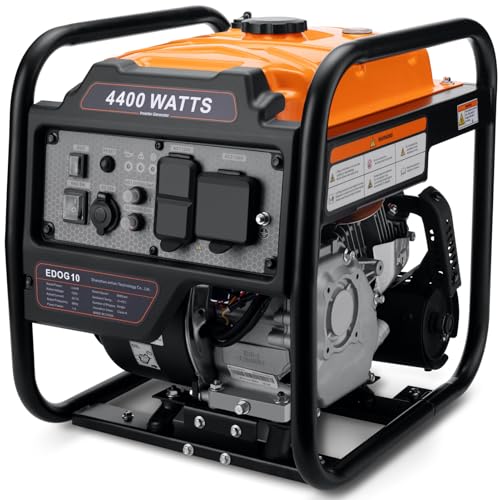
Oxseryn 4400W Portable Inverter Generator, Gas Powered Open Frame, Low Noise ECO Mode, RV Ready Home Backup Power

maXpeedingrods MXR4000GT 4000W Dual Fuel Inverter Generator with Bluetooth App Control
As an Amazon Associate we earn from qualifying purchases. Product prices and availability are accurate as of the date/time indicated.
Frequently Asked Questions
What size generator do I need to run a refrigerator?
A full-size fridge typically needs about 300 to 800 running watts and 1,200 to 2,200 starting watts, depending on the model. A 2,000-watt inverter generator often handles one fridge plus lights, but check your fridge’s label and the generator’s surge rating.
Can a 5,000-watt generator run a whole house?
Not a whole house with central AC. It can run essentials such as a fridge, sump pump, furnace blower, lights and a few electronics if your total, including the biggest motor start and 20% headroom, stays under about 5,000 watts.
Do I need a transfer switch for a portable generator?
If you want to power hardwired house circuits, yes. A transfer switch or interlock, installed by a licensed electrician, prevents dangerous backfeed. If you only plug appliances into the generator with proper cords, you don’t need one.
What size generator can run a central air conditioner?
A 3-ton central AC typically draws 3,000 to 4,000 running watts and can need 6,000 to 10,000 to start, so you often need 7,500 to 10,000 watts or more for the AC alone. A soft-start kit can lower the surge. Check the AC’s nameplate.
{“@context”: “https://schema.org”, “@type”: “FAQPage”, “mainEntity”: [{“@type”: “Question”, “name”: “What size generator do I need to run a refrigerator?”, “acceptedAnswer”: {“@type”: “Answer”, “text”: “A full-size fridge typically needs about 300 to 800 running watts and 1,200 to 2,200 starting watts, depending on the model. A 2,000-watt inverter generator often handles one fridge plus lights, but check your fridge’s label and the generator’s surge rating.”}}, {“@type”: “Question”, “name”: “Can a 5,000-watt generator run a whole house?”, “acceptedAnswer”: {“@type”: “Answer”, “text”: “Not a whole house with central AC. It can run essentials such as a fridge, sump pump, furnace blower, lights and a few electronics if your total, including the biggest motor start and 20% headroom, stays under about 5,000 watts.”}}, {“@type”: “Question”, “name”: “Do I need a transfer switch for a portable generator?”, “acceptedAnswer”: {“@type”: “Answer”, “text”: “If you want to power hardwired house circuits, yes. A transfer switch or interlock, installed by a licensed electrician, prevents dangerous backfeed. If you only plug appliances into the generator with proper cords, you don’t need one.”}}, {“@type”: “Question”, “name”: “What size generator can run a central air conditioner?”, “acceptedAnswer”: {“@type”: “Answer”, “text”: “A 3-ton central AC typically draws 3,000 to 4,000 running watts and can need 6,000 to 10,000 to start, so you often need 7,500 to 10,000 watts or more for the AC alone. A soft-start kit can lower the surge. Check the AC’s nameplate.”}}]}













