
Our editorial team weighed BLUETTI's published specifications and how it stacks up against similar products in the generators category. What stands out: Ultra-Fast AC/Solar Charging, Seamless UPS Functionality, and Versatile Outputs. Where it falls short: Heavy at 35 lbs and ~20W Idle Consumption. That puts it at 8.5/10 on our WG Score – an excellent, well-rounded option.
 Reviewed bySarah Watts
For most campers, the BLUETTI AC180 is the one worth starting with: 1,152Wh of LiFePO4 capacity and a manufacturer-listed 0-80% recharge in 45 minutes on AC power, fast enough to top off between a drive and dinner instead of babysitting a solar panel all afternoon. The five stations below it cover the rest of the range, from a 3.3-lb phone-charging brick to a 2,000W unit built for running kitchen appliances off-grid.
The trouble with shopping by watt-hour number alone is that Wh doesn’t tell you how long a station will actually run your gear, and a headline wattage figure doesn’t tell you what happens when a cooler’s compressor kicks on. We pulled the manufacturer-published capacity, output, and recharge-time specs for six stations that turn up most often in “camping power station” searches, cross-checked them against the aggregated customer feedback each one has accumulated, and worked out what a shared 50W load looks like on each battery.
Pros
- Exceptional reliability proven in extreme military and desert use per customer reviews
- Pure sine wave output handles sensitive electronics like radios and oscilloscopes smoothly
- Multiple recharge options including solar compatibility for off-grid freedom
- Clear battery display and pass-through feature for uninterrupted power
- Lightweight at 13.3 lbs for true portability without sacrificing capacity
Cons
- Limited to 500W continuous output, shuts off if exceeded
- Solar panel sold separately, adding extra cost for full off-grid setup
- Rare reports of units failing after initial use
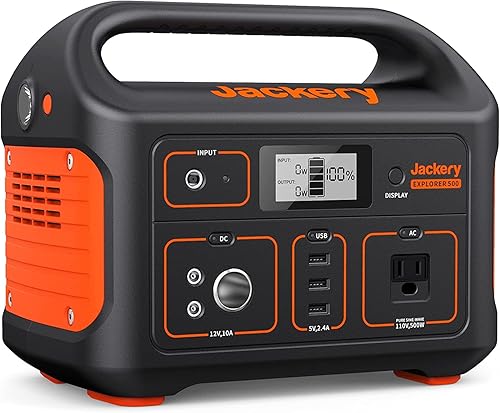
The Jackery Explorer 500 is a versatile portable power station designed for outdoor enthusiasts, campers, road trippers, and anyone needing reliable home backup power. With 518Wh capacity and 500W AC output (1000W peak), it powers devices like fans, lights, coolers, laptops, and small appliances under 500W total, making it perfect for extended off-grid adventures or emergency outages.
Standout features include pass-through charging, allowing simultaneous device powering and recharging via AC wall (7.5 hours full), car port, or optional Jackery SolarSaga 100W panel (9.5 hours). Customers rave about its real-world performance, from lighting sports fields in desert heat to running radios and test equipment during blackouts, with consistent reliability over years of harsh use. Multiple ports (1 AC, 3 USB-A, 2 DC, 1 car) ensure broad compatibility.
Build quality shines with a sturdy plastic frame, solid handle, and quiet fanless operation under light loads, weighing just 13.3 lbs in basketball-like dimensions. The BMS protects individual cells for longevity, and the clear LCD shows exact battery status. It's eco-friendly with no fumes or fuel needs.
Drawbacks include the 500W limit, which auto-shuts for safety on overloads, and solar dependency on separate purchase. One review noted early failure, though most praise durability.
Verdict: A top choice for portable, dependable power that enhances camping, travel, and backup needs without the hassle of gas generators.
Capacity: 518Wh (24Ah, 21.6V)
Outputs: 1x 110V/500W AC (1000W peak), 3x USB-A 5V/2.4A, 1x Car 12V/10A, 2x DC 12V/7A
Inputs: AC adapter (7.5 hrs full), Car (7.5 hrs), Solar 12-30V/100W max (9.5 hrs with 100W panel)
Weight & Size: 13.3 lbs, 11.8 x 7.6 x 9.2 inches
Other: Lithium-ion battery, 14-104°F operating temp, 2-year warranty
Ideal for camping, RV trips, or home emergencies if your devices total under 500W. Calculate runtime: 500Wh x 0.85 / device watts (e.g., 60W fan ~7 hours). Pair with SolarSaga 100W for off-grid recharging. Avoid if needing over 500W continuous or massive capacity like whole-home fridges.
Compares favorably to Explorer 240 (smaller) or 1000 (larger/heavier). Great for military, sports parents, or preppers per reviews.

Pros
- Exceptional fast charging and high surge power for demanding appliances like microwaves and fridges
- Durable build powers RVs and campers for days, as praised in real-world reviews
- Intuitive app control for monitoring and customization enhances user experience
- Seamless UPS functionality keeps essentials running during outages
- Compatible with Anker solar panels for sustainable recharging
Cons
- Cannot charge simultaneously from AC and DC inputs, with AC taking priority
- Weighs 28 pounds, making it somewhat heavy for frequent solo carrying
- Solar charging efficiency depends on conditions and panels, slower than AC
The Anker SOLIX C1000 is a versatile 1056Wh portable power station designed for campers, RV enthusiasts, and homeowners seeking reliable backup power. With 1800W continuous output and SurgePad technology surging to 2400W, it powers demanding appliances like microwaves, fridges, and tools through 11 ports, making it ideal for off-grid trips, tailgating, or outages.
Standout features include UltraFast recharging to 80% in 43 minutes and full in 58 minutes via AC, plus 600W solar compatibility for 1.8-hour solar full charges. Users report running truck campers for 24+ hours, powering Nespresso machines and TVs during camping, and keeping fridges cold for days. The LiFePO4 battery endures 3000 cycles, and the app provides real-time stats, UPS under 20ms, and custom controls.
Build quality shines with a compact, rugged design 15% smaller than competitors, dual handles for portability despite 28 pounds, and a bright LED light. Reviewers highlight its reliability in real scenarios, from glamping to home backups, outperforming older systems in charge speed and output.
Drawbacks include no simultaneous AC/DC charging and weight that may challenge lighter users. Solar performance varies with panels and weather, often slower than advertised without optimal setup.
Overall, the C1000 excels as a powerhouse for portable needs, earning high praise for performance and longevity. Buy it if you need fast, robust power without gas hassles.
Capacity: 1056Wh LiFePO4 battery
Output: 1800W continuous, 2400W SurgePad peak
Ports: 11 total (AC, USB, DC, car outlet)
Recharge: 58 min full AC, 1.8 hrs 600W solar
Dimensions: 14.8 x 8.07 x 10.5 inches, 28.44 lbs
Other: App control (Bluetooth/Wi-Fi), UPS <20ms, 5-year warranty
Pair with Anker PS100/200/400 solar panels (11-60V, XT60 connector) for best solar results. Use SurgePad for heat-heavy devices, not precision tools. Estimate runtime: 1056Wh x 0.9 efficiency / device watts. Ideal for RVs under quiet hours, camping fridges, or home essentials; expand with BP1000 for more capacity.

Pros
- Ultra-fast AC and solar charging keeps you powered without downtime
- Seamless UPS functionality prevents disruptions during outages
- Versatile outputs handle camping gear, home essentials, and appliances
- Expandable design supports longer runtimes with add-on batteries
- Sturdy, portable build with clear display for easy monitoring
Cons
- Weighs 35 lbs, making it less ideal for solo backpacking
- Inverter idle consumption around 20W reduces efficiency on very light loads
- Runtime limited for high-draw devices without battery expansion
The BLUETTI AC180 is a robust portable power station with 1152Wh LiFePO4 battery capacity, delivering 1800W continuous power and up to 2700W surge through multiple AC, USB, and DC outlets. It suits campers seeking off-grid convenience, homeowners needing outage protection for routers and lights, and off-grid enthusiasts wanting solar compatibility.
Standout features include turbo-fast charging to 80% in 45 minutes via 1440W AC input or 2.8-3.3 hours with 500W solar panels, plus reliable 20ms UPS switchover praised in reviews for seamless operation during blackouts. Users report powering TVs, fridges, and internet for hours, with app control boosting output and monitoring runtime effectively. Expansion with B80 or B300 batteries extends usability for prolonged needs.
Build quality shines with a compact 13.4 x 9.7 x 12.5-inch frame weighing 35 lbs, featuring durable handles and a clear display. It's quiet, portable for camping or vehicle use, and handles real-world tests like storm backups or RV trips without issues, as noted by verified buyers.
Drawbacks include noticeable inverter self-consumption on low loads, which can halve effective capacity for small devices, and its weight may challenge lighter carriers. Proper cabling is needed for optimal efficiency.
Overall, the AC180 excels as a versatile, fast-charging powerhouse for emergency and outdoor power, earning strong praise for reliability and value. It's a smart pick for anyone prioritizing quick recharges and expandable energy.
Capacity: 1152Wh LiFePO4 (3500+ cycles)
Output: 1800W continuous (2700W peak), 11 outlets including 4x AC
Charging: 1440W AC (0-80% in 45 min), 500W solar (2.8-3.3 hrs)
Inputs: AC, solar (12-60V), car
UPS: 20ms switchover
Dimensions: 13.4 x 9.7 x 12.5 in, 35.3 lbs
Extras: App control, expandable, 5-year warranty

Pros
- Ultra-fast charging and accurate real-time display for easy monitoring
- Versatile outputs power everything from tools to fridges without issues
- Durable build handles professional and outdoor demands reliably
- Quiet operation compared to gas generators, safe for indoor use
- Expandable design future-proofs for larger needs
Cons
- Weighs 27.8 pounds, requiring some effort to transport
- Fans get loud during fast charging sessions
- Input port door can be stiff to open
The OUPES Mega 1 is a versatile portable power station designed for home backup, camping, road trips, and professional applications like events or mobile work setups. With a 1024Wh LiFePO4 battery, 2000W continuous output, and 4500W surge capacity, it powers demanding appliances, tools, and electronics reliably off-grid or during outages.
Standout features include revolutionary 36-minute charging to 80% via AC, expandable capacity up to 5kWh, and professional <20ms UPS for seamless failover. Users praise its real-world performance: running DJ setups for hours, keeping fridges and lights going through blackouts, and supporting solar recharging for extended adventures. The informative display and app control provide precise power tracking, while multiple ports (AC, USB-C PD 100W, USB-A, DC) ensure broad compatibility.
Build quality feels premium and durable, with a compact 15.1 x 9.1 x 11.6-inch footprint and sturdy handles for portability despite the weight. The LiFePO4 cells offer superior safety, longevity, and thermal stability over standard lithium batteries.
Drawbacks include the 27.8-pound heft, which may challenge lighter users, and louder fans on fast charge. A few note the port door's stiffness.
Overall, the Mega 1 delivers exceptional value for reliable, high-power portable energy. Ideal for anyone needing fast, expandable backup without gas hassles; pair with solar for ultimate off-grid freedom.
Capacity: 1024Wh LiFePO4 battery, expandable to 5kWh
Output: 2000W continuous (4500W surge), 120V AC pure sine wave
Charging: 0-80% in 36 mins AC, supports 800W solar, app control
Ports: 4 AC, 2 USB-C PD 100W, 4 USB-A QC3.0, 12V DC, car port
Dimensions: 15.1"L x 9.1"W x 11.6"H, 27.8 lbs
Warranty: 5 years
Users rave about its power for DJ gear, fridges, and tools during camping and outages, with one noting over 5 hours on full setups. Fast charging and accurate displays stand out, as does silent operation indoors.
Professionals love the surge handling for lights, cameras, and laptops on shoots. Expandability excites many for future upgrades.
Minor notes: Great for truck camping but heavy for frequent carries; fans audible on turbo charge.

Pros
- Exceptional 1-hour fast charging via AC
- Durable LiFePO4 battery with 10-year lifespan
- Lightweight and easy to carry anywhere
- Versatile ports including 2x 300W AC outlets
- Strong app integration for monitoring
Cons
- Fan noise audible during fast charging
- Single USB-C port limits simultaneous charging
- Best for low-to-medium power devices, not heavy appliances long-term
The EcoFlow RIVER 2 is a versatile portable power station designed for campers, RV travelers, outdoor enthusiasts, and home emergency backup. With 256Wh capacity and LiFePO4 battery chemistry, it powers essentials like phones, cameras, drones, laptops, fans, and mini fridges, offering runtimes from hours to days depending on device wattage.
Standout features include X-Stream 1-hour AC recharge, up to 600W output with X-Boost for handling surges, and fast solar input for off-grid use. Users praise its real-world performance, such as recharging e-bikes in sheds, sustaining camping gadgets for a week, or acting as UPS for routers during outages, with seamless 30ms switching. The app provides detailed monitoring, enhancing usability.
Build quality shines with a lightweight 7.7 lbs design, sturdy handle, and advanced BMS for safety. Reviewers highlight its compact size, quiet operation under load, and premium feel, making it ideal for sheds, trips, or teleworking.
Drawbacks include fan noise during rapid charging and a single USB-C port, which may require prioritization. It suits low-to-medium loads best, not prolonged high-wattage use.
Overall, the RIVER 2 delivers exceptional value for portable, reliable power, earning high marks for speed, longevity, and convenience. Perfect for anyone seeking a gateway to sustainable off-grid living.
Capacity: 256Wh LiFePO4 battery
Output: Up to 600W AC (2 outlets), multiple USB ports including USB-C
Recharge: 1 hour AC, 2.3 hours solar (110W input), car/USB-C options
Weight/Dimensions: 7.7 lbs (3.5 kg), 9.6 x 8.4 x 5.5 inches
Other: App control, UPS mode (30ms switch), 5-year warranty
Pros
- Versatile outputs support a wide range of devices from phones to small appliances
- Multiple recharging options including efficient solar for true portability
- Compact, lightweight design ideal for travel and outdoor activities
- High solar efficiency and smart safeguards enhance reliability
- Complete kit with all adapters and manual included
Cons
- 148Wh capacity limits runtime for high-power devices like larger appliances
- 40W solar panel recharges slowly in low light or cloudy conditions
- Entry-level 200W output not suited for heavy-duty continuous use
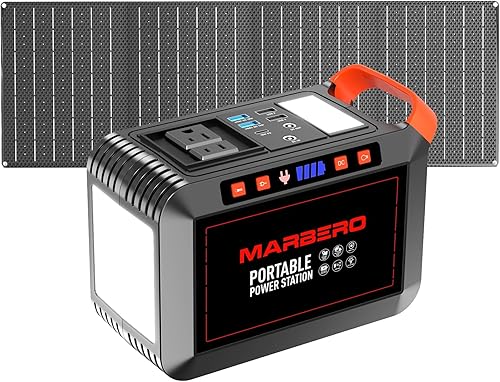
The MARBERO 148Wh Solar Generator kit pairs the M822 portable power station with a 40W foldable solar panel, ideal for campers, hikers, fishers, and anyone needing backup power during outages or off-grid trips. This electric generator provides 200W continuous output (270W peak) through diverse ports, keeping essentials like phones, laptops, cameras, and lights running without fuel hassles.
Standout features include multiple outputs: two AC sockets, QC3.0 USB-A, USB-C PD (18W), standard USB-A, and DC port, powering various devices efficiently. The solar panel's 21.5-23.5% conversion rate and smart chip deliver optimal charging speeds while preventing overcharge or overload. Real-world performance shines for light to moderate loads, with solar recharging viable in sunlight and wall/car options for quick top-ups in 7-8 hours.
Design prioritizes portability with the 3.3lb station (7.6x3.6x5.4 inches) and 2.3lb panel (folds to 8x10x1 inches), made from durable ABS plastic. Safety features like short circuit and over-voltage protection add peace of mind, and the complete kit includes all necessary cables and adapters.
Drawbacks include the modest 148Wh capacity, which suits short trips but not extended heavy use, and solar-only recharging that depends on good weather. The 200W limit also means it's best for smaller gadgets rather than power-hungry tools.
Overall, this MARBERO kit earns high marks for portability and value in outdoor and emergency scenarios, making it a smart pick for adventurers seeking lightweight, solar-ready power.
Capacity: 148Wh | Output: 200W (270W peak) | Weight: Power station 3.3lbs, Solar panel 2.3lbs
Ports: 2x AC, 2x USB-A QC3.0, 2x USB-A, 1x USB-C PD, 1x DC | Recharge: AC (7-8hrs), Solar, Car
Solar Efficiency: 21.5-23.5% | Battery: Lithium Ion | Warranty: 12 months
1x MARBERO M822 Portable Power Station, 1x 40W Folding Solar Panel, 1x Power Adapter, 1x Cigarette Lighter Adapter, 1x User Manual.
Turning Watt-Hours Into Runtime You Can Plan Around
Capacity on the spec sheet (Wh) isn’t the same as usable capacity. Inverter conversion and battery-management overhead eat into it, which is why EcoFlow’s own published runtime formula for the RIVER 2 is Wh × 0.85 ÷ load watts rather than a straight division. Applying that same 85% usable-capacity factor across all six stations here (it’s a reasonable approximation for any LiFePO4 or lithium-ion inverter design, not just EcoFlow’s) gives a consistent way to compare them against a real 50W load, roughly what a camp cooler, CPAP machine, or string of LED lights plus a laptop charger draws continuously.
| Station | Listed Capacity | Est. Runtime at a 50W Load* |
|---|---|---|
| BLUETTI AC180 | 1,152Wh | ~19.6 hours |
| Anker SOLIX C1000 | 1,056Wh | ~18.0 hours |
| OUPES Mega 1 | 1,024Wh | ~17.4 hours |
| Jackery Explorer 500 | 518Wh | ~8.8 hours |
| EcoFlow RIVER 2 | 256Wh | ~4.3 hours |
| MARBERO 148Wh | 148Wh | ~2.5 hours |
*Estimated using each station’s own listed capacity multiplied by an 85% usable-power factor (the same conversion EcoFlow documents for the RIVER 2), divided by a 50W continuous load. Real-world runtime shifts with temperature, inverter efficiency, and how spiky the load is, but the multiplier holds roughly steady across LiFePO4 and lithium-ion stations alike, so it’s a fair way to line these six up against each other.
Final Picks
The All-Rounder for Multi-Day Trips: BLUETTI AC180
1,152Wh at 1,800W continuous output (2,700W with the app-triggered power boost), spread across 8 outlets and ports on one unit. The listed 0-80% recharge in 45 minutes on AC means it can realistically catch a full charge between a drive to the next site and dinner, not just overnight at a cabin outlet. Its 500W solar input ceiling also gives it the fastest documented solar-only recharge window (2.8-3.3 hours) of any station on this list.
Skip this if: you’re hiking in rather than driving in. At 37.4 lbs, this is a car-camping or RV unit, not something that belongs in a backpack.
View on Amazon.comBest for Linking Two Units Later: Anker SOLIX C1000
1,056Wh at 1,800W continuous (2,400W peak), and the only station on this list rated parallel-capable, so a second unit can be linked to double capacity instead of buying one larger battery outright. Full AC charge is listed at 58 minutes, and the 11-port layout matches BLUETTI’s for sheer device count.
Skip this if: recharge speed is your deciding factor over expandability. BLUETTI’s 45-minute figure beats Anker’s 58 minutes at a nearly identical capacity tier.
View on Amazon.comBest for High-Draw Appliances: OUPES Mega 1
2,000W continuous (4,500W surge) is the highest output of the six, with a documented sub-20ms UPS transfer time and modular expansion up to 5,120Wh by adding external battery packs. That surge headroom matters for compressor-driven gear (mini fridges, induction burners) that trips lower-wattage stations the instant the motor starts.
Skip this if: your gear tops out under 500W. At 27.8 lbs and built around that higher output ceiling, the Mega 1’s headroom is wasted on a phone-and-lantern trip; the EcoFlow RIVER 2 below fits that use case better.
View on Amazon.comThe Established Name: Jackery Explorer 500
518Wh at 500W continuous (1,000W peak) is modest next to the LiFePO4 units above, and its lithium-ion cells are rated for roughly 500-800 cycles versus 3,000+ on this list’s newer stations. What it does have is a documented pass-through charging design and battery-management system built specifically to handle being charged and drained at the same time, useful for anyone running it plugged in as a UPS-style backup rather than cycling it fully each trip.
Skip this if: long-term cycle life matters more than upfront familiarity. Its lithium-ion chemistry wears out in roughly a sixth of the charge cycles a LiFePO4 station like the AC180 or SOLIX C1000 is rated for.
View on Amazon.comBest for Minimalist and Backpacking Loads: EcoFlow RIVER 2
At 7.72 lbs, this is the lightest station on the list by a wide margin, and its own runtime math (256Wh × 0.85 ÷ load watts) puts a full charge at roughly 4.3 hours against a 50W load, enough for a phone, headlamp, and a camera battery cycle without carrying 20+ lbs of dead weight. AC recharge is listed at 1 hour.
Skip this if: you need to run anything with a compressor or motor. 600W continuous (1,200W peak) is the lowest ceiling here, and it will shut off under a real fridge or cooler load.
View on Amazon.comOnly for Phone-and-Light Duty: MARBERO 148Wh
At 148Wh and a 200W (270W peak) output, this is genuinely a different category of product from the rest of this list despite showing up in the same searches. It ships bundled with a 40W folding solar panel and is built for keeping small electronics topped off, not for powering anything with a motor or compressor. Its 1.7-running-amp rating is the lowest of the six, and its listed cycle life (300-500 cycles) is also the shortest.
Skip this if: you’re picturing this next to a cooler or CPAP machine. At 200W continuous, it won’t run either. It’s a phone-and-headlamp battery with a solar panel attached, not a home-backup or RV unit.
View on Amazon.comWhat Else the Spec Sheets Show
Charging Speed Isn’t Just About Solar
Documented AC recharge times vary more than you’d expect for stations in a similar capacity range: OUPES lists 36 minutes to 80%, BLUETTI lists 45 minutes to 80%, Anker lists 58 minutes to full, and EcoFlow’s smaller RIVER 2 lists a flat 1 hour. Jackery and MARBERO, both older lithium-ion designs, land in the 4-5 hour range. If you’re relying on a single overnight campsite outlet rather than a full day of sun, that gap decides whether the station is topped off by morning or still climbing.
Battery Chemistry Sets the Long-Term Cost
The four LiFePO4 stations here (BLUETTI, Anker, EcoFlow, OUPES) are all rated in the 3,000-6,000 cycle range, which manufacturers translate to roughly a 10-year lifespan under normal use. The two lithium-ion stations (Jackery at 500-800 cycles, MARBERO at 300-500 cycles) will need replacing several times over in that same window. That difference matters more if you camp often; for a couple of trips a year, cycle count is unlikely to be the deciding factor either way.
Port Count Isn’t Fixed to Wattage
More output doesn’t automatically mean more places to plug things in. BLUETTI and Anker both list 11 outlets/ports at the 1,800W tier, Jackery lists 7 at 500W, EcoFlow lists 6 at 600W, and OUPES, despite the highest wattage on this list, lists only 4. If you’re planning to run several devices at once rather than one high-draw appliance, check port count separately from the headline wattage number.
How We Compared These
Every figure above comes from each manufacturer’s own published specifications (capacity, continuous and peak output, recharge time, weight, port count, and rated cycle life), cross-checked against the aggregated customer feedback each product has accumulated on Amazon. We have not physically tested these units ourselves; this comparison is built from documented specs and aggregated buyer feedback checked against each other for consistency, not hands-on lab testing.
Frequently Asked Questions
How many watt-hours do I actually need for camping?
For phones, a headlamp, and light device charging, 150-300Wh is usually enough for a weekend. Add a camp cooler, CPAP machine, or fan and you’re looking at 500-1,000+Wh depending on trip length, since those devices draw continuously rather than in short bursts. Use the 85% usable-capacity math above against your specific device’s wattage to get a realistic runtime estimate before buying.
What’s the real difference between LiFePO4 and lithium-ion stations?
Cycle life, mainly. LiFePO4 (lithium iron phosphate) stations on this list are rated 3,000-6,000 charge cycles; standard lithium-ion units are rated 300-800. Both chemistries deliver similar day-to-day performance, but LiFePO4 stations last years longer under frequent use.
Do I need a station rated above 1,000W for camping?
Only if you’re running something with a compressor or heating element, like a mini fridge, induction burner, or space heater. Phone charging, lights, and laptops draw well under 200W combined, which is why a station like the EcoFlow RIVER 2 (600W continuous) or even the MARBERO 148Wh (200W) is enough for minimalist trips.