Our editorial team weighed Westinghouse Outdoor Power Equipment's published specifications and how it stacks up against similar products in the generators category. What stands out: Ultra-Quiet at 52dBA, 18-Hour Runtime, and Clean Power for Electronics. Where it falls short: Minor Oil/Fuel Odor on Arrival and Propane Tank/Hose Sold Separately. That puts it at 8.7/10 on our WG Score – an excellent, well-rounded option.
 Reviewed bySarah Watts
Small generator petrol use is about 0.2 gallons (0.76 L) per hour at 50% load, based on a sample 2,000W inverter unit.
Petrol use by load level
This table uses one sample 2,000W unit from a published consumption chart. Every row is for that same unit, in US gallons per hour with the liter equivalent.
| Load | Watts drawn | Gallons per hour | Liters per hour |
|---|---|---|---|
| 25% | 500W | 0.10 | 0.38 |
| 50% | 1,000W | 0.20 | 0.76 |
| 75% | 1,500W | 0.30 | 1.14 |
| 100% | 2,000W | 0.40 | 1.51 |
These are sample figures, not a rule for every machine. Engine size, design and tank vary by model, so the manufacturer spec sheet or manual governs for yours.
Why inverter generators save petrol at low load
An inverter generator adjusts engine speed to match the power being drawn. A conventional portable runs at a fixed speed, so it burns closer to the same petrol whether it powers one lamp or a full load.
That makes the saving largest at light load, such as the 25% and 50% rows above. At full load the gap narrows, because both types are working at their limit.
How to check this on your own unit:
- Fill the tank to a marked level and note the time you start.
- Run only the items you actually need, such as a fridge and a few lights, for a set period like two hours.
- Stop the engine, let it cool, then refill to the same mark using a measuring jug and record how much you added.
- Divide the amount added by the hours run to get your real hourly burn.
Repeat with a heavier load to see the difference. Switching off items you do not need, and using the generator’s eco mode if it has one, helps keep the engine at low speed.
How to calculate runtime, cost and liters
Use these three formulas, with the 0.2 gal/h figure from the table as the example rate.
- Runtime (hours) = tank size in gallons ÷ gallons per hour. In this example, a 1-gallon tank ÷ 0.2 = 5 hours, and a 0.5-gallon tank ÷ 0.2 = 2.5 hours.
- Cost per hour = gallons per hour × price per gallon. In this example, using a placeholder price of $4.00 per gallon, 0.2 × $4.00 = $0.80 per hour, or $6.40 for 8 hours. Swap in your local price.
- Gallons to liters: multiply by 3.785 (1 US gallon = 3.785 L). In this example, 0.2 gal × 3.785 = 0.76 L per hour. To go the other way, divide liters by 3.785.
Tank capacity is printed on the spec sheet, and the rated runtime there is usually quoted at a stated load, often 25% or 50%.
What makes a small generator use more petrol
Real burn rates drift away from spec-sheet numbers for these reasons:
- Higher load: the table shows burn rising with every step up in watts.
- Cold weather: a cold engine runs richer and burns more until it warms up.
- Altitude: thinner air changes the fuel-air mix, and carbureted engines can run rich unless adjusted.
- Poor maintenance: a dirty air filter or worn spark plug wastes fuel.
- Ethanol petrol: it carries less energy per gallon than pure petrol, so expect slightly shorter runtime. Use only the ethanol blend the manual allows.
How much petrol to store for an outage
Multiply your hourly burn by the hours you plan to run. In this example, 3 days at 8 hours a day is 24 hours, and 24 × 0.2 gal/h = 4.8 gallons (about 18.2 L) at 50% load.
- Store petrol only in approved fuel containers, away from ignition sources and living space.
- Local fire codes can cap how much you may keep, so check yours.
- Stop the engine and let it cool before refueling, and do it outdoors.
Planning steps:
- List the appliances you will power and estimate how many hours each day they must run.
- Use your own measured hourly burn if you have one, since the figure above is only an example.
- Add a safety margin, for example an extra container’s worth, in case the outage runs longer than expected.
- Count how many approved containers you need, and label each with the purchase date.
Petrol ages in storage, so rotate your stock by using older fuel in your car and refilling containers with fresh petrol. A fuel stabilizer can help if you must keep it for months.
Our Top Picks
Ready to shop? These are the top-rated options from our related roundup, Best Small Generators Inverter of 2026.

Westinghouse iGen5000DF 5000 Peak Watt Dual Fuel Inverter Generator - Super Quiet RV Ready Remote Start
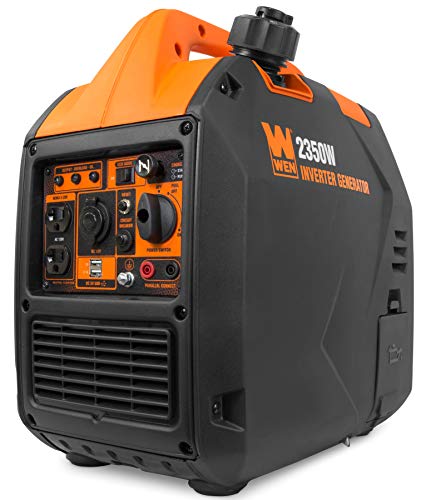
WEN 56235i 2350W Super Quiet Portable Inverter Generator - Ultra Lightweight 39lbs, Fuel Shut-Off, Clean Power for Camping RV

Westinghouse iGen4000DFc 4000 Peak Watt Dual Fuel Inverter Generator - Super Quiet RV Ready Remote Start CO Sensor
As an Amazon Associate we earn from qualifying purchases. Product prices and availability are accurate as of the date/time indicated.
Frequently Asked Questions
Does a generator burn petrol with nothing plugged in?
Yes. A running engine always burns petrol, even at zero load. An inverter generator in eco mode burns far less than a conventional unit running at fixed speed.
Are UK gallon figures the same as US gallon figures?
No. A UK gallon is 4.546 L, about 20% larger than a 3.785 L US gallon. Convert UK figures to liters first before comparing them with US numbers.
Why did my generator run out of petrol before the calculated time?
Motor-driven appliances draw extra power at startup, and the usable tank volume is often below the stated capacity. Rerun the calculation with the real watts drawn and the actual fuel you added.
Can I mix oil into the petrol for my small generator?
Only if the manual says it is a two-stroke model. Four-stroke generators take plain petrol, and oil mixed into the tank damages the engine.
{“@context”: “https://schema.org”, “@type”: “FAQPage”, “mainEntity”: [{“@type”: “Question”, “name”: “Does a generator burn petrol with nothing plugged in?”, “acceptedAnswer”: {“@type”: “Answer”, “text”: “Yes. A running engine always burns petrol, even at zero load. An inverter generator in eco mode burns far less than a conventional unit running at fixed speed.”}}, {“@type”: “Question”, “name”: “Are UK gallon figures the same as US gallon figures?”, “acceptedAnswer”: {“@type”: “Answer”, “text”: “No. A UK gallon is 4.546 L, about 20% larger than a 3.785 L US gallon. Convert UK figures to liters first before comparing them with US numbers.”}}, {“@type”: “Question”, “name”: “Why did my generator run out of petrol before the calculated time?”, “acceptedAnswer”: {“@type”: “Answer”, “text”: “Motor-driven appliances draw extra power at startup, and the usable tank volume is often below the stated capacity. Rerun the calculation with the real watts drawn and the actual fuel you added.”}}, {“@type”: “Question”, “name”: “Can I mix oil into the petrol for my small generator?”, “acceptedAnswer”: {“@type”: “Answer”, “text”: “Only if the manual says it is a two-stroke model. Four-stroke generators take plain petrol, and oil mixed into the tank damages the engine.”}}]}