

Our editorial team weighed WEN's published specifications and how it stacks up against similar products in the generators category. What stands out: Versatile RV/Transfer-Switch Outlets, Long Runtime, and Wheels & Handles. Where it falls short: Needs Gasoline Storage and Noisier Than Inverter Models. That puts it at 8.2/10 on our WG Score – an excellent, well-rounded option.
 Reviewed byDaniel
A dual fuel generator can run on natural gas only if the manufacturer lists natural gas for that model, because most dual fuel units burn just gasoline and propane.
Dual fuel usually means gasoline and propane
On portable generators, “dual fuel” almost always means gasoline plus propane (LP). Natural gas is a third fuel that needs different fuel hardware, so it is not included unless the spec sheet says so.
Natural gas is available in two ways:
- Tri-fuel model: built with gasoline, propane and natural gas inlets from the factory.
- Manufacturer-approved conversion kit: offered for certain models only, and it must be made for your exact model number.
Do not assume a propane regulator or a generic kit will work. Unapproved conversions can leak, run poorly and void your warranty. The term also has other meanings: a diesel-natural gas “dual-fuel” engine is an industrial setup where diesel acts as a pilot ignition source, and it is not a portable gasoline unit.
How to check whether your model can use natural gas
- Find the model number on the data plate, not just the marketing name.
- Open the owner’s manual and look at the fuel section. It should list natural gas (NG) by name.
- Look for a natural gas inlet or a separate NG hose connection on the unit.
- Check the manufacturer’s site or call support and ask whether an approved NG kit exists for that exact model.
- Ask what the kit does to the warranty before you buy it.
If the manual lists only gasoline and LP, treat natural gas as unsupported. For the full breakdown of fuel categories, see our guide to dual fuel vs tri-fuel vs single-fuel generators.
Why output drops on natural gas
Natural gas carries less energy per cubic foot than propane: about 1,030 BTU per cubic foot, against about 2,516 for propane. The engine gets less energy per intake charge, so rated watts are usually lower on gas fuels than on gasoline.
The size of the drop depends on the model, so use the wattage the manual prints for natural gas. One review site cited an example of an 11,000 starting-watt gasoline rating falling to about 8,000 W on natural gas, which is a model-specific example and not a rule.
Worked example, using that example’s figures: you need 7,500 starting watts to cover a refrigerator, sump pump and furnace fan.
- Gasoline rating: 11,000 W, which covers 7,500 W.
- Natural gas rating: 8,000 W, which still covers 7,500 W with 500 W to spare (8,000 − 7,500).
If the natural gas rating had been 7,000 W, the same load would not fit. Always size against the lowest rating of the fuel you plan to use.
What a natural gas hookup requires
Connecting to a house line is not the same as attaching a propane cylinder. These are the parts involved:
- Rated hose or fitting: use the gas hose and quick-connect the manufacturer specifies for the generator.
- Regulator: must match the fuel and the unit. Home standby manuals call for 5 to 7 inches water column of natural gas supply pressure, and not below 5 inches once installed.
- Accessible manual shutoff valve in the supply line.
- Pipe sizing: the line must carry the generator’s full fuel demand, which is listed in its manual.
Fixed piping should be done by a licensed gas fitter, following NFPA 54 for natural gas and local code, and a permit may be required. Leak-test every joint before the first start. A generator that already burns propane has different requirements, covered in can a generator run on propane.
Natural gas vs propane vs gasoline
| Factor | Natural gas | Propane | Gasoline |
|---|---|---|---|
| Energy per cubic foot | About 1,030 BTU | About 2,516 BTU | Liquid fuel, sold by the gallon |
| Fuel supply | Utility line, no refueling | Tanks you must refill or swap | Cans you must refill |
| Storage | None on site | Tank storage outdoors | Shelf life is limited |
| Weight vs air | Lighter, rises | Heavier, pools low | Liquid vapors pool low |
| Main drawback | Needs gas line, may stop in an outage | Finite tank supply | Refueling and storage |
Natural gas wins for long outages because the supply is continuous. Propane suits homes without a gas line. Gasoline gives the most power but needs the most handling.
Safety risks and the safer route
Running any generator produces carbon monoxide. Operate it outdoors only, away from windows, doors and vents, as the manual directs, and use CO alarms inside the home.
- Leaks: natural gas rises and propane sinks, so never put propane tanks in enclosed or low spaces.
- Unapproved kits: use only manufacturer-approved kits and regulators.
- Backfeeding: never plug a generator into a wall outlet. Use a transfer switch or interlock installed to code.
The safer route: if you want natural gas, buy a unit sold as tri-fuel or a permanently installed standby generator, and let a licensed pro handle the gas line and electrical connection.
Our Top Picks
Ready to shop? These are the top-rated options from our related roundup, Best Dual Fuel Generators 4000-7000 Watt of 2026.

Westinghouse iGen4000DFc 4000 Peak Watt Dual Fuel Inverter Generator - Super Quiet RV Ready Remote Start CO Sensor

WEN GN5602X 5600W Portable Generator Electric Start RV-Ready CO Sensor 4500 Running Watts
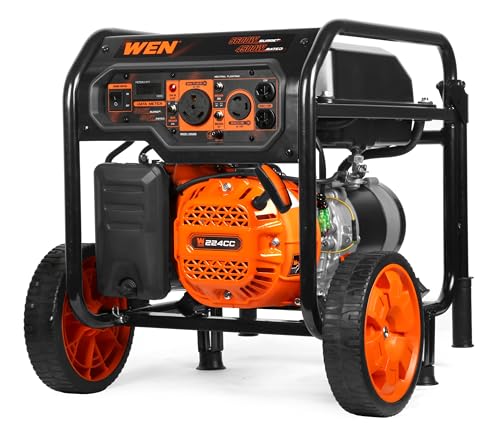
WEN GN5600 5600W Portable Generator RV-Ready Transfer Switch 4500 Running Watts 224cc Engine
As an Amazon Associate we earn from qualifying purchases. Product prices and availability are accurate as of the date/time indicated.
Frequently Asked Questions
Can I convert my dual fuel generator to natural gas with any kit?
No. Use only a kit the manufacturer approves for your exact model number. Generic or homemade conversions can leak, damage the engine and void the warranty. If no approved kit exists, the unit cannot be converted safely.
Do I need a permit to connect a portable generator to a house gas line?
Often a permit is required for fixed gas piping, depending on your local code. A licensed gas fitter will know the rules in your area. Call your local building department before any work begins.
Is a tri-fuel generator the same as a standby generator?
No. A tri-fuel generator is portable and can burn gasoline, propane or natural gas. A standby generator is permanently installed, fed by a fixed gas line, and usually starts automatically through a transfer switch.
Will natural gas keep running if my power goes out?
Usually yes, because gas utilities run on line pressure, not household electricity. Outages or shutoffs from the utility can still interrupt supply, so keep a backup fuel option if your model also supports propane or gasoline.
{“@context”: “https://schema.org”, “@type”: “FAQPage”, “mainEntity”: [{“@type”: “Question”, “name”: “Can I convert my dual fuel generator to natural gas with any kit?”, “acceptedAnswer”: {“@type”: “Answer”, “text”: “No. Use only a kit the manufacturer approves for your exact model number. Generic or homemade conversions can leak, damage the engine and void the warranty. If no approved kit exists, the unit cannot be converted safely.”}}, {“@type”: “Question”, “name”: “Do I need a permit to connect a portable generator to a house gas line?”, “acceptedAnswer”: {“@type”: “Answer”, “text”: “Often a permit is required for fixed gas piping, depending on your local code. A licensed gas fitter will know the rules in your area. Call your local building department before any work begins.”}}, {“@type”: “Question”, “name”: “Is a tri-fuel generator the same as a standby generator?”, “acceptedAnswer”: {“@type”: “Answer”, “text”: “No. A tri-fuel generator is portable and can burn gasoline, propane or natural gas. A standby generator is permanently installed, fed by a fixed gas line, and usually starts automatically through a transfer switch.”}}, {“@type”: “Question”, “name”: “Will natural gas keep running if my power goes out?”, “acceptedAnswer”: {“@type”: “Answer”, “text”: “Usually yes, because gas utilities run on line pressure, not household electricity. Outages or shutoffs from the utility can still interrupt supply, so keep a backup fuel option if your model also supports propane or gasoline.”}}]}













