Our editorial team weighed 's published specifications and how it stacks up against similar products in the generators category. What stands out: Exceptionally Quiet, Lightweight & Durable, and Electric Start. Where it falls short: Needs Gasoline Refueling and Occasional Battery Maintenance. That puts it at 8.2/10 on our WG Score – an excellent, well-rounded option.
 Reviewed byTristan
Starting watts on a generator are the extra power motors briefly draw for a few seconds when they start. Running watts are what the appliance keeps using afterward, and a generator lists the two ratings separately.
Starting watts vs running watts
Running watts (also called rated or continuous watts) are the power a generator can supply hour after hour. Starting watts (also called surge or peak watts) are a higher output the generator can deliver only for a few seconds, just long enough to get a motor spinning.
Both numbers are printed on the generator’s label or spec sheet, and they are not interchangeable. A generator listed at 3,000 running and 3,500 starting watts cannot carry 3,500 watts continuously. The extra 500 watts is a short burst, not spare capacity.
Each appliance has the same two numbers. For a fuller side-by-side breakdown, see running watts vs starting watts explained.
Why motors and compressors need a surge
A motor at rest has no spinning rotor to oppose the incoming current, so it pulls a very large current the instant it receives power. This is called inrush current, and on a compressor it is closely tied to the motor’s locked-rotor amps. As the motor reaches full speed, the current drops quickly to its normal running level.
The whole event usually lasts only a few seconds, which is why generators rate their surge capacity for such a short window. Because watts equal volts multiplied by amps, a brief spike in amps is a brief spike in watts.
Which loads surge and which do not
- Big surge: refrigerators, freezers, air conditioners, well pumps, sump pumps, and power tools with induction motors such as table saws and air compressors.
- Little or none: resistive loads such as incandescent bulbs, space heaters, toasters and coffee makers, plus most electronics like LED lights, TVs and laptop chargers.
Typical starting and running watts for common appliances
These are typical averages from utility and generator-maker charts. Your own appliance can be higher or lower, so treat the table as a planning starting point and confirm against the nameplate.
| Appliance | Running watts | Starting watts |
|---|---|---|
| Refrigerator | 600-800 | 1,500-2,000 |
| Sump pump (1/3 hp) | 800 | 1,300 |
| Window air conditioner (10,000 BTU) | 1,200 | 3,600 |
| Circular saw | 1,200 | 2,400 |
| Space heater | 1,500 | 1,500 |
| LED bulb | 10 | 10 |
Notice the circular saw needs about double its running watts to start, while the air conditioner needs about triple. There is no single surge multiplier that fits every appliance, which is why the nameplate matters more than any rule of thumb.
Refrigerators are the most common reason people look up this number. The page on the generator size needed to run a refrigerator covers that case in detail.
How to add up your total starting watts
Because motors rarely start at the exact same moment, you do not add every surge together. Add all running watts, then add only the single largest extra amount needed to start.
- List every appliance you plan to run at the same time.
- Write down each one’s running watts and starting watts from its nameplate or manual.
- Add all the running watts together.
- For each motor load, subtract running watts from starting watts to get its extra surge.
- Pick the largest extra surge and add it to the running total.
- Optionally, add a margin (such as 20%) so the generator is not working at its limit.
Worked example
Example figures only, not specifications: a refrigerator (700 running, 2,000 starting), a sump pump (800 running, 1,300 starting), lights (100 running) and a TV (150 running).
- Running total: 700 + 800 + 100 + 150 = 1,750 watts
- Extra surge: refrigerator 2,000 – 700 = 1,300; sump pump 1,300 – 800 = 500. The largest is 1,300.
- Starting requirement: 1,750 + 1,300 = 3,050 watts
- Optional 20% margin: 3,050 x 1.2 = 3,660 starting watts, and 1,750 x 1.2 = 2,100 running watts
For whole-home totals, the guide on how many watts a portable generator needs walks through the larger list.
How to find the real starting watts for your appliance
Look for the data plate on the appliance. It usually lists volts and running amps, and motor-driven units such as air conditioners often add LRA (locked-rotor amps).
- Running watts: amps x volts. Example: 9 amps x 120 volts = 1,080 watts.
- Worst-case starting watts: LRA x volts. Example: 36 LRA x 120 volts = 4,320 watts.
LRA describes the harshest case, so real startup draw is often lower. If the plate lists no surge figure, check the manual or the manufacturer’s support page.
Some equipment starts gently. Air conditioners and pumps with a soft-start kit or a variable-speed inverter drive pull far less inrush than a standard single-speed unit. The plate or spec sheet of that specific model is the only reliable source for its figure.
What happens if starting watts exceed the generator’s rating
When a surge is larger than the generator can supply, the engine bogs down and voltage sags. You may see lights dim, hear the motor hum without turning, or watch the generator lug and sputter.
Outcomes range from harmless to costly:
- The generator’s breaker trips and everything shuts off.
- The appliance fails to start and its motor overheats while stalled.
- Repeated low-voltage starts can shorten the life of compressors and pumps.
How to recover
Switch off or unplug all loads, reset the generator breaker, and let the engine settle. Then start the largest motor first with nothing else running, and add the other loads one at a time, waiting for each to reach steady running. If the largest motor still will not start, the generator’s starting rating is too low for it.
Inverter models handle surge differently from open-frame conventional units. The page on what type of portable generator you need explains the trade-offs.
Using the numbers to check a generator’s label
Compare your two results to the two ratings on the generator: your running total must fit under its running watts, and your starting requirement must fit under its starting watts. Both tests must pass.
Our Top Picks
Ready to shop? These are the top-rated options from our related roundup, Best 2500 Watt Portable Generators of 2026.
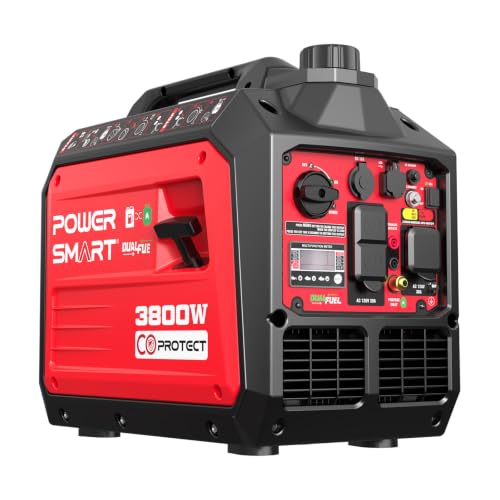
PowerSmart 3800 Watt Dual Fuel Inverter Generator Quiet Portable Gas Propane with CO Sensor RV Ready
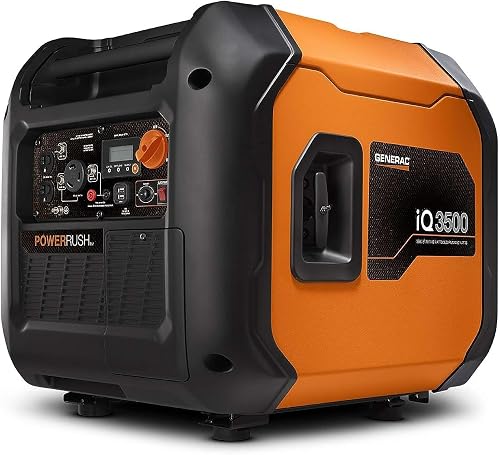
Generac iQ3500 3500W Portable Inverter Generator - Quiet, Lightweight, Electric Start, CARB Compliant for Camping & Jobsites

maXpeedingrods MXR4000GT 4000W Dual Fuel Inverter Generator with Bluetooth App Control
As an Amazon Associate we earn from qualifying purchases. Product prices and availability are accurate as of the date/time indicated.
Frequently Asked Questions
Is starting wattage the same as peak wattage?
On generator labels, starting, surge and peak watts are generally used for the same short-burst rating. Check the manual to see how the manufacturer defines it and how long it can be held.
Can an inverter generator start an AC rated above its surge?
Not reliably. The surge rating is the limit for a brief start, so an air conditioner whose startup need exceeds it may stall or trip the breaker. Compare the unit’s nameplate figures to the generator’s starting rating.
Does a soft-start kit let a smaller generator run my AC?
A soft-start kit can reduce the inrush current, which may lower the starting watts you need to plan for. Confirm the figures with the kit maker and the air conditioner’s specifications before relying on it.
Can I add a 20% margin to both numbers?
Yes, as optional guidance. A margin on both the running total and the starting requirement keeps the generator from working at its limit. It is a cushion, not a rating, and the label figures are still what you compare against.
{“@context”: “https://schema.org”, “@type”: “FAQPage”, “mainEntity”: [{“@type”: “Question”, “name”: “Is starting wattage the same as peak wattage?”, “acceptedAnswer”: {“@type”: “Answer”, “text”: “On generator labels, starting, surge and peak watts are generally used for the same short-burst rating. Check the manual to see how the manufacturer defines it and how long it can be held.”}}, {“@type”: “Question”, “name”: “Can an inverter generator start an AC rated above its surge?”, “acceptedAnswer”: {“@type”: “Answer”, “text”: “Not reliably. The surge rating is the limit for a brief start, so an air conditioner whose startup need exceeds it may stall or trip the breaker. Compare the unit’s nameplate figures to the generator’s starting rating.”}}, {“@type”: “Question”, “name”: “Does a soft-start kit let a smaller generator run my AC?”, “acceptedAnswer”: {“@type”: “Answer”, “text”: “A soft-start kit can reduce the inrush current, which may lower the starting watts you need to plan for. Confirm the figures with the kit maker and the air conditioner’s specifications before relying on it.”}}, {“@type”: “Question”, “name”: “Can I add a 20% margin to both numbers?”, “acceptedAnswer”: {“@type”: “Answer”, “text”: “Yes, as optional guidance. A margin on both the running total and the starting requirement keeps the generator from working at its limit. It is a cushion, not a rating, and the label figures are still what you compare against.”}}]}