

Our editorial team weighed WEN's published specifications and how it stacks up against similar products in the generators category. What stands out: Ultra-Quiet & Lightweight, Reliable Cold-Weather Starts, and Clean Power for Electronics. Where it falls short: Oil Change Every 25 Hours and Minor Oil Burn Risk. That puts it at 8.4/10 on our WG Score – an excellent, well-rounded option.
 Reviewed byTristan
The quietest portable generator is a 2,000-watt-class inverter, such as the Honda EU2200i or the Yamaha EF2200iS.
Which portable generator is the quietest?
Small inverter generators in the 2,000-watt class are the quietest engine-driven portable units. Battery power stations are quieter still, because they have no engine, only a cooling fan.
| Model | Running / max watts | Listed noise | Distance | Load |
|---|---|---|---|---|
| Honda EU2200i inverter | 1,800 / 2,200 | 48–57 dBA | 7 m (23 ft) | Range spans light load to rated load |
| Yamaha EF2200iS inverter | 1,800 / 2,200 | 51.5 dBA | 7 m (23 ft) | Quarter load |
Start with the caveats. A noise rating means something only when you know its distance and load, and these two models are not listed on the same basis. Yamaha gives one figure at quarter load, while Honda gives a range from light load to rated load. Ratings can change between model years, so read the current spec sheet or the label on the exact unit you are considering.
A headline number is usually the best case. A generator working near its limit is louder than the same unit running a small load, and your site changes the result again. Walls, hard ground and the direction the case faces all affect what you hear. The sections below show how to put different ratings on the same footing.
Why are inverter generators quieter than open-frame models?
Three design differences account for most of the gap:
- Variable engine speed. An inverter converts the engine’s output to clean power electronically, so the engine can slow down at light load. A conventional generator must hold a constant speed (commonly 3,600 rpm) to produce 60 Hz power, whatever the load.
- Enclosed case. Inverter units sit inside a sound-damping shell. Open-frame units expose the engine and muffler.
- Smaller engines. Most quiet inverters sit in the 1,000–3,500 watt range. A smaller engine generally makes less noise than the larger engines needed for 5,000 watts and up.
The practical result is that an inverter’s noise follows your load. Plug in a few small devices and the engine settles into a low hum. Add a heavy appliance and the engine speeds up, so the unit gets louder. An open-frame generator stays at one speed, so it is loud from the first minute.
How do you compare dBA ratings fairly?
Two numbers are comparable only when they share the same distance, the same load and the same mode. Many makers rate at 7 m (23 ft). Others use closer distances or full load, and some quote the eco mode figure.
Distance: about 6 dB per doubling
In open space, sound drops about 6 dB each time you double the distance. That figure is 20 × log10(2), which is 6.02 dB. Starting from the Yamaha EF2200iS rating of 51.5 dBA at 23 ft and quarter load:
| Distance from generator | Level |
|---|---|
| 11.5 ft | 57.5 dBA |
| 23 ft | 51.5 dBA |
| 46 ft | 45.5 dBA |
| 92 ft | 39.5 dBA |
Walls, trees and hard ground change real-world results, so treat the table as a guide. A 6 dB difference is about four times the sound energy, which is easy to hear.
Worked example: converting two ratings
Generator A is rated 51 dBA at 7 m. Generator B is rated 56 dBA at 4 m. The distance ratio is 7 ÷ 4 = 1.75, and 20 × log10(1.75) is about 4.9 dB. Generator B at 7 m is therefore 56 − 4.9 = 51.1 dBA. The two are effectively equal, even though 56 looks much worse.
Checking a spec sheet
- Find the distance behind the number. If it is not 7 m (23 ft), convert it as above.
- Find the load. Quarter load is a best-case style rating, and full load is the loudest the unit gets.
- Check whether the figure is for eco mode or normal running.
- Look for the test standard or label note, and use only figures that come from the maker’s manual or label.
What campground and HOA noise limits apply?
Limits vary by park and by local ordinance. Some places set a decibel limit, others only set quiet hours, and some ban generators outright. Many measure at a set distance, at the neighboring site or at the property line, so a number on a box doesn’t settle the question.
- Ask the park or HOA for the written limit, the measurement distance and the allowed run hours.
- Convert the generator’s rating to that distance using the table above.
- Use the figure for your actual load, not the best-case one.
Rule of thumb: if the rating at your distance and load is at least 5 dBA under the limit, you have a margin for hard ground and a heavier load than planned.
How can you make a portable generator quieter?
Placement and load do more than any accessory.
- Add distance. Every doubling of distance cuts about 6 dB. A longer, properly rated extension cord lets you move the generator away instead of running it close.
- Aim the exhaust and case away from people and neighbors, and set the unit on grass or dirt rather than concrete or next to a reflective wall.
- Keep the load low. A smaller load lets an inverter slow down. Use eco mode if the model has it.
- Turn off what you don’t need so the engine isn’t working harder than necessary.
Don’t enclose a generator in a box, shed or homemade baffle to muffle it, because blocked airflow causes overheating and exhaust buildup. Follow your manual for placement, and see our portable generator safety rules for setup.
What power do you give up for the quietest models?
You give up capacity. A 2,000-watt-class inverter delivers about 1,800 running watts, which covers lights, phone chargers, a CPAP, a small fridge or a laptop setup. It will not run a large RV air conditioner, a well pump or an electric range by itself.
Worked example: a quiet camp load
CPAP 60 W + LED lights 40 W + phone and tablet chargers 50 W + mini fridge 150 W = 300 W. Against 1,800 running watts, that is 300 ÷ 1,800, or about 17% load. That is below the quarter-load point (450 W) used for the Yamaha rating, so its listed figure is a fair guide here.
Appliances with motors need extra surge watts on startup, so check the nameplate before assuming a fit. For loads this small, a battery power station may be enough, and it makes no engine noise at all.
Decision rule: if your running load stays under about 1,500 watts and quiet matters, a 2,000-watt-class inverter fits, and a power station fits when the load is a few hundred watts for a few hours. If you are comparing models side by side, our quietest portable generators roundup lists current options.
Our Top Picks
Ready to shop? These are the top-rated options from our hands-on roundup, Best Quietest Portable Generators of 2026.

Westinghouse iGen5000DF 5000 Peak Watt Dual Fuel Inverter Generator - Super Quiet RV Ready Remote Start
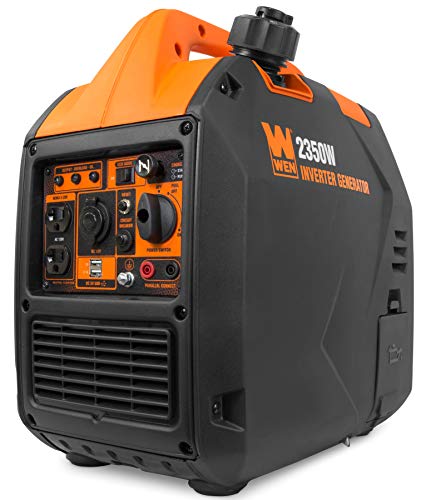
WEN 56235i 2350W Super Quiet Portable Inverter Generator - Ultra Lightweight 39lbs, Fuel Shut-Off, Clean Power for Camping RV

maXpeedingrods MXR4000GT 4000W Dual Fuel Inverter Generator with Bluetooth App Control
As an Amazon Associate we earn from qualifying purchases. Product prices and availability are accurate as of the date/time indicated.
Frequently Asked Questions
Does eco mode make a generator quieter?
Usually yes at light load, because the engine slows down to match demand. The saving disappears when the load rises, so check whether a listed dBA figure was measured in eco mode or normal mode before comparing it.
Is a 2,200-watt inverter too big for a small camp load?
No. Inverters adjust engine speed to the load, so a 300 W load on a 2,200-watt unit runs at low speed and makes little noise. Size to your peak need, not your average one.
Are dual fuel or propane generators quieter than gas ones?
Fuel type doesn’t set the noise level. Engine design, muffler and case do. Compare each unit’s dBA rating, distance and load rather than assuming propane is quieter.
Is the Honda EU2200i quieter than the Yamaha EF2200iS?
The listings are not on the same basis. Honda gives a 48–57 dBA range across loads, and Yamaha gives 51.5 dBA at quarter load, both at 7 m. Compare at the same load before choosing.
Is a power station better than a generator for sleeping nearby?
Yes, if it covers your load. A power station has no engine, so it makes only fan noise. Decision rule: choose a power station for a few small devices overnight, and a generator for heavy running loads.
{“@context”: “https://schema.org”, “@type”: “FAQPage”, “mainEntity”: [{“@type”: “Question”, “name”: “Does eco mode make a generator quieter?”, “acceptedAnswer”: {“@type”: “Answer”, “text”: “Usually yes at light load, because the engine slows down to match demand. The saving disappears when the load rises, so check whether a listed dBA figure was measured in eco mode or normal mode before comparing it.”}}, {“@type”: “Question”, “name”: “Is a 2,200-watt inverter too big for a small camp load?”, “acceptedAnswer”: {“@type”: “Answer”, “text”: “No. Inverters adjust engine speed to the load, so a 300 W load on a 2,200-watt unit runs at low speed and makes little noise. Size to your peak need, not your average one.”}}, {“@type”: “Question”, “name”: “Are dual fuel or propane generators quieter than gas ones?”, “acceptedAnswer”: {“@type”: “Answer”, “text”: “Fuel type doesn’t set the noise level. Engine design, muffler and case do. Compare each unit’s dBA rating, distance and load rather than assuming propane is quieter.”}}, {“@type”: “Question”, “name”: “Is the Honda EU2200i quieter than the Yamaha EF2200iS?”, “acceptedAnswer”: {“@type”: “Answer”, “text”: “The listings are not on the same basis. Honda gives a 48–57 dBA range across loads, and Yamaha gives 51.5 dBA at quarter load, both at 7 m. Compare at the same load before choosing.”}}, {“@type”: “Question”, “name”: “Is a power station better than a generator for sleeping nearby?”, “acceptedAnswer”: {“@type”: “Answer”, “text”: “Yes, if it covers your load. A power station has no engine, so it makes only fan noise. Decision rule: choose a power station for a few small devices overnight, and a generator for heavy running loads.”}}]}













