

Our editorial team weighed PlugSaf's published specifications and how it stacks up against similar products in the extension cords category. What stands out: Exceptional Weather Resistance, Three-Outlet Design, and High-Visibility Yellow & LED. Where it falls short: Bulky 50-Foot Length and Premium Price Point. That puts it at 8.9/10 on our WG Score – an excellent, well-rounded option.
 Reviewed byEthan
To hook up a portable generator safely, never plug it into a wall outlet; use outdoor-rated cords or an electrician-installed interlock or transfer switch.
Which way to hook up a portable generator is safest?
Pick the method by how much you need to power. For a refrigerator, lights and other plug-in items, use heavy-duty outdoor cords. For a furnace, well pump or many circuits, use an interlock kit or transfer switch installed by a licensed electrician. NEC Article 702 covers optional standby systems like this. Local code, permits and utility rules vary, so confirm with your building department before any panel work, and follow your generator’s manual and labels for every setup step.
| Method | What it powers | Electrician and permit | Upfront cost | Main drawback |
|---|---|---|---|---|
| Extension cords | Individual appliances you can reach | None for cords | Lowest | Cannot power hardwired loads such as a furnace or well pump |
| Interlock kit with inlet box | Any circuit in the panel, switched on one at a time | Licensed electrician; permit usually required | Moderate | You manage the load by hand and get no signal when utility power returns |
| Manual transfer switch | A chosen group of circuits, such as fridge, lights and furnace | Licensed electrician; permit usually required | Highest | Only the circuits wired to it are covered |
Decision rule: if everything you need plugs into a standard outlet and each cord carries 16 A (1,920 W) or less at 120 V, use cords. If you need anything hardwired, have an electrician install an inlet with an interlock or transfer switch. Get written quotes, since cost depends on your panel, the distance to the inlet and local permit fees.
How to hook up a portable generator with extension cords
Use this method when you only need plug-in appliances. For more on placement and fueling, see our portable generator safety guide.
- Choose the spot. Set the generator outdoors on dry, level ground with the exhaust pointed away from doors, windows and vents. Use the minimum distance printed in your owner’s manual or on the label. Never run it in a garage, basement, crawlspace or enclosed porch, even with a door open.
- Check your CO alarms. Test battery or plug-in carbon monoxide alarms on every level and near bedrooms before you start the engine.
- Check the grounding instructions. Read the manual and the generator’s bonding label to see whether your model needs a ground rod and wire, then do exactly what they say.
- Fuel up with the engine off and cool. Check the oil, then add fuel from an approved container.
- Start with no load. Unplug everything and switch off the generator’s breakers so the engine starts unloaded.
- Start the engine and let it run until it sounds steady.
- Run the cords. Use outdoor-rated cords marked with a W, fully uncoiled, from the generator to each appliance. Keep them out of puddles and away from door frames that can pinch them.
- Add loads one at a time, starting with the biggest motor, such as the refrigerator. Stay under the generator’s rated running watts.
What cord size and generator size do you need?
Match the cord to the amps: amps equal watts divided by volts. The amp rating and gauge are printed on a UL-listed cord, and your generator manual sets its own receptacle limits. Never use thin, indoor-rated household cords.
| Load on one cord | Current | Cord to use |
|---|---|---|
| Up to 1,440 W | 12 A at 120 V | 14 AWG, 15-amp outdoor cord |
| Up to 1,920 W | 16 A at 120 V | 12 AWG, 20-amp outdoor cord |
| Generator to a 30-amp inlet | 30 A at 240 V (7,200 W) | 10 AWG, four-wire, rated 30 A, L14-30 plugs |
| Generator to a 50-amp inlet | 50 A at 240 V (12,000 W) | 6 AWG, four-wire, rated 50 A |
The first two rows hold continuous loads to 80% of the cord rating, a rule of thumb. For long runs, use the cord maker’s chart to pick a heavier gauge and limit voltage drop.
Worked example: fridge, freezer and lights
Example figures for plug-in loads only. Check your own appliance labels.
| Appliance | Running W | Starting W | Extra to start |
|---|---|---|---|
| Refrigerator | 700 | 2,100 | 1,400 |
| Chest freezer | 500 | 1,500 | 1,000 |
| Lights and chargers | 300 | 300 | 0 |
Running total: 700 + 500 + 300 = 1,500 W. Motors rarely start at the same instant, so add only the largest extra: 1,500 + 1,400 = 2,900 W peak. Apply 20% headroom to the running watts once: 1,500 × 1.2 = 1,800 W. Look for a generator rated at least 1,800 running watts and 2,900 starting watts.
At 120 V, 1,500 W is 12.5 A, just over the 12 A limit for a 14 AWG cord. Put the refrigerator and lights on one cord (1,000 W, 8.3 A) and the freezer on a second (500 W, 4.2 A).
Startup and shutdown order for a house hookup
This is the operating sequence once an electrician has installed an inlet with an interlock kit or transfer switch. Follow the labels and instructions that came with your equipment if they differ.
Startup
- With the generator off and outside, turn the main breaker off (interlock) or set the transfer switch to the utility position.
- Switch off the branch breakers for circuits you do not need.
- Plug the cord into the inlet box and the generator while the engine is off.
- Start the generator and let it run until steady.
- Interlock: slide the plate and switch the generator breaker on. Transfer switch: flip it to the generator position.
- Turn circuits on one at a time, largest motor first.
Shutdown
- Turn the branch breakers off one by one.
- Switch the generator breaker off, or set the transfer switch to off.
- Stop the engine and unplug the cord at the generator, then the inlet.
- Confirm utility power is back, for example from the utility’s outage map or neighbors’ lights, since an interlock cannot tell you.
- Return the interlock plate or transfer switch to the utility position and turn the main on.
When do you need an electrician and a permit?
Any work inside the panel or on the house wiring needs a licensed electrician. That covers installing an interlock kit, a backfeed breaker, a power inlet box and a transfer switch. Interlock kits are made for specific panel brands and models, so a kit that fits one panel can be wrong for another.
Permits and inspections are usually required, and some utilities want notice of a standby generator. Rules vary by city, county and utility, so call your building department first.
Questions to ask your electrician:
- Is the interlock kit listed for my exact panel brand and model?
- Is the inlet outdoor-rated, and are the wire and conduit sized for the breaker?
- Which circuits should go on a transfer switch?
- Will you pull the permit and schedule the inspection?
Before the electrician sizes the inlet, check which receptacle your generator has. The inlet, cord and generator outlet should share the same amp rating and plug style, such as a 30-amp L14-30. A mismatch needs a listed adapter.
Why a male-to-male cord and backfeeding are deadly
A male-to-male cord, sometimes called a suicide cord, has live prongs on both ends. Plugging a generator into a wall outlet sends power backward through the house wiring, through the meter and onto the utility line. A neighborhood transformer can step that power up to dangerous line voltage, and line workers who think the wire is dead can be electrocuted. It also bypasses your breakers, can overheat wiring and start a fire, and can wreck the generator when utility power returns. The NEC requires transfer equipment that keeps the generator and utility from connecting at the same time, and backfeeding is illegal under many local codes.
Carbon monoxide is the other killer. It is colorless and odorless, and symptoms include headache, dizziness, weakness, nausea and confusion. If anyone feels them, get into fresh air and call 911.
Place alarms as the alarm manufacturer directs, usually on each level and near sleeping areas. For more on running and fueling, read our portable generator safety guide.
Common mistakes when you hook up a portable generator
- Leaving a cord coiled. Coils trap heat, so unroll the full length.
- Adding every load at once. Starting everything together can trip the generator or stall the engine.
- Running near the limit. Keep continuous loads under the rated running watts with headroom.
- Mixing plug styles. Match the inlet, cord and generator outlet instead of forcing a fit.
- Skipping a trial run. Test your cords or inlet hookup in daylight before an outage, so you find problems early.
Our Top Picks
Ready to shop? These are the top-rated options from our hands-on roundup, Best Generator Extension Cords of 2026.

PlugSaf 50FT 10 Gauge Outdoor Extension Cord, 3 Outlets Weatherproof Heavy Duty, Waterproof Yellow SJTW ETL Listed

POWGRN 50ft 12/3 Waterproof Outdoor Extension Cord Heavy Duty 15A 1875W SJTW Yellow ETL Listed
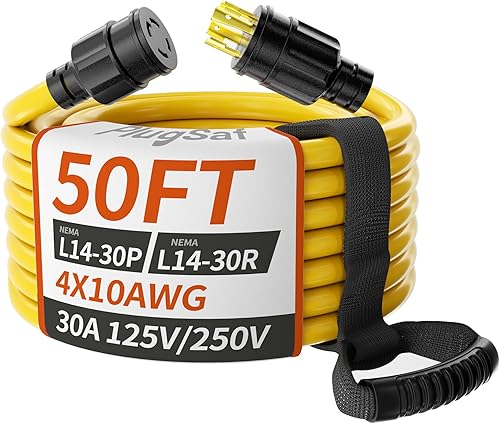
PlugSaf 50FT 30 Amp 4-Prong Generator Extension Cord - Heavy Duty 10 Gauge STW, ETL Listed Yellow
As an Amazon Associate we earn from qualifying purchases. Product prices and availability are accurate as of the date/time indicated.
Frequently Asked Questions
Can I plug a generator into a dryer outlet?
No. A dryer outlet connects to your house wiring, so it backfeeds just like a wall outlet. To feed a 240-volt circuit, have an electrician install an inlet with an interlock or transfer switch. Decision rule: if power has to travel through the panel, it needs transfer equipment.
Can a portable generator run a well pump or central air conditioner?
Sometimes. Both are usually hardwired 240-volt loads, so they need an inlet with an interlock or transfer switch, and the generator must cover their starting watts. Read the nameplate, then have an electrician confirm the size.
Can I use a 30-amp generator with a 50-amp inlet?
Only with a listed adapter made for that pairing, and you still get just the generator’s 30 amps. Decision rule: match the inlet, cord and generator outlet ratings, and if they differ, the lowest rating sets your limit.
Is a 3,000-watt generator too big for a fridge and a few lights?
Not too big. The example above needs about 1,800 running watts and 2,900 starting watts, so a 3,000-watt unit covers it with room to add a small load. A much larger unit burns more fuel at light loads, so size to your total.
Can I run two appliances from one extension cord?
Yes, if their combined amps stay within the cord’s rating. Add the running watts, divide by 120 volts, and compare the result to the 12 A or 16 A limits in the table. If the total is higher, use a second cord.
{“@context”: “https://schema.org”, “@type”: “FAQPage”, “mainEntity”: [{“@type”: “Question”, “name”: “Can I plug a generator into a dryer outlet?”, “acceptedAnswer”: {“@type”: “Answer”, “text”: “No. A dryer outlet connects to your house wiring, so it backfeeds just like a wall outlet. To feed a 240-volt circuit, have an electrician install an inlet with an interlock or transfer switch. Decision rule: if power has to travel through the panel, it needs transfer equipment.”}}, {“@type”: “Question”, “name”: “Can a portable generator run a well pump or central air conditioner?”, “acceptedAnswer”: {“@type”: “Answer”, “text”: “Sometimes. Both are usually hardwired 240-volt loads, so they need an inlet with an interlock or transfer switch, and the generator must cover their starting watts. Read the nameplate, then have an electrician confirm the size.”}}, {“@type”: “Question”, “name”: “Can I use a 30-amp generator with a 50-amp inlet?”, “acceptedAnswer”: {“@type”: “Answer”, “text”: “Only with a listed adapter made for that pairing, and you still get just the generator’s 30 amps. Decision rule: match the inlet, cord and generator outlet ratings, and if they differ, the lowest rating sets your limit.”}}, {“@type”: “Question”, “name”: “Is a 3,000-watt generator too big for a fridge and a few lights?”, “acceptedAnswer”: {“@type”: “Answer”, “text”: “Not too big. The example above needs about 1,800 running watts and 2,900 starting watts, so a 3,000-watt unit covers it with room to add a small load. A much larger unit burns more fuel at light loads, so size to your total.”}}, {“@type”: “Question”, “name”: “Can I run two appliances from one extension cord?”, “acceptedAnswer”: {“@type”: “Answer”, “text”: “Yes, if their combined amps stay within the cord’s rating. Add the running watts, divide by 120 volts, and compare the result to the 12 A or 16 A limits in the table. If the total is higher, use a second cord.”}}]}













