

Our editorial team weighed maXpeedingrods's published specifications and how it stacks up against similar products in the generators category. What stands out: App Control for Remote Operation, Dual Fuel Flexibility, and Includes Parallel Cables. Where it falls short: App Needs WiFi/Internet and No THD Spec Provided. That puts it at 7.7/10 on our WG Score – a solid, dependable choice.
 Reviewed byDaniel
Yes, battery operated generators are good for short outages, electronics, CPAP machines, camping and a refrigerator for a day or so. They are a poor fit for central AC, electric heat or multi-day outages with no solar. The deciding factors are how many watts you need and for how many hours.
Are battery operated generators worth it? The fit-or-skip rule
A battery operated generator is a portable power station: a battery, an inverter and outlets in one box. Use this rule before you shop:
- Buy one if your must-run loads total under about 1,500 watts and your daily energy need is under about 2,000 watt-hours (Wh), or you can recharge with solar.
- Buy gas instead if you need to run a well pump, a window or central AC, or an electric heater for many hours, or outages in your area last several days with no sun.
- Consider both if you want quiet indoor power for medical and electronic needs plus a gas unit for heavy loads.
Everything below explains how to check where you land.
What a battery operated generator actually is
It stores energy in a lithium battery and converts it to 120V AC through an inverter. It has no engine, so there is no exhaust, no oil and no fuel to store. You recharge it from a wall outlet, a car’s 12V port or solar panels. Charging speed varies a lot by model, so check the manufacturer’s input rating.
Two numbers matter most:
- Capacity (Wh): how much energy is stored. This sets how long it runs.
- Output (W): how much it can deliver at once, plus a short surge rating for motor startup. This sets what it can run.
Many units use pure sine-wave inverters, which suit laptops, CPAP machines and other sensitive electronics. Confirm this in the spec sheet.
How long will a battery generator run your appliances?
Use this formula: runtime (hours) = rated Wh × 0.85 ÷ load watts. The 0.85 allows for inverter losses. Cold weather and an aging battery reduce it further, so treat results as a best case.
Worked example: one day of essentials
Say you want to keep a fridge, a router, a CPAP and some charging going. These are typical estimates; check your own labels or use a plug-in watt meter.
- Efficient fridge, averaged over the day: about 1,200 Wh
- Wi-Fi router, 15 W × 24 hours: 360 Wh
- CPAP without heated humidifier, 40 W × 8 hours: 320 Wh
- Phones, laptop and a few LED lights: about 300 Wh
That totals roughly 2,180 Wh per day. A 2,000 Wh unit has about 1,700 Wh usable, so it covers most of one day. To stretch it, skip the router at night and run only the fridge and CPAP, or add solar.
Runtime by battery size
| Load (typical watts) | 500 Wh | 1,000 Wh | 2,000 Wh | 3,000 Wh |
|---|---|---|---|---|
| Wi-Fi router (15 W) | 28 hrs | 57 hrs | 113 hrs | 170 hrs |
| CPAP (40 W) | 10 hrs | 21 hrs | 42 hrs | 64 hrs |
| Fridge (about 50 W average) | 8 hrs | 17 hrs | 34 hrs | 51 hrs |
| Window AC (600 W) | 40 min | 1.4 hrs | 2.8 hrs | 4.2 hrs |
| Space heater (1,500 W) | Likely can’t run it | 34 min | 68 min | 1.7 hrs |
Values are calculated with the formula above, not lab-tested. Your appliance wattage and the unit’s real efficiency will differ.
Battery vs gas inverter generator: side-by-side
| Factor | Battery generator | Gas inverter generator |
|---|---|---|
| Noise | Near silent; fan hum at most | Quiet for gas, but still an engine |
| Fumes | None; can be used indoors | Carbon monoxide; outdoors only |
| Maintenance | Minimal; keep charged | Oil changes, fuel stabilizer, carburetor care |
| Runtime | Fixed by capacity | Refuel and keep going |
| Cost per Wh | Higher; one comparison found about 7 times the cost for roughly 3,600 Wh of energy | Lower |
| Recharge/refuel | Hours by wall; longer by solar | Minutes with a fuel can |
| Heavy loads | Limited by output and capacity | Better, especially 240V models |
For light loads, a recreational gas inverter generator may run a TV and a few lights roughly 8 to 13 hours per tank, versus about 3 to 9 hours for a power station, according to one RV industry comparison. Actual numbers depend on the model and load.
Choose battery if you value silence, indoor use and zero upkeep. Choose gas if you need long runtime at high wattage. If gas is your lean, see our best inverter generators roundup.
The real downsides of battery operated generators
- Limited capacity. When it is empty, it is done until you recharge.
- Slow recharge. A large unit can take several hours from a wall outlet and a day or more from modest solar. Check the model’s maximum input.
- Weight. Units around 2,000 Wh are commonly dozens of pounds, and larger ones can be heavy enough to need wheels or two people. Check the spec.
- Mostly 120V. Many models cannot run 240V loads like well pumps, dryers or central AC. A few larger systems offer 240V, often with a bundle or adapter.
- Surge trips. A sump pump or fridge compressor can briefly pull several times its running watts. If that exceeds the unit’s surge rating, it shuts off even with a full battery. Look up the startup watts on the appliance label or manual.
Common mistake: buying by watt-hours alone. A 3,000 Wh unit with a 1,000 W output still cannot run a 1,500 W heater.
LiFePO4 vs NMC: which battery chemistry to look for
Look for lithium iron phosphate (LiFePO4) if you plan to use the unit regularly or keep it for years. Manufacturers commonly rate LiFePO4 units for about 3,000 or more cycles to 80% capacity, while NMC (nickel manganese cobalt) lithium-ion units are often rated in the hundreds to around 1,000 cycles. These are manufacturer figures and vary by model.
LiFePO4 is also generally more heat-tolerant. NMC tends to be lighter for the same capacity. Check the low-temperature charging limit too: many lithium batteries should not charge below freezing unless the unit has built-in heating.
If you want a roundup of options, see our best portable battery generators.
Who should buy one, and how to use it safely
Good fits
- Short outages that need a fridge, router, medical devices and lights. Our picks for solar generators for home backup cover larger setups.
- Camping, tailgating and job sites. See camping battery generators.
- Apartments or any place you cannot run an engine.
Poor fits
- Whole-house backup, central AC or electric heat.
- Outages of several days with no solar or other way to recharge.
Quick pre-purchase checklist
- List your must-run devices and their running and surge watts.
- Multiply watts by hours for a daily Wh total.
- Pick a unit with usable capacity above that total, and surge output above your biggest startup load.
- Confirm the chemistry, pure sine wave output and solar input rating.
Safety
- Never backfeed your home through a wall or dryer outlet. Whole-home connections need a transfer switch or interlock installed by a licensed electrician, following the NEC and local code.
- Use only the manufacturer’s charger and cables. Keep the unit dry and away from heat, and avoid charging or storing it in extreme temperatures.
- Use heavy-duty extension cords rated for the load.
- If you also own a gas generator, run it outdoors and well away from windows and doors. Battery units do not produce carbon monoxide.
Our Top Picks
Ready to shop? These are the top-rated options from our hands-on roundup, Best Battery Inverter Generators of 2026.
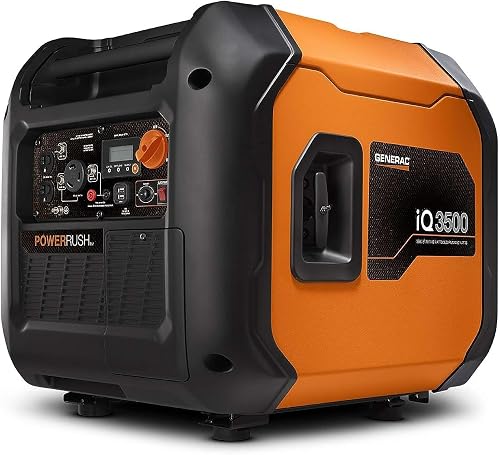
Generac iQ3500 3500W Portable Inverter Generator - Quiet, Lightweight, Electric Start, CARB Compliant for Camping & Jobsites

maXpeedingrods MXR4000GT 4000W Dual Fuel Inverter Generator with Bluetooth App Control
As an Amazon Associate we earn from qualifying purchases. Product prices and availability are accurate as of the date/time indicated.
Frequently Asked Questions
Can a battery generator power a whole house?
Not in most cases. Typical units run 120V essentials like a fridge, lights and electronics. Whole-house loads such as central AC, electric ranges and water heaters need far more power than most portable units provide. Large home battery systems exist, but they are a different, professionally installed product.
How long does a portable power station last?
Lifespan depends on chemistry and use. Manufacturers commonly rate LiFePO4 units for about 3,000 or more charge cycles, while NMC units are often rated lower. Check the cycle rating for your model. Heat and deep discharges shorten battery life.
Can I use a battery generator indoors?
Yes, since there is no combustion or exhaust. Keep it on a stable, dry surface with airflow around its vents, away from heat sources. Follow the manual. This is the main safety advantage over gas generators, which must always run outdoors.
What size battery generator do I need for a power outage?
Add the running watts of what you must power, then multiply by hours for watt-hours. Choose a unit whose surge output exceeds your largest motor startup. For a fridge, router and CPAP, roughly 1,000 to 2,000 Wh covers about a day, depending on your appliances.
{“@context”: “https://schema.org”, “@type”: “FAQPage”, “mainEntity”: [{“@type”: “Question”, “name”: “Can a battery generator power a whole house?”, “acceptedAnswer”: {“@type”: “Answer”, “text”: “Not in most cases. Typical units run 120V essentials like a fridge, lights and electronics. Whole-house loads such as central AC, electric ranges and water heaters need far more power than most portable units provide. Large home battery systems exist, but they are a different, professionally installed product.”}}, {“@type”: “Question”, “name”: “How long does a portable power station last?”, “acceptedAnswer”: {“@type”: “Answer”, “text”: “Lifespan depends on chemistry and use. Manufacturers commonly rate LiFePO4 units for about 3,000 or more charge cycles, while NMC units are often rated lower. Check the cycle rating for your model. Heat and deep discharges shorten battery life.”}}, {“@type”: “Question”, “name”: “Can I use a battery generator indoors?”, “acceptedAnswer”: {“@type”: “Answer”, “text”: “Yes, since there is no combustion or exhaust. Keep it on a stable, dry surface with airflow around its vents, away from heat sources. Follow the manual. This is the main safety advantage over gas generators, which must always run outdoors.”}}, {“@type”: “Question”, “name”: “What size battery generator do I need for a power outage?”, “acceptedAnswer”: {“@type”: “Answer”, “text”: “Add the running watts of what you must power, then multiply by hours for watt-hours. Choose a unit whose surge output exceeds your largest motor startup. For a fridge, router and CPAP, roughly 1,000 to 2,000 Wh covers about a day, depending on your appliances.”}}]}













