

Our editorial team weighed GRECELLPOWERSTATION's published specifications and how it stacks up against similar products in the generators category. What stands out: Fast Charging, Long Hold, Compact, Simple Controls, and Reliable for Light-Medium Loads. Where it falls short: Struggles With Heating Appliances and Drains Quickly Under Heavy Load. That puts it at 8/10 on our WG Score – an excellent, well-rounded option.
 Reviewed byEthan
The power needed for power outage backup is about 3,000–5,000 running watts for essentials like a fridge, lights and electronics, 5,000–7,500 watts for a partial home, and 8,500 watts or more for a whole house with central air. Add up your running watts, add the largest startup surge, then add about 20% extra.
Quick answer: how many watts by backup level
Your number depends on what you refuse to lose during an outage. These are common planning ranges, not exact figures for any one house.
| Backup level | What it runs | Typical size |
|---|---|---|
| Essentials only | Fridge, some lights, phone charging, Wi-Fi, TV, maybe a furnace fan | 3,000–5,000 W |
| Partial home | Essentials plus a sump or well pump, a window AC or microwave | 5,000–7,500 W (up to about 10,000 W with several motors) |
| Whole home | Nearly everything, including central AC and an electric water heater | 8,500–26,000 W standby; 15,000–20,000 W or more with central AC |
A 7,500-watt portable generator is a common home backup size because it covers most essentials plus one or two big motors. A 3,000–7,000 W unit usually will not handle central AC or an electric water heater on top of the basics.
If you only need to keep food cold and devices charged, a battery-based unit can be enough. Section five covers that. For gas-powered options, see our picks for portable generators for a home power outage.
Running watts vs. starting watts
Running (rated) watts are what an appliance draws continuously. Starting (surge) watts are the brief spike when a motor or compressor kicks on, often two to three times the running figure and lasting a second or two. A generator must cover the surge, or it will bog down or trip its breaker.
Typical figures are below. Real numbers vary by model and age, so check the nameplate.
| Appliance | Running watts | Starting watts |
|---|---|---|
| Refrigerator | about 700 | about 2,200 |
| Sump pump | about 800 | about 1,300 |
| Washing machine | about 1,150 | about 2,250 |
| Furnace fan (about 1/2 hp) | about 400–800 | about 1,200–2,300 |
| Well pump (1/2 hp, 240 V) | about 1,000 | about 2,000–3,000 |
| Window AC | about 500–1,500 | about 1,200–3,000 |
| Microwave | about 625–1,000 | little or none |
| Space heater | about 1,800 | none (resistive) |
| LED bulbs, TV, router | about 5–200 each | none |
Heating elements and lights have no real surge. Anything with a motor or compressor does.
How to size a generator: a worked example
The formula: take the largest single starting surge, add the running watts of everything else you will run at the same time, then add about 20% as a buffer.
Say you want to run these during a storm:
- Refrigerator: 700 running, 2,200 starting
- Sump pump: 800 running
- Furnace fan: 800 running, about 2,300 starting (the largest surge)
- Lights: 150 W
- TV, router and chargers: 250 W
- Largest surge: 2,300 W (furnace fan).
- Running watts of everything else: 700 + 800 + 150 + 250 = 1,900 W.
- Subtotal: 2,300 + 1,900 = 4,200 W.
- Add 20%: 4,200 × 1.2 = about 5,040 W.
That points to a generator rated around 5,000–5,500 running watts, with surge capacity above that. The microwave (up to 1,000 W) fits only if you pause something else, so treat it as a rotating load.
Stagger the start-up
Start the generator with nothing plugged in. Then switch on the biggest motor loads one at a time, such as the fridge, then the furnace fan, then the pump. Add lights and electronics last. Running the microwave or a space heater means turning something else off first. Staggering lets a smaller generator do the work of a bigger one.
If you want quieter, cleaner power for electronics, our guide to inverter generators for home outages covers the trade-offs.
The big loads: central AC, water heater and range
Three appliances decide whether you need a mid-size or a large generator.
- Central air conditioning: a typical unit runs on 240 V and can draw several thousand running watts, with a much larger startup surge unless it has a soft-start kit. The size varies with tonnage, so check the outdoor unit’s nameplate.
- Electric water heater: typically around 4,500 W on a 240 V circuit. It cycles on and off, which makes it a good load to skip or schedule.
- Electric range: each burner or oven element can pull well over 1,000 W. Cooking on a camp stove or gas grill (outdoors only) is easier than powering the range.
Can a 5,000-watt generator run central air? Sometimes, for a small unit with a soft starter and little else running. It is a tight fit, and you would give up most other loads. Whole-home backup with central AC often needs 15,000–20,000 W or more, which usually means a standby generator.
Also check outlets and breakers. 240 V loads such as well pumps and AC need a generator with a 240 V outlet, and they are normally wired through a transfer switch rather than plugged in. For whole-house planning, see our overview of generators for home backup power.
Watts vs. watt-hours: when a battery or solar generator is enough
Readers often mix these up. Watts measure power at a moment. Watt-hours (Wh) measure stored energy, like the size of a gas tank. A power station needs enough watts of output to start your loads and enough watt-hours to last.
A refrigerator averages roughly 40–60 W over a day, even though it peaks near 700 W when the compressor starts. Using about 50 W average and allowing for inverter losses, here is a rough fridge-only runtime:
| Battery size | Approximate fridge runtime |
|---|---|
| 1 kWh (1,000 Wh) | about 12–17 hours |
| 2 kWh | about 1–1.5 days |
| 3 kWh | about 1.5–2 days |
These are estimates. Your fridge’s age, door openings and room temperature change the result, and every other load shortens it. Add up each device’s watts times the hours you will use it to get Wh.
A battery or solar generator can run a fridge, lights, Wi-Fi and chargers quietly and with no fumes, but it will not run central AC, an electric water heater or a range. It also needs enough sun or a charging source to keep going on multi-day outages. Compare options in our guides to portable power stations for home backup.
Fuel use, runtime and cost per outage hour
Generators burn fuel based on load, not just size. Most portable units run at about 50% load for the rated runtime on their spec sheet, so use that figure as a starting point.
| Fuel | What to expect |
|---|---|
| Gasoline (portable) | A 5,000–7,500 W unit at half load often burns roughly 0.5–0.9 gallons per hour, so a 5-gallon can may last about 6–10 hours. Check your model’s runtime rating. |
| Propane | Uses roughly 1.3–1.5 times the volume of gasoline for the same output. A 20 lb cylinder holds about 4.7 gallons, so expect a few hours at half load. |
| Natural gas (standby) | Runs off the home gas line, with no refueling. Standby units are installed and sized by a professional. |
| Diesel | Common on larger units. Consumption depends heavily on the model. |
To estimate cost, multiply gallons per hour by your local fuel price. For example, 0.7 gal/hr at $4.00 a gallon (an illustrative price, not a quote) is about $2.80 per hour. Over a 48-hour outage, that is the difference between needing a few cans and needing a dozen.
Prioritizing loads is the cheapest way to cut fuel use: run the fridge and furnace fan, skip the dryer, and use heating elements only in short bursts.
Find your real wattage and run it safely
Measure instead of guessing
Plug a watt meter between the appliance and the wall to read actual running watts. For hardwired or 240 V loads, read the nameplate and multiply amps × volts. For example, 10 A at 240 V is 2,400 W. Nameplates show maximum draw, so real use is often lower. Motors still need extra headroom for starting.
Safety rules that matter
- Never run a generator indoors, in a garage, or near doors, windows or vents. Carbon monoxide can kill within minutes.
- Keep it at least 20 feet from the house, with the exhaust pointed away.
- Install battery-powered CO alarms on every level of the home.
- Never backfeed power through a wall outlet. Use a properly installed transfer switch or interlock, set up by a licensed electrician with permits as required by the NEC and local code.
- Let the engine cool before refueling, and store fuel safely in approved containers.
- Use heavy-duty, outdoor-rated extension cords sized for the load, and do not overload the generator.
Our Top Picks
Ready to shop? These are the top-rated options from our hands-on roundup, Best Solar Generators For Home Power Outage of 2026.

Jackery Explorer 1000 v2 Portable Power Station: 1070Wh LiFePO4, 1500W Output, 1Hr Fast Charge, Solar Generator for Camping, RV, Emergencies

Anker 521 256Wh LiFePO4 Portable Power Station, 300W Solar Generator 600W Surge, 6 Ports PowerHouse
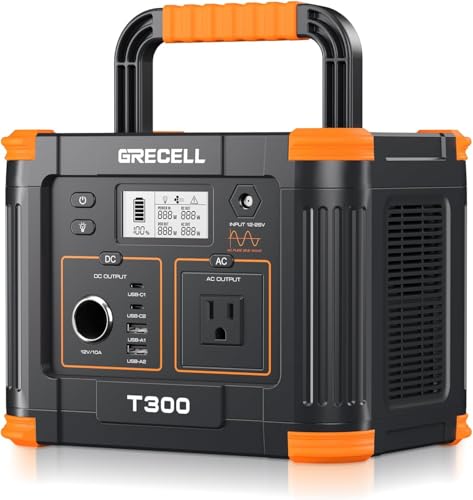
GRECELL 300W Portable Power Station 230Wh Solar Generator, 60W PD USB-C, 110V Pure Sine Wave AC for Camping & Blackouts
As an Amazon Associate we earn from qualifying purchases. Product prices and availability are accurate as of the date/time indicated.
Frequently Asked Questions
How many watts do I need to run a refrigerator during a power outage?
Plan for about 700 running watts and about 2,200 starting watts for a typical refrigerator. Check the nameplate on yours, since newer models can draw less. The generator or power station must handle the startup surge, not just the running figure.
What size generator do I need to run a whole house?
Whole-house backup typically needs 8,500 to 26,000 watts, and homes with central AC often need 15,000 to 20,000 watts or more. A load calculation by a licensed electrician will give you the right size for your home.
Can a 5,000-watt generator run central air conditioning?
Only in limited cases, such as a small unit with a soft-start kit and few other loads. Central AC is a 240 V load with a large startup surge, so most homes need a bigger generator or must skip other appliances.
Can a portable power station run my home during an outage?
It can run essentials like a fridge, lights, Wi-Fi and chargers, usually for many hours to a couple of days depending on capacity. It generally cannot run central AC, an electric water heater or a range for any useful time.
{“@context”: “https://schema.org”, “@type”: “FAQPage”, “mainEntity”: [{“@type”: “Question”, “name”: “How many watts do I need to run a refrigerator during a power outage?”, “acceptedAnswer”: {“@type”: “Answer”, “text”: “Plan for about 700 running watts and about 2,200 starting watts for a typical refrigerator. Check the nameplate on yours, since newer models can draw less. The generator or power station must handle the startup surge, not just the running figure.”}}, {“@type”: “Question”, “name”: “What size generator do I need to run a whole house?”, “acceptedAnswer”: {“@type”: “Answer”, “text”: “Whole-house backup typically needs 8,500 to 26,000 watts, and homes with central AC often need 15,000 to 20,000 watts or more. A load calculation by a licensed electrician will give you the right size for your home.”}}, {“@type”: “Question”, “name”: “Can a 5,000-watt generator run central air conditioning?”, “acceptedAnswer”: {“@type”: “Answer”, “text”: “Only in limited cases, such as a small unit with a soft-start kit and few other loads. Central AC is a 240 V load with a large startup surge, so most homes need a bigger generator or must skip other appliances.”}}, {“@type”: “Question”, “name”: “Can a portable power station run my home during an outage?”, “acceptedAnswer”: {“@type”: “Answer”, “text”: “It can run essentials like a fridge, lights, Wi-Fi and chargers, usually for many hours to a couple of days depending on capacity. It generally cannot run central AC, an electric water heater or a range for any useful time.”}}]}













