

Our editorial team weighed 's published specifications and how it stacks up against similar products in the generators category. What stands out: Exceptionally Quiet, Lightweight & Durable, and Electric Start. Where it falls short: Needs Gasoline Refueling and Occasional Battery Maintenance. That puts it at 8.2/10 on our WG Score – an excellent, well-rounded option.
 Reviewed byDaniel
No, you don’t strictly need an inverter generator for an RV, but it is the better choice for quiet campgrounds, electronics and dry camping.
Who needs a generator at all
If you camp mostly at full-hookup sites, you may rarely need one, because shore power runs the A/C, microwave and outlets directly. A generator earns its place when you dry camp or boondock, or when campground power fails.
An RV’s built-in inverter does not replace it. The inverter turns battery power into 120V for small loads, while a generator carries big AC loads and recharges the batteries. Built-in RV generators run roughly 5,000-10,000 W and portable ones roughly 1,000-6,000 W (Escapees).
When an inverter generator matters and when a conventional unit will do
| Your situation | Inverter generator? | Reason |
|---|---|---|
| Full-hookup sites only | No | Shore power does the work |
| Campgrounds with quiet hours | Yes | Quieter, steadier engine |
| Laptops, CPAP, TV electronics on generator power | Yes, preferred | Clean sine-wave output suits sensitive electronics |
| Remote land with no noise rules, big loads, tight budget | Optional | A conventional open-frame unit costs less per watt |
The practical differences come down to four things:
- Noise: inverter models often run 50-60 dB at quarter load (Camping World). Some makers quote only the quarter-load figure, so check which rating is listed, and read the campground’s own rules for limits and quiet hours.
- Power quality: true sine wave output is the safer choice for sensitive electronics, while cheaper modified sine output is choppier (Escapees). Check your electronics’ manufacturer guidance rather than assuming damage either way.
- Fuel use: fuel burn rises with load, so heavy loads like A/C burn much more than light loads (Escapees). Eco-mode inverter models can run roughly 10-20 hours per tank depending on load (Camping World).
- Weight: a Honda EU1000 is about 28.7 lbs and an EU2000 about 46 lbs, while larger models like the EU3000 weigh far more, so check the spec sheet for the exact unit. Conventional units of the same output are typically heavier.
How many watts does your RV need? A worked example
Size to the running total plus the biggest startup surge. Check the A/C nameplate for its real running and starting figures; the numbers below are assumptions for this example only.
| Load (in this example) | Running watts |
|---|---|
| 15,000 BTU roof A/C | 1,400 |
| Refrigerator on electric | 200 |
| Converter/battery charger | 600 |
| Lights, TV, device charging | 300 |
| Total running | 2,500 |
Now add the startup surge. Assume the A/C needs 3,500 W to start with no soft-start. The other loads add 200 + 600 + 300 = 1,100 W, so the peak is 3,500 + 1,100 = 4,600 W. With a soft-start device that cuts the A/C start to an assumed 2,100 W, the peak falls to 2,100 + 1,100 = 3,200 W.
With two A/C units, the running load is 2 x 1,400 + 1,100 = 3,900 W. Start them one at a time, never together.
In this example, a 2,000 W class generator is too small even for the 2,500 W running total. Escapees calls a 13.5K BTU roof A/C marginal at best on a single Honda EU2000, even with a soft-start kit. Camping World says 2,000-3,000 W inverter generators suit most travel trailers, with larger fifth wheels and motorhomes needing more.
Can an inverter generator run an RV air conditioner?
Yes, if its running watts cover your total load and its surge rating covers the A/C start. Two tools help when a single unit falls short:
- Soft-start device: it reduces the surge the compressor draws at startup. The reduction varies by product, so rely on the maker’s figures.
- Parallel kit: it links two compatible units so their output combines. The kit is usually sold separately, and both generators must be models designed to pair (Camping World, Escapees).
Altitude and heat reduce engine output, so follow the manual or label for derating. For models built around A/C loads, see these inverter generators for RV air conditioners.
30-amp vs 50-amp RVs: what the generator outlet must match
A 30-amp inlet carries up to 30 A at 120V, a ceiling of 3,600 W (30 x 120). A 50-amp RV has two 120V legs, so its ceiling is 12,000 W (50 x 240).
- 30-amp RV: look for a 30A RV-style (TT-30) outlet on the generator, or use a proper adapter from a 20A household outlet. The generator’s rated output limits you before the plug does.
- 50-amp RV: most portable inverter generators cannot supply both legs. A 50A-to-30A adapter on a 30A outlet works, but you will need to shed loads.
Use correctly rated adapters and cords, and never improvise a cord that backfeeds the RV. Run the generator outdoors, away from windows, doors and vents, and keep working CO alarms in the RV.
Lighter loads: batteries and solar as an alternative
For lights, fans, phones and a laptop, a lithium or deep-cycle battery bank with solar can replace a generator. Big heating and cooling loads are where batteries run out, because they draw far more power than a small bank can supply for long.
The decision rule: if your loads stay under a few hundred watts, batteries and solar can cover you. If you want the A/C or microwave off-grid, you need a generator, and an inverter model is the quieter, more fuel-efficient way to get one. Overnight generator fuel for a small unit is estimated at $15-20 (Escapees, rough estimate).
Our Top Picks
Ready to shop? These are the top-rated options from our related roundup, Best Inverter Generators For RV Air Conditioner of 2026.

Honda EU2200i 2200W Super Quiet Portable Inverter Generator with CO-Minder & Bluetooth App
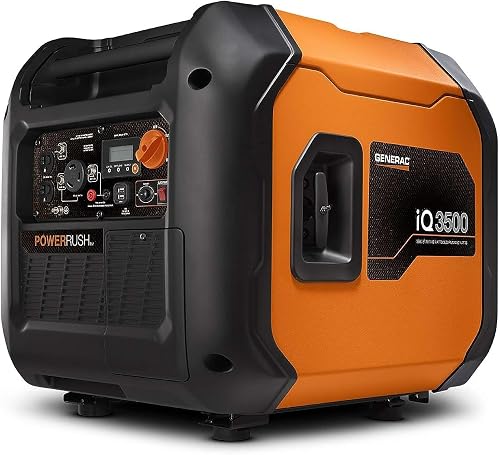
Generac iQ3500 3500W Portable Inverter Generator - Quiet, Lightweight, Electric Start, CARB Compliant for Camping & Jobsites

maXpeedingrods MXR4000GT 4000W Dual Fuel Inverter Generator with Bluetooth App Control
As an Amazon Associate we earn from qualifying purchases. Product prices and availability are accurate as of the date/time indicated.
Related reading: WEN DF680iX Dual Fuel Inverter Generator RV-Ready Electric Review 2026 · The Best Portable RV Inverter Generators of 2026
Frequently Asked Questions
Can I run my generator while the RV is driving?
No. A portable generator should not run while the RV is moving. Use the engine’s charging system, the battery bank or a built-in generator instead, and shut the portable unit off before you roll.
Can I plug in shore power and the generator at the same time?
No. Connect only one source to the RV inlet at a time. Turn off the generator and unplug it before switching to shore power.
Why does my generator trip when the A/C starts?
The A/C startup surge is higher than the generator’s surge rating, or the total load is too high. Turn off other loads, add a soft-start device, or use a larger or paralleled generator.
Can I run an inverter generator in the rain?
Only with a manufacturer-approved cover or canopy that keeps the exhaust clear and the unit ventilated. Never run it enclosed, under an awning attached to the RV, or in a compartment.
{“@context”: “https://schema.org”, “@type”: “FAQPage”, “mainEntity”: [{“@type”: “Question”, “name”: “Can I run my generator while the RV is driving?”, “acceptedAnswer”: {“@type”: “Answer”, “text”: “No. A portable generator should not run while the RV is moving. Use the engine’s charging system, the battery bank or a built-in generator instead, and shut the portable unit off before you roll.”}}, {“@type”: “Question”, “name”: “Can I plug in shore power and the generator at the same time?”, “acceptedAnswer”: {“@type”: “Answer”, “text”: “No. Connect only one source to the RV inlet at a time. Turn off the generator and unplug it before switching to shore power.”}}, {“@type”: “Question”, “name”: “Why does my generator trip when the A/C starts?”, “acceptedAnswer”: {“@type”: “Answer”, “text”: “The A/C startup surge is higher than the generator’s surge rating, or the total load is too high. Turn off other loads, add a soft-start device, or use a larger or paralleled generator.”}}, {“@type”: “Question”, “name”: “Can I run an inverter generator in the rain?”, “acceptedAnswer”: {“@type”: “Answer”, “text”: “Only with a manufacturer-approved cover or canopy that keeps the exhaust clear and the unit ventilated. Never run it enclosed, under an awning attached to the RV, or in a compartment.”}}]}













