

Our editorial team weighed Westinghouse's published specifications and how it stacks up against similar products in the generators category. What stands out: Tri-Fuel Flexibility, Powerful 550cc Cast-Iron Engine, and CO Sensor Auto-Shutdown. Where it falls short: Heavy at 230 lbs and Large Footprint, Limited Solo Portability. That puts it at 8.9/10 on our WG Score – an excellent, well-rounded option.
 Reviewed bySarah Watts
A 5000 watt generator costs about $500 to $1,000 for a conventional portable; inverter and dual fuel models cost more. The price depends mostly on engine type, electric start, brand tier and whether the label shows running or starting watts. Compare units at the same running watts, since that figure sets what the generator can actually power.
Typical 5000 watt generator price range
Conventional open-frame gasoline portables in the 3,500 to 5,000 watt class are commonly estimated at about $500 to $1,000 (thepricer.org). Treat that as a rough estimate, not a live quote. Prices move with sales, shipping and stock, so check current Home Depot, Lowe’s or Harbor Freight listings.
| Type | Price position | What you are paying for |
|---|---|---|
| Conventional gasoline | Baseline, about $500 to $1,000 | Open-frame engine, simplest design, louder operation |
| Inverter | Above a conventional unit of the same output | Electronics that produce cleaner power, usually in a quieter enclosure |
| Dual fuel | Above the gasoline-only version from the same brand | Propane hookup in addition to gasoline |
Wide inverter ranges quoted online cover every size from small to large, so only compare units at the same running watts.
What pushes the price up or down
Beyond engine type, these features account for most of the gap between two 5000 watt listings:
- Electric start: a push-button or key-start system costs more than a recoil pull cord, and it matters on larger engines that are harder to pull.
- CO shutoff: a sensor that stops the engine when carbon monoxide builds up. It is an add-on safeguard, not a replacement for running the unit outdoors and keeping battery-powered CO alarms inside.
- Brand tier: budget names such as Predator, WEN and DuroMax generally sit below premium names such as Honda and Generac. Confirm the pattern on the specific models you are comparing.
- Warranty: length and terms vary by model, and longer coverage is often a sign of a higher price tier.
- Tank size, runtime and noise rating: a larger fuel tank and a lower decibel rating add cost.
- Outlet layout: a 240-volt outlet and a transfer-switch-ready receptacle are not on every model.
Running watts vs starting watts on the label
Many motors need a short burst of extra power to start. That burst is the starting (surge) watts figure. The running (rated) watts figure is what the unit holds continuously. A listing that leads with a big headline number may be quoting the starting figure, so its continuous output can be lower. One Harbor Freight model sold as "5000 watt" was reported to deliver only 4,000 running watts; verify any specific model on the manufacturer’s spec sheet.
Read the nameplate or spec sheet in this order:
- Find the running or rated watts and make sure it is near or above 5,000.
- Find the starting or peak watts and treat it as a short-term limit only.
- Confirm the outlet voltages (120 volt only, or 120/240 volt).
- Note the fuel types the unit is approved for.
Check the label or manual for the exact figures on your model. Two units at the same sticker price can differ by 1,000 running watts.
What 5,000 running watts can power: a worked example
The wattages below are hypothetical round numbers for this example. Your appliances will differ, so read their labels.
| Load in this example | Running watts |
|---|---|
| Refrigerator | 700 |
| Sump pump | 800 |
| Furnace fan | 600 |
| Window air conditioner | 1,200 |
| Lights and chargers | 200 |
| Total | 3,500 |
Arithmetic: 700 + 800 + 600 + 1,200 + 200 = 3,500 watts. On a unit with 5,000 true running watts, that leaves 5,000 − 3,500 = 1,500 watts of headroom. On a unit that actually delivers 4,000 running watts, the same load leaves only 500 watts. This is why the running figure matters more than the headline number.
For a longer list of loads, see whether a 5000 watt generator is big enough.
Ongoing and hidden costs after you buy
The sticker price is only part of what you spend.
Fuel
A 5,000 watt unit at moderate load is estimated to burn roughly 0.5 gallon of gasoline per hour. That is an unverified, low-confidence figure, so use the fuel-consumption chart for your model. Multiply gallons per hour by hours run by your local gas price. In this example, 0.5 gallon per hour for 12 hours is 0.5 × 12 = 6 gallons.
Maintenance and storage
- Engine oil and filter changes at the interval the manufacturer lists.
- Fuel stabilizer if gasoline will sit in the tank or in storage.
- Approved fuel containers, kept away from ignition sources.
- A cover that keeps the unit dry between uses.
Connecting it to the house
Adding a transfer switch or interlock to a portable generator is estimated at about $400 to $850 (thepricer.org). The inlet, a properly rated heavy-gauge cord and electrician labor all affect the total. Permit and inspection rules depend on your local code, and the work should be done by a licensed electrician rather than by plugging the generator into a wall outlet.
Cost per running watt: a quick value check
To compare two listings fairly, divide the price by the running watts, not the headline watts.
Formula: price ÷ running watts = cost per running watt.
The prices and wattages below are hypothetical and chosen only to show the math.
| Hypothetical unit | Price | Running watts | Cost per running watt |
|---|---|---|---|
| Unit A | $750 | 4,000 | $750 ÷ 4,000 = $0.1875 (about $0.19) |
| Unit B | $900 | 5,000 | $900 ÷ 5,000 = $0.18 |
In this example, Unit B costs $150 more but is cheaper per running watt and has more usable capacity. Add the extras that matter to you, such as electric start or a longer warranty, to the price before dividing, and compare the results.
Checking a 5000 watt generator price at current retailers
Because published ranges age quickly, build your own snapshot before you decide:
- Write down the date you checked each listing.
- Record the price before tax and shipping.
- Note what is included, such as oil, a wheel kit, a battery or a cord adapter.
- Compare units only at the same running watts and the same fuel setup.
- Record the warranty length for each.
Our live roundups track current options, including affordable 5000 watt generators and 5000 watt dual fuel generators, so you can see how the tiers above play out on real models.
Our Top Picks
Ready to shop? These are the top-rated options from our related roundup, Best Affordable 5000 Watt Generators of 2026.
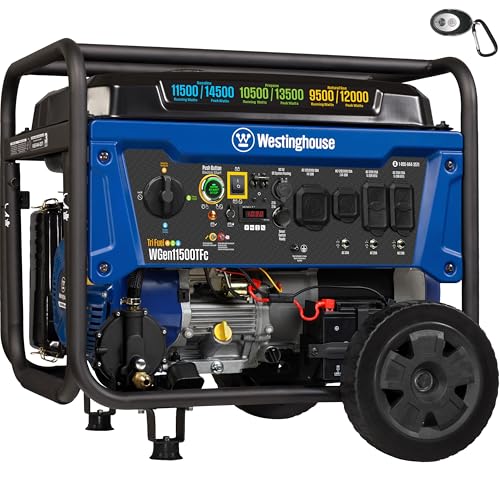
Westinghouse WGen11500TFc 14500 Peak Watt Tri-Fuel Portable Generator with Remote Start & CO Sensor

Westinghouse iGen5000DF 5000 Peak Watt Dual Fuel Inverter Generator - Super Quiet RV Ready Remote Start

WEN RV-Ready 4000-Watt Open Frame Inverter Generator GN400iM
As an Amazon Associate we earn from qualifying purchases. Product prices and availability are accurate as of the date/time indicated.
Frequently Asked Questions
Is a 5000 watt generator cheaper used?
Usually yes, since used units sell below new ones. Check the running watts, engine condition and outlets, and ask to see it run under load before you pay.
Does a 5000 watt inverter cost more than a 7000 watt conventional?
It can. Inverter models cost more than conventional units of the same output, so a 5000 watt inverter can land near or above a larger conventional unit. Compare the actual listings.
Will a 5000 watt generator run a 240-volt welder?
Only if the generator has a 240-volt outlet and its running and starting watts cover the welder’s nameplate draw. Check both labels before you buy.
Does a higher starting watts number make a generator cost more?
The starting figure is only a short-term limit. Judge the price against the running watts, which is what the unit holds continuously.
Will a 5000 watt generator start a well pump?
Compare the pump’s starting wattage on its nameplate with the generator’s starting watts rating. A 240-volt pump also needs a 240-volt outlet on the generator.
{“@context”: “https://schema.org”, “@type”: “FAQPage”, “mainEntity”: [{“@type”: “Question”, “name”: “Is a 5000 watt generator cheaper used?”, “acceptedAnswer”: {“@type”: “Answer”, “text”: “Usually yes, since used units sell below new ones. Check the running watts, engine condition and outlets, and ask to see it run under load before you pay.”}}, {“@type”: “Question”, “name”: “Does a 5000 watt inverter cost more than a 7000 watt conventional?”, “acceptedAnswer”: {“@type”: “Answer”, “text”: “It can. Inverter models cost more than conventional units of the same output, so a 5000 watt inverter can land near or above a larger conventional unit. Compare the actual listings.”}}, {“@type”: “Question”, “name”: “Will a 5000 watt generator run a 240-volt welder?”, “acceptedAnswer”: {“@type”: “Answer”, “text”: “Only if the generator has a 240-volt outlet and its running and starting watts cover the welder’s nameplate draw. Check both labels before you buy.”}}, {“@type”: “Question”, “name”: “Does a higher starting watts number make a generator cost more?”, “acceptedAnswer”: {“@type”: “Answer”, “text”: “The starting figure is only a short-term limit. Judge the price against the running watts, which is what the unit holds continuously.”}}, {“@type”: “Question”, “name”: “Will a 5000 watt generator start a well pump?”, “acceptedAnswer”: {“@type”: “Answer”, “text”: “Compare the pump’s starting wattage on its nameplate with the generator’s starting watts rating. A 240-volt pump also needs a 240-volt outlet on the generator.”}}]}













