

Our editorial team weighed 's published specifications and how it stacks up against similar products in the generators category. What stands out: Exceptionally Quiet at 52dBA, 12-Hour Runtime, and Lightweight & Portable. Where it falls short: Small 0.98-Gallon Tank and Parallel Cord Sold Separately. That puts it at 8.5/10 on our WG Score – an excellent, well-rounded option.
 Reviewed byDaniel
Generator sizes run from about 1,000 watts for small portable units up to 20,000 watts or more for home standby models.
Generator size classes and what each typically powers
| Size class | Typical running watts | Typically powers | Voltage |
|---|---|---|---|
| Small portable / inverter | 1,000–3,000 | Phones, laptops, lights, TV, CPAP, a small fridge, camp loads | 120V |
| Mid-size portable | 3,000–7,500 | Fridge, sump pump, lights, furnace blower, a window AC | 120V, some 240V |
| Large portable | 8,000–12,000 | 240V loads such as a well pump or central AC, wired through a transfer switch | 120V and 240V |
| Home standby | 10,000–24,000 | Essential circuits up to most of a house | 120V and 240V |
These are rough conventions, not industry standards. Manufacturers draw the lines differently, so go by the wattage on the specific model’s label. Industrial generators sit well above this range, commonly starting around 50 kW, and are not used for typical homes.
Running watts vs starting watts
Running (rated) watts is what a generator can supply continuously. Starting (peak or surge) watts is extra output available for a few seconds, which motors and compressors need to get going. Refrigerators, sump pumps and air conditioners all draw a surge at startup, then settle to their lower running figure.
As a rough estimate, a motor can briefly draw two to three times its running watts when it starts. The appliance nameplate gives the real number, so use it instead of this estimate.
Watch the units on labels. One kilowatt (kW) equals 1,000 watts. Some labels instead show kVA, which measures apparent power and is not the same as usable watts. Compare generators using the watts or kW figure.
How generator types map onto the size classes
- Inverter generators: mostly found in the small and lower mid-size classes. They are quieter and compact, with 120V output on most models. See what size inverter generator you need for matching one to your loads.
- Conventional open-frame portables: cover mid-size through large portable. They are louder and heavier, and weight climbs with output. Units around 7,500 watts are often well over 200 lb, so check the spec sheet for the model.
- Dual fuel portables: usually mid-size and large. They run on gasoline or propane, and the propane rating is typically lower than the gasoline rating, so read both figures.
- Standby generators: permanently installed, usually fueled by natural gas or propane. They make up the top class and start automatically through an automatic transfer switch.
Central AC and other big loads by size
Central air conditioning is the load that pushes a home into the larger classes. In the table above, a well pump or central AC falls in the large portable class, at roughly 8,000–12,000 running watts, and it needs a 240V outlet and a transfer switch. The exact figure depends on the compressor model, so confirm it against the AC’s own label before choosing a size.
Whole-home backup that includes central AC moves into the home standby class, which runs from about 10,000 to 24,000 watts in the table. Where a house lands in that range depends on the house and which circuits it needs to power.
Smaller classes can handle a window AC, but central AC and other big 240V motor loads generally call for the large portable or standby classes. Because manufacturers draw the lines differently, compare the model’s rated watts to your loads rather than relying on the class name alone.
Worked example: picking a size class from your loads
Here is one illustrative set of loads. These figures are rough estimates for this example only, not typical values for every appliance.
- List running watts: fridge 700 + sump pump 800 + lights 200 + furnace blower 500 = 2,200 W.
- Find the biggest startup surge. In this example the sump pump starts at 2,100 W, which is 1,300 W above its running 800 W (2,100 − 800).
- Add that extra surge to the running total: 2,200 + 1,300 = 3,500 W needed at startup.
The decision rule: the generator’s running rating must cover 2,200 W, and its starting rating must cover 3,500 W. Both fit the low end of the mid-size class in the table. If a model’s ratings land right at those numbers, step up to the next size. For a fuller method, see how to size a generator for your home.
120V or 240V, transfer switches and standby sizing
Check voltage before size. Small units usually offer only 120V. Central AC, well pumps, electric dryers and ranges use 240V, which means a mid-size or larger model with a 240V outlet.
Powering house circuits needs a transfer switch or interlock installed by a licensed electrician under local code. Never connect a generator to a house through an outlet.
Standby units are sized to the house, not to a label alone. An installer or electrician should run a load calculation, pull permits and handle gas and electrical connections as local code requires. For help deciding what to back up, see what size backup generator you need.
Our Top Picks
Ready to shop? These are the top-rated options from our related roundup, Best Portable Electric Power Generators of 2026.

Honda EU2200iTAN 2200W Super Quiet Portable Inverter Generator with CO-Minder - Ideal for Camping, RV, Home Backup

Westinghouse iGen2800 2800 Peak Watt Super Quiet Lightweight Portable Inverter Generator - Gas Powered, Parallel Ready
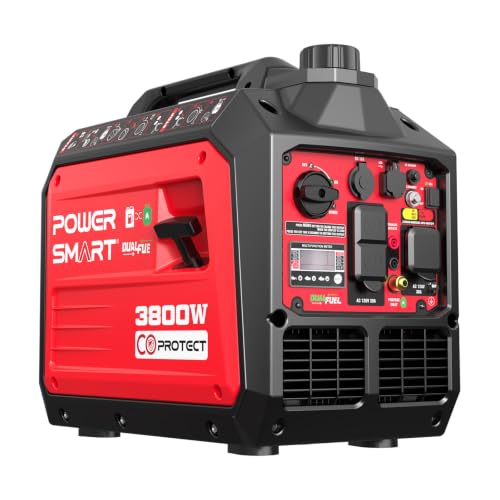
PowerSmart 3800 Watt Dual Fuel Inverter Generator Quiet Portable Gas Propane with CO Sensor RV Ready
As an Amazon Associate we earn from qualifying purchases. Product prices and availability are accurate as of the date/time indicated.
Frequently Asked Questions
Is a bigger generator always better?
No. A generator far larger than your loads costs more, weighs more and burns more fuel at light load. Choose the smallest class whose running and starting ratings cover your list, with some headroom.
Can I run a generator at its peak rating the whole time?
No. Peak watts are only available for a few seconds during startup. Continuous loads must stay within the running rating, and overloading can trip the breaker or damage the unit.
Can I combine two small inverter generators instead of buying one large one?
Some inverter models support parallel operation with a manufacturer cable or kit. It usually works only between compatible units, typically from the same maker, so check the manual before buying a second one.
Can a portable generator power an entire house?
Only if its ratings cover the circuits you run and it is connected through a transfer switch or interlock. Many homes with central air or electric heat exceed what a portable can handle, so you may need to run only selected circuits.
{“@context”: “https://schema.org”, “@type”: “FAQPage”, “mainEntity”: [{“@type”: “Question”, “name”: “Is a bigger generator always better?”, “acceptedAnswer”: {“@type”: “Answer”, “text”: “No. A generator far larger than your loads costs more, weighs more and burns more fuel at light load. Choose the smallest class whose running and starting ratings cover your list, with some headroom.”}}, {“@type”: “Question”, “name”: “Can I run a generator at its peak rating the whole time?”, “acceptedAnswer”: {“@type”: “Answer”, “text”: “No. Peak watts are only available for a few seconds during startup. Continuous loads must stay within the running rating, and overloading can trip the breaker or damage the unit.”}}, {“@type”: “Question”, “name”: “Can I combine two small inverter generators instead of buying one large one?”, “acceptedAnswer”: {“@type”: “Answer”, “text”: “Some inverter models support parallel operation with a manufacturer cable or kit. It usually works only between compatible units, typically from the same maker, so check the manual before buying a second one.”}}, {“@type”: “Question”, “name”: “Can a portable generator power an entire house?”, “acceptedAnswer”: {“@type”: “Answer”, “text”: “Only if its ratings cover the circuits you run and it is connected through a transfer switch or interlock. Many homes with central air or electric heat exceed what a portable can handle, so you may need to run only selected circuits.”}}]}













