

Our editorial team weighed PowerSmart's published specifications and how it stacks up against similar products in the generators category. What stands out: Dual Fuel Flexibility, Quiet Operation, and Reliable Recoil Start, Solid Build. Where it falls short: Manual Recoil Start, Harder in Cold and ~4-Hour Runtime at 50% Load. That puts it at 8.4/10 on our WG Score – an excellent, well-rounded option.
 Reviewed bySarah Watts
The right generator size for a building is its running watts plus the largest motor’s starting surge, plus 25% headroom.
Build the load list from nameplates
Start by deciding what the generator must carry: the whole building or only critical circuits such as the refrigerator, furnace blower, well pump, lights and internet. Then read the nameplate or manual of each item. Nameplates list watts, or amps and volts.
- Running watts are what a load draws continuously.
- Starting watts are the brief surge motors draw at startup (compressors, pumps, blower motors). Use the manufacturer’s figure. Where none is published, treat a multiple of running watts as a rough estimate only.
- If only amps are printed, watts = amps x volts (120 or 240).
Motors rarely start at the same instant, so add up all running watts, then add only the single largest surge increase (starting watts minus running watts of that one motor). For a step-by-step version aimed at houses, see how to size a generator for your home.
Worked example: a small house, critical loads
| Load | Voltage | Running W | Starting W |
|---|---|---|---|
| LED lights (15 fixtures) | 120V | 150 | 150 |
| Refrigerator | 120V | 700 | 2,100 |
| Furnace blower | 120V | 600 | 1,800 |
| Well pump (1 HP) | 240V | 1,200 | 3,600 |
| Microwave | 120V | 1,100 | 1,100 |
| Router, TV, computers | 120V | 400 | 400 |
These are assumed example values; replace them with your own nameplate numbers.
- Running total: 150 + 700 + 600 + 1,200 + 1,100 + 400 = 4,150 W.
- Largest surge increase is the well pump: 3,600 – 1,200 = 2,400 W.
- Peak load: 4,150 + 2,400 = 6,550 W.
- Add 25% headroom: 6,550 x 1.25 = 8,187.5, so look for about 8,200 running watts and round up to the next available model.
To see how a given wattage compares with typical appliances, check how many appliances a generator can run by size.
Use panel amperage as a ceiling, not a target
Your main breaker gives the maximum the building can draw: amps x 240 V. A 100 A service is 100 x 240 = 24,000 W and a 200 A service is 200 x 240 = 48,000 W. That is what the wiring and utility connection allow, not what you actually use. Sizing to it buys a far larger machine than a load list would justify. Use it only to confirm that your calculated number sits well below the service limit.
Handle 240V loads and generator outlets
A 240V load draws half the amps of the same wattage at 120V: amps = watts / 240. In the example, the pump draws 1,200 / 240 = 5 A running and 3,600 / 240 = 15 A while starting. The generator needs a 240V receptacle or panel output rated for that current, and the 120V loads should be spread across both legs. Check the manual for the per-leg limit.
Well pumps, central AC and electric dryers are the usual 240V loads. Pump surge depends on horsepower and model; see the generator size for a well pump by horsepower for pump-specific numbers.
Portable or standby, and why a transfer switch is required
A portable generator suits a calculated load that fits its output and a handful of circuits. A standby generator is permanently installed, starts automatically and can carry a whole building. The dividing line is your load total from the steps above, plus whether you want automatic operation.
Any connection to building wiring needs a transfer switch or interlock installed by a licensed electrician. Never plug a generator into a wall outlet, because that backfeeds the grid and can electrocute utility workers. Installation falls under the NEC and local permits; NEC Article 702 covers optional standby systems and Article 220 covers load calculations. Have the electrician confirm your numbers. For sizing the backup itself, see what size backup generator you need.
Commercial buildings: demand factor, kW and kVA
Shops and offices are sized in kW, then converted to kVA. Not every connected load runs at once, so an engineer applies a demand factor. Vendor guides give a typical commercial power factor of 0.8 to 0.9 and use 0.8 as the default; kVA = kW / power factor.
Assumed example: 24 kW connected x 0.75 demand factor = 18 kW. Add 25%: 18 x 1.25 = 22.5 kW. Convert: 22.5 / 0.8 = 28.1 kVA, then round up to the next standard unit.
Match the building’s voltage and phase. A three-phase service with three-phase motors needs a three-phase generator. Square-foot rules of thumb that vendors publish are rough and are not code-compliant load calculations.
Fuel type and runtime
Runtime = usable fuel capacity / hourly consumption at your actual load. Take consumption from the fuel table in the manual, which lists it at set load levels, not from the tank size. Natural gas standby units run as long as the gas supply lasts, while portables are limited by the tank or cylinder. Diesel manufacturers also warn that running a unit far below its rating for long periods can cause wet stacking, so avoid an oversized choice.
Our Top Picks
Ready to shop? These are the top-rated options from our related roundup, Best Dual Fuel Portable Generators For Whole House of 2026.

Westinghouse iGen4000DFc 4000 Peak Watt Dual Fuel Inverter Generator - Super Quiet RV Ready Remote Start CO Sensor
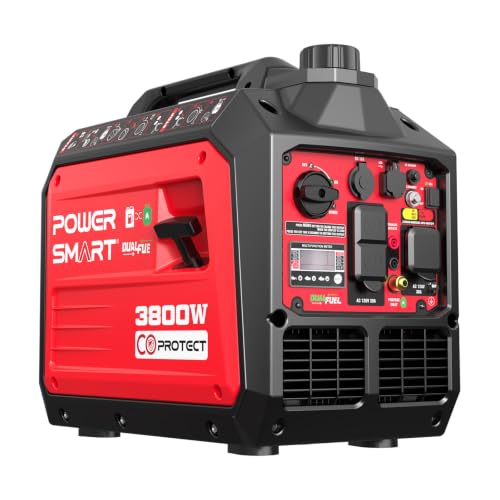
PowerSmart 3800 Watt Dual Fuel Inverter Generator Quiet Portable Gas Propane with CO Sensor RV Ready

maXpeedingrods MXR4000GT 4000W Dual Fuel Inverter Generator with Bluetooth App Control
As an Amazon Associate we earn from qualifying purchases. Product prices and availability are accurate as of the date/time indicated.
Frequently Asked Questions
Can I size a generator from my electric bill?
Only a commercial bill that lists peak demand in kW works, because kWh is energy used over time, not watts. A residential kWh total cannot be converted to a generator size. Use a load list or a clamp meter instead.
Do I need a three-phase generator?
Yes if the building has three-phase service and three-phase motors. A single-phase house or small shop needs a single-phase generator, and the electrician matches voltage and phase to the service.
Can I run two smaller generators together?
Only if the manufacturer offers a parallel kit for those models. Getting 240V from a parallel pair needs a kit built for 240V output, and the manual states which models can be combined.
Does a soft starter let me buy a smaller generator?
It can, because a soft starter on an AC compressor lowers its starting surge. Recalculate the largest surge using the starting amps on the device’s label, not the original compressor figure.
{“@context”: “https://schema.org”, “@type”: “FAQPage”, “mainEntity”: [{“@type”: “Question”, “name”: “Can I size a generator from my electric bill?”, “acceptedAnswer”: {“@type”: “Answer”, “text”: “Only a commercial bill that lists peak demand in kW works, because kWh is energy used over time, not watts. A residential kWh total cannot be converted to a generator size. Use a load list or a clamp meter instead.”}}, {“@type”: “Question”, “name”: “Do I need a three-phase generator?”, “acceptedAnswer”: {“@type”: “Answer”, “text”: “Yes if the building has three-phase service and three-phase motors. A single-phase house or small shop needs a single-phase generator, and the electrician matches voltage and phase to the service.”}}, {“@type”: “Question”, “name”: “Can I run two smaller generators together?”, “acceptedAnswer”: {“@type”: “Answer”, “text”: “Only if the manufacturer offers a parallel kit for those models. Getting 240V from a parallel pair needs a kit built for 240V output, and the manual states which models can be combined.”}}, {“@type”: “Question”, “name”: “Does a soft starter let me buy a smaller generator?”, “acceptedAnswer”: {“@type”: “Answer”, “text”: “It can, because a soft starter on an AC compressor lowers its starting surge. Recalculate the largest surge using the starting amps on the device’s label, not the original compressor figure.”}}]}













