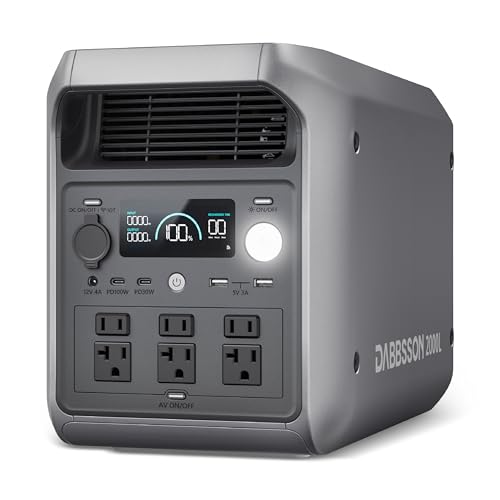
Our editorial team weighed Dabbsson's published specifications and how it stacks up against similar products in the generators category. What stands out: Lightweight for 2048Wh Capacity, Handles Heavy Simultaneous Loads, and Fast 100W USB-C Charging. Where it falls short: Fan Runs Even at Low/No Load and Challenging WiFi App Setup. That puts it at 8.4/10 on our WG Score – an excellent, well-rounded option.
 Reviewed byEthan
Among the best 3000 watt portable power stations, the Anker SOLIX F3000 Portable Power Station is the best-overall pick. Its 3,072Wh LiFePO4 battery, 3,600W pass-through charging and 120/240V output suit home backup, and the system can expand to 24kWh. The other five models each lean toward a different need, such as portability, quiet running or a larger battery. Compare them side by side below, then use the buying guide to match watts and watt-hours to your appliances. You can also browse every model in our 2,000 to 3,999 watt category.
Pros
- Exceptionally lightweight and compact for its 2048Wh capacity, easy to transport
- Handles heavy loads like heat guns and fridges simultaneously with stable output
- Fast USB-C charging up to 100W powers laptops without adapters
- Reliable UPS mode prevents interruptions for PCs, fridges, and medical devices
- Excellent customer service and 5-year warranty for peace of mind
Cons
- Fan activates periodically even at low or no loads, creating noticeable noise
- WiFi app setup can be challenging, requiring Bluetooth fallback
- Energy management settings like discharge limits may not function reliably
The Dabbsson 2000L is a versatile 2048Wh portable power station designed for camping, RV trips, home backups, and job sites. Powered by innovative semi-solid LiFePO4 batteries, it offers extended runtime and superior safety, making it ideal for users needing dependable off-grid power without the bulk of traditional generators.
Standout features include a massive 2200W AC output with 3300W power boost, enabling it to run multiple high-demand devices like refrigerators, heat guns, and blenders simultaneously. Real-world tests confirm stable performance under load, with 100W USB-C ports charging gaming laptops efficiently and a <15ms UPS mode ensuring uninterrupted power for critical devices. Ultra-fast recharging to 80% in 1.5 hours via AC or 800W solar input keeps you powered flexibly.
Its slim 11.2 x 18.3 x 8.9-inch frame weighs just 41 pounds, praised for fitting neatly beside car AC units or in RVs. The build features a fire-resistant UL94-V0 design, intuitive display, and app control via WiFi or Bluetooth for monitoring and customization. Customers highlight its quiet operation during use and reliability on camping trips powering lights, fridges, and e-bikes.
Drawbacks include fan noise at idle, tricky WiFi setup, and occasional app glitches like unresponsive energy limits. Despite these, the overall build quality and performance earn high marks from users who value its portability and power.
Verdict: The Dabbsson 2000L excels as a lightweight powerhouse for outdoor enthusiasts and emergency preparedness, delivering exceptional value with long-lasting batteries and versatile outputs. Highly recommended for anyone prioritizing portability and runtime.
Capacity: 2048Wh
Output: 2200W rated, 3300W boost (6 AC outlets)
Battery: Semi-solid LiFePO4, 4000+ cycles
Ports: 6x AC, 2x USB-C (100W/30W), 2x USB-A, Car Port, DC5521
Charging: 1500W AC, 800W solar, car charging
Dimensions: 11.2 x 18.3 x 8.9 inches, 41 lbs
Features: App control, <15ms UPS, LED light, overload protection
Users rave about its compact size and power for camping, running fridges for 20 hours and charging e-bikes seamlessly. One reviewer called it the 'smallest and lightest 2000Wh power bank' with modern design and top customer service.
Campers powered lights, monitors, kettles, and more over 5-day trips, praising the display for runtime estimates. Home users appreciate reliable outage protection for freezers and laptops.
Some note fan noise and WiFi hurdles but agree the value outweighs minor issues, especially with the 5-year warranty.

Pros
- High 3600W output powers air fryers, microwaves, and RVs effectively
- Fast recharging and solar compatibility extend off-grid runtime
- UL-certified UPS ensures no interruptions for security cams and calls
- Compact for its capacity, praised in reviews for camping and backups
- Durable build with 5-year warranty and positive real-world tests
Cons
- Heavy at 59.5 pounds, often requires two handles or a cart to move
- Lacks built-in wheels or cord storage, reducing true portability
- One review noted shutdowns in sub-15°F temps despite specs
The Jackery HomePower 3000 is a high-capacity portable power station designed for homeowners, RVers, and anyone needing robust backup during outages or off-grid adventures. With 3072Wh LFP battery storage and 3600W output (7200W surge), it powers essentials like refrigerators for up to 2 days, fans, lights, routers, and even microwaves or air fryers, making it a go-to for emergencies, storms, or dry camping.
Standout features include a UL-certified UPS that switches in under 20ms to prevent disruptions to security systems, medical devices, or video calls. Versatile charging reaches full in 2.2 hours via AC, supports solar up to 80% in 9 hours with two 200W panels, and offers app monitoring plus multiple ports like dual 100W USB-C PD and RV TT-30. Feedback highlights its real-world prowess, running RVs for days, powering 43-inch TVs, and handling power tools effortlessly.
Build quality shines with ChargeShield 2.0 AI tech extending battery life to 4000 cycles, a space-efficient CTB design that's 47% smaller and 43% lighter than competitors, and a sturdy honeycomb base. At 59.5 pounds and 16.4 x 12.8 x 12 inches, it's portable with dual handles but heavy for solo lifting, prompting some users to add carts.
Drawbacks include its weight limiting easy mobility and rare cold-weather issues below 15°F in one test. Overall, the HomePower 3000 excels as a reliable, future-proof solar generator for home backups and RV use, earning strong praise for performance and value.
Capacity: 3072Wh LFP Battery
Output: 3600W Continuous (7200W Surge), 120V AC
Ports: 4 AC, TT-30 RV, USB-C PD (x2), USB-A, DC
Charge Time: 2.2 Hours AC (0-100%), 9 Hours Solar (80% with 400W)
Weight/Dimensions: 59.5 lbs, 16.4"L x 12.8"W x 12"H
Warranty: 5 Years
Ideal for RV owners dry camping, homeowners in storm-prone areas, or off-grid enthusiasts. Pair with SolarSaga 200W panels for renewable charging. Consider weight if solo portability matters; opt for carts or lighter models like Explorer 2000 v2 for less power needs. Test fridge runtime matches real use at 30+ hours per reviews.

Pros
- Large 3072Wh LiFePO4 capacity with a 5-year warranty
- Low idle power draw extends standby and backup time
- Quiet operation, even under heavy load
- Built-in wheels and handle make the 91.5 lb unit easier to move
- App control for charging limits, power saving, and monitoring
Cons
- At 91.5 lb, it is at the heavy end of portable power stations
- USB ports stay active with a standing power draw that can interfere with charging small devices
- No built-in 240V split-phase output for whole-home backup
The Anker SOLIX F3000 is a portable power station built around a 3072Wh LiFePO4 battery. It delivers 3600W of AC output and can be recharged from AC power, solar panels, or a generator, with solar input rated at 2400W max.
This unit fits homeowners who want backup power for refrigerators, lights, electronics, and medical or comfort devices during outages. It also suits RV owners and campers, where reviewers have reported running an RV air conditioner for over 4 hours and recharging from solar and a gas generator.
Standout features include pass-through charging, which lets the unit power loads while it recharges, and expansion to 24kWh with compatible batteries. The 120V/240V output and parallel capability allow it to run heavier appliances when two units are paired. The Bluetooth and Wi-Fi app gives control over charging limits, power saving, and port behavior.
Build quality reviewers describe as solid and well designed, with a handle and built-in wheels that help with a 91.5 lb unit. The chassis is large for a portable unit, so storage space and transport access should be considered before buying.
Drawbacks include the weight, USB ports that draw standing power and can interfere with charging very small devices, and the lack of built-in 240V split-phase output for whole-home backup. Overall, the F3000 is a strong choice for backup power, RV use, and off-grid charging, provided its weight and output configuration fit your needs.

Pros
- Exceptionally fast charging and versatile input options keep you ready quickly
- Powerful output handles real-world loads like freezers, lights, and chargers effortlessly
- Long-lasting LiFePO4 battery praised for reliability over lead-acid alternatives
- Quiet operation and app integration enhance usability for home and camping
- Solid build quality feels premium and withstands daily use
Cons
- Fewer outlets than previous models may limit simultaneous device connections
- AC outlets auto-shutoff at very low power draws under 15W, requiring DC alternatives for efficiency
- Solar charging can be slower than expected, especially with panel shading
The EcoFlow DELTA 3 Max Plus is a high-capacity 2048Wh LiFePO4 portable power station designed for home backup, RV camping, and off-grid adventures. With 3000W AC output expandable to 3800W via X-Boost, it powers demanding appliances like refrigerators, microwaves, and power tools, making it perfect for users needing reliable energy during outages or remote trips.
Standout features include a lightning-fast 80% recharge in 43 minutes across five methods (AC, solar, car, generator, or hybrid), expandable storage up to 10kWh, and a 10ms UPS transfer time for seamless protection of PCs and medical gear. Real-world performance shines in reviews: campers pair it with EVs like Rivian for buffered power, garage users run freezers and chargers indefinitely with solar input, and it outperforms traditional UPS units with superior LFP battery longevity.
Build quality is robust yet portable at 49 pounds with dimensions of 9.52 x 12 x 19.44 inches, featuring a clear display and intuitive app for monitoring and customization. Its whisper-quiet 25dB operation suits nighttime use, though some note fewer outlets and low-power AC shutoffs as minor hurdles, best mitigated with DC ports or inverters.
Drawbacks include limited automation for peak-hour grid avoidance and slower solar yields from shading, but these pale against its power, speed, and scalability. Verdict: A top-tier solar generator for proactive preppers, RV enthusiasts, and homeowners seeking durable, app-smart backup without gas hassles.
Capacity: 2048Wh LiFePO4 Battery
Output: 3000W AC (3800W X-Boost), 3 AC Outlets
Charging: 80% in 43 mins (AC/Solar/Car/Generator/Hybrid)
Dimensions: 9.52"L x 12"W x 19.44"H, 49 lbs
Expandability: Up to 10kWh with extra batteries
Warranty: 5 Years

Pros
- High 3000W output handles power tools, grills, and TVs simultaneously
- Fast recharge and long 10-year LFP battery lifespan
- Expandable system with up to 10 batteries for massive capacity
- Rugged, safe design with flame-retardant materials and quiet operation
- Versatile ports including DJI drone fast-charge
Cons
- Heavy at 48.5 lbs, requires effort to transport without wheels
- Occasional unexpected sleep mode interrupts use
- App connectivity can feel limited for advanced settings
The DJI Power 2000 is a compact 2048Wh LFP portable power station designed for demanding users like campers, RVers, off-grid enthusiasts, and homeowners seeking reliable backup power. With 3000W continuous output and a 4500W peak, it runs high-draw appliances such as kettles, power tools, projectors, and even pellet grills without breaking a sweat, making it a versatile electric generator alternative to noisy gas models.
Standout performance shines in real-world scenarios: recharges to 80% in just 55 minutes via AC, supports up to 1800W solar input, and offers seamless 10ms UPS switching for uninterrupted device protection. Reviews praise its ability to replace gas generators for business tools, run Starlink and TVs for hours, and provide quiet power on boats or job sites. Expansion to 22.5kWh with add-on batteries ensures extended runtime for blackouts or remote adventures.
Build quality impresses with a flame-retardant housing, sub-nano coatings, and smart BMS for safety in wet or rugged conditions, plus ultra-quiet 30dB operation quieter than a whisper. At 17.6 x 8.8 x 12.7 inches and 48.5 lbs, it's portable yet sturdy, with 15 ports including dual 140W USB-C and DJI-specific fast-charge options. Wireless app control via DJI Home adds convenience for monitoring.
Drawbacks include its weight, which may need a trolley for easy movement, rare sleep mode glitches, and app quirks for some advanced features. Overall, the DJI Power 2000 earns high marks for power density, speed, and reliability, making it a top pick for those prioritizing performance over lightness.
Capacity: 2048Wh LFP battery
Output: 3000W continuous (4500W peak), 15 ports including 4 AC, 4 USB-C (140W max), 4 USB-A
Recharge: 0-80% in 55 mins (AC), supports solar up to 1800W
Noise: 30dB ultra-quiet
Dimensions/Weight: 17.6 x 8.8 x 12.7 inches, 48.5 lbs
Other: 10ms UPS, expandable to 22.5kWh, app control, 10-year lifespan
Compared to DJI Power 1000 series, the Power 2000 doubles capacity to 2048Wh while matching 3000W output in bundled solar kits, but at higher weight. It outperforms smaller models in runtime for heavy loads and expansion potential.
Ideal if you need more power than 1000Wh units; choose bundles with 100W/200W Zignes solar panels for off-grid setups. Best for high-demand users vs lighter options for basic camping.

Pros
- Quiet operation with push-button start and no fuel to store
- Indoor use with no exhaust fumes
- Expandable battery capacity for longer runtime
- Multiple charging inputs including AC, solar, and 12V car charging
- Wheels and telescoping handle ease transport
Cons
- Weighs 92 pounds, which is heavy to lift without the wheels
- Solar-only charging can take about 3 days in cloudy weather, according to reviewers
- Output is limited to 120V with no 240V outlet
The ABOK Ark3600 is a portable power station with a 3840Wh LiFePO4 battery, a 3600W rated output, and 4500W peak power. It is designed for home backup, camping, RV trips, and jobsite use where a fuel generator is impractical.
This model suits households that want quiet, fume-free backup power for refrigerators, lighting, phones, and electronics during outages. Buyers who need to run heavy loads for long periods can expand capacity up to 11520Wh by connecting an additional unit.
Standout features include 15 output ports covering 120V AC, USB-C PD up to 100W, XT60, and 12V outputs. The unit reaches a full charge in 1.29 hours when AC and solar input are combined. The LiFePO4 chemistry is rated for over 4000 cycles, and the Bluetooth app lets owners monitor and adjust the unit remotely. A telescoping handle and wheels help move the 92 pound unit.
The main drawbacks are its weight and its slower charging on solar alone. Reviewers report that solar-only charging can take around three days depending on weather. The output is limited to 120V with no 240V outlet, and one reviewer found the app documentation difficult to navigate.
Overall, the ABOK Ark3600 offers high capacity and a wide range of outlets for indoor backup and portable power. Buyers should be prepared for its weight and slower solar recharge.
Our Top Picks for 2026
Each pick below carries the editorial role it earns, based on specs and owner feedback. Read the skip note under each pick before you commit, because every model has a trade-off that matters for some buyers.
Best Overall: Anker SOLIX F3000 Portable Power Station
The Anker SOLIX F3000 earns the best-overall role because it pairs a 3,072Wh LiFePO4 battery with 3,600W pass-through charging, so you can recharge from a 120V generator and keep running appliances at full power. Its 120/240V output and expansion path to 24kWh leave room for growing backup needs. Solar recharging reaches 2,400W, and the listing cites 125 hours of AC idle standby time for low-draw periods.
Skip this if: you do not need 240V output or pass-through charging, since those are the features that set this unit apart.
View on Amazon.comLightweight Pick: DABBSSON 2048Wh Portable Power Station
The DABBSSON 2048Wh Portable Power Station earns the lightweight role at 41 lbs, with an 11.2 x 18.3 x 8.9 inch frame that the listing calls smaller and lighter than most in its class. Its semi-solid LiFePO4 cells and AI-driven battery management system support steady use, and 1,500W AC input recharges it to 80% in 1.5 hours. The 2,200W rated output, with P-Boost up to 3,300W, suits moderate loads well.
Skip this if: you need a steady 3000W rating, since the rated output is 2,200W with boost to 3,300W.
View on Amazon.comBest for Home Backup: Jackery HomePower 3000 Portable Power Station
The Jackery HomePower 3000 Portable Power Station is built for backup work, pairing a 3072Wh LFP battery with 3600W output and a 7200W surge rating for essentials such as a fridge, fan, WiFi router and lights. Its UL-certified UPS switches within 20ms, a figure the listing ties to sensitive loads like security cameras. It recharges fully in 1.7 hours through hybrid AC and DC input, or 2.2 hours from AC alone.
Skip this if: you need 240V output, since the listing highlights AC, USB-C, USB-A and DC ports rather than a 240V outlet.
View on Amazon.comBest for Expansion: EF ECOFLOW Portable Power Station DELTA 3 Max Plus
The EcoFlow DELTA 3 Max Plus earns the expansion role with a 2048Wh LiFePO4 battery that the listing says can grow from 2kWh to 10kWh with EcoFlow extra batteries. Its 3000W max output and up to 3800W X-Boost mode can run nearly all household appliances, and it switches to battery in under 10ms. Five charging options include AC, solar, car, Smart Generator and PV plus car, and 0 to 80% recharge takes 64 minutes.
Skip this if: you need the largest base battery here, since 2048Wh is the starting point before any expansion batteries are added.
View on Amazon.comBest for Quiet Running: DJI Power 2000 Portable Power Station
The DJI Power 2000 Portable Power Station earns the quiet role because its listing states it runs as low as 30 dB, which helps for sleeping in an RV. It pairs a 2048Wh LFP battery and 3000W stable output with 80% recharge in 55 minutes. Its 15 ports, including dual full SDC ports, suit a group charging phones, lights and fans at once. For more quiet options, see our camping-focused 3000 watt generator roundup.
Skip this if: you need the largest battery in this list, since its 2048Wh base capacity is below the Anker, Jackery and ABOK units.
View on Amazon.comHighest Capacity: ABOK Ark3600 Portable Power Station
The ABOK Ark3600 Portable Power Station has the largest base battery in this list at 3840Wh, expandable up to 11520Wh. Its 3600W rated output and 4500W peak power support 99% of household appliances according to the listing, and its EV-grade LiFePO4 battery is rated for over 4000 cycles. The 15 output ports include 30A and 20A AC outlets, and a telescoping handle with wheels makes it easier to move.
Skip this if: you often work below 32°F, because the listing warns charging may not begin for 30 minutes to 2 hours in colder conditions.
View on Amazon.comQuick Comparison: Side by Side
- – Large 3072Wh LiFePO4 capacity with a 5-year warranty.
- – Low idle power draw extends standby and backup time.
- – Quiet operation, even under heavy load.
- – Lightweight for 2048Wh Capacity.
- – Handles Heavy Simultaneous Loads.
- – Fast 100W USB-C Charging.
- – 3600W Output.
- – Fast Recharging, Solar Compatible.
- – UL-Certified UPS.
- – Exceptionally Fast Charging.
- – Powerful Real-World Output.
- – Long-Lasting LiFePO4 Battery.
- – 3000W Output.
- – 10-Year LFP Lifespan.
- – Expandable to 10 Batteries.
- – Quiet operation with push-button start and no fuel to store.
- – Indoor use with no exhaust fumes.
- – Expandable battery capacity for longer runtime.
- – At 91.5 lb, it is at the heavy end of portable power stations.
- – USB ports stay active with a standing power draw that can interfere with charging small devices.
- – No built-in 240V split-phase output for whole-home backup.
- – Fan Runs Even at Low/No Load.
- – Challenging WiFi App Setup.
- – Unreliable Discharge Limit Settings.
- – Heavy at 59.5 lbs.
- – No Built-In Wheels or Cord Storage.
- – Rare Shutdowns Below 15°F.
- – Fewer Outlets Than Previous Models.
- – AC Auto-Shutoff Below 15W.
- – Solar Charging Slower With Shading.
- – Heavy at 48.5 lbs, No Wheels.
- – Occasional Unexpected Sleep Mode.
- – Limited App Settings.
- – Weighs 92 pounds, which is heavy to lift without the wheels.
- – Solar-only charging can take about 3 days in cloudy weather, according to reviewers.
- – Output is limited to 120V with no 240V outlet.
Buying Guide for 2026
Continuous Output Versus Surge Ratings
Match your 3000 watt target to continuous output, not to peak or surge figures. Jackery HomePower 3000 and ABOK Ark3600 both list 3600W rated output, while Anker SOLIX F3000 lists 3,600W pass-through charging and 120/240V output. DJI Power 2000 lists 3000W stable output, and EcoFlow DELTA 3 Max Plus lists 3000W max output with X-Boost up to 3800W. The DABBSSON unit rates 2200W, with P-Boost to 3300W treated as a peak figure. Add the watts of loads you run together, then choose a unit whose continuous rating covers that total with margin. For a value-focused view of 3000 watt generators, see our value-focused 3000 watt generator roundup.
Watt-Hours, Runtime and a Quick Calculation
Runtime is roughly watt-hours divided by load in watts. Using the 190W fridge load cited in the Anker SOLIX F3000 listing, 3,072 / 190 is about 16 hours, and the same load on the DJI Power 2000 gives 2,048 / 190, about 10.8 hours. Straight division ignores inverter losses and assumes the fridge pulls its full 190W nonstop. That is why the listing’s 42-hour figure is so much longer, since a compressor cycles and averages well below its running draw. Use the division as a rough planning check, then compare it with the maker’s own estimate.
Recharge Speed, Solar Input and Expansion
Recharge time matters most when you cannot wait a full day for sun. The Dabbsson unit reaches 80% in 1.5 hours from 1,500W AC, the DJI Power 2000 in 55 minutes and the EcoFlow DELTA 3 Max Plus in 64 minutes. Jackery HomePower 3000 takes 1.7 hours with hybrid AC and DC input. For solar, Anker lists 2,400W recharging, while Dabbsson accepts up to 800W. Expansion ceilings differ too: Anker lists up to 24kWh, DJI up to 22.5kWh, EcoFlow up to 10kWh and ABOK up to 11520Wh, so confirm which expansion batteries each brand supports before you plan around them.
Portability, Noise and Outlets
Weight decides how often you will move the unit. Dabbsson is the only model here with a stated weight, 41 lbs, so check the other listings’ dimensions directly before choosing. ABOK adds a telescoping handle and wheels, which helps on rough ground. Noise is most specific for DJI, at as low as 30 dB, while Dabbsson and EcoFlow mention quiet operation modes. For crews, DJI and ABOK each list 15 ports, and Jackery adds dual 100W PD ports for fast phone and tablet charging.
Why Trust Our Reviews
We build these picks from published specifications and aggregated owner feedback. For each model, we compare continuous output, surge or peak ratings, watt-hour capacity, recharge times, expansion limits and port counts, then flag where listing claims do not match simple math. Our goal is to make the trade-offs clear, so you can match a unit to your loads and schedule rather than trusting a single headline number.
Frequently Asked Questions
Can a 3000 watt portable power station cover home backup?
The continuous rating matters more than the headline number, so compare your largest running load against it rather than the surge. Jackery HomePower 3000 lists a UPS that switches within 20ms, which suits essentials such as a router and lights. Anker SOLIX F3000 adds 120/240V output and an expansion path to 24kWh for larger loads. Leave margin for loads that start at the same time.
Do I need solar panels to use these?
No. Jackery HomePower 3000 and EcoFlow DELTA 3 Max Plus both list solar panels as optional, and the EcoFlow also charges from a Smart Generator. Dabbsson accepts up to 800W of solar input, so a larger panel array only speeds recharging up to that limit.
Is quiet operation a real difference between these models?
It can be. The DJI Power 2000 is the only model here with a stated noise level, as low as 30 dB, which helps for overnight use in an RV. Dabbsson and EcoFlow mention quiet operation modes, but their listings give no decibel figure. If noise is your top filter, our quiet 2,500 watt generator roundup covers more options.