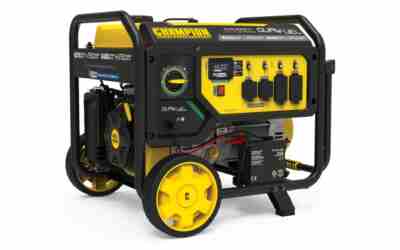
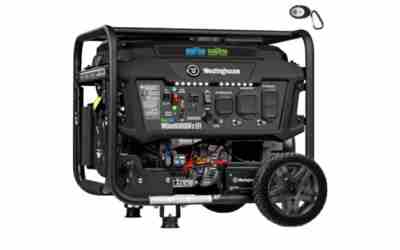
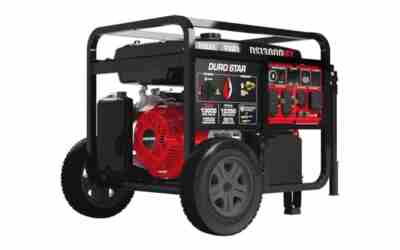
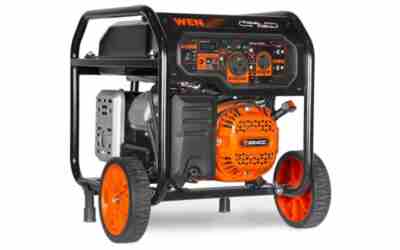
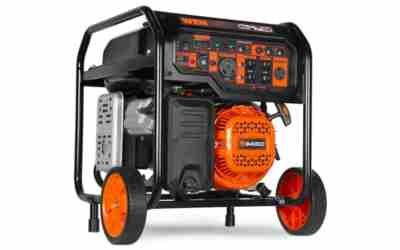
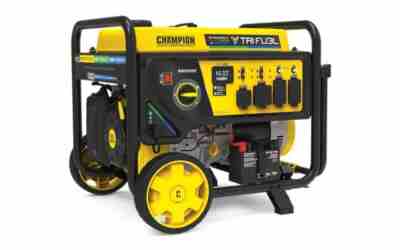
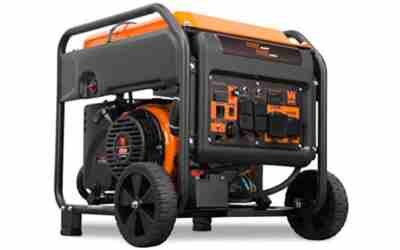
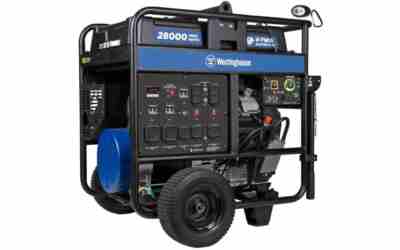
For best 12,000 watt portable generators, our top overall pick is the Westinghouse WGen9500DF Dual Fuel Portable Generator, because its 12,500 peak watt rating is the nearest to the 12,000-watt label in this lineup. It runs on gasoline or propane and includes a transfer switch ready outlet, which suits home backup. If you need more sustained output, the GENMAX GM15000ET offers 11,000 running watts. For more options in this size class, browse our 10 kW and above generator category.

Pros
- Powerful 457cc engine handles heavy startup loads like motors and appliances reliably
- Dual fuel capability reduces maintenance and allows indefinite propane storage
- Multiple start options including remote ensure convenience in any weather
- Transfer switch ready outlets simplify whole-home backup setup
- Durable cast iron sleeve and 3-year warranty provide long-term peace of mind
Cons
- Weighs 210 pounds, requiring two people to flip for wheel assembly
- Operates at 74 decibels, typical for its power class but noticeable outdoors
- Propane output slightly lower than gasoline at 11,200 peak watts
The Westinghouse WGen9500DF is a robust dual fuel portable generator designed for home backup, jobsites, or RV use, delivering 12,500 peak watts on gasoline and 11,200 on propane. Homeowners facing frequent outages or needing reliable power for essentials like refrigerators, air conditioners, and well pumps will find it indispensable, especially with its transfer switch compatibility for safe, direct connection to household circuits.
Standout features include remote electric start up to 260 feet, push-button operation, and recoil backup, praised in reviews for effortless startups even in cold weather. The 457cc OHV engine powers heavy loads smoothly, with users reporting it runs entire homes seamlessly. Dual fuel flexibility lets you switch fuels on the fly, and up to 12 hours runtime on gas keeps you covered. GFCI outlets and VFT data center provide safety and real-time monitoring of voltage, frequency, and hours.
Build quality shines with a cast iron cylinder sleeve, automatic low oil shutdown, and never-flat wheels for portability. Reviewers highlight sturdy construction, easy assembly, and included accessories like oil, propane hose, and tool kit. It meets EPA and CARB standards, with rubber outlet covers adding protection.
Drawbacks include its 210-pound weight, which demands care during setup, and 74 dB noise level suitable for outdoor use but not silent. Some note minor packaging oil residue or manual errors, though performance remains strong.
Overall, the WGen9500DF excels as a value-packed powerhouse for emergency preparedness, backed by a 3-year warranty. It outperforms competitors in power and versatility, earning high praise for reliability and ease.
Power Output: 9,500 running / 12,500 peak watts (gas); 8,500 running / 11,200 peak (propane)
Engine: 457cc 4-Stroke OHV, 16.76 HP
Fuel Capacity: 6.6 gallons gas; propane hose included
Outlets: 2x GFCI 120V 20A, L14-30R 30A, 14-50R 50A RV
Dimensions: 27.2"L x 26.1"W x 26.5"H; Weight: 210 lbs
Runtime: Up to 12 hours at 50% load
Warranty: 3-Year Limited
Pros
- Built-in CO sensor with automatic shutdown improves safety
- Quiet 62 dBA operation suits campsites and tailgates
- Lightweight and compact for easy transport
- Clean inverter power safe for sensitive electronics
- Backed by a 3-year limited warranty
Cons
- 2,000 running watts will not handle large appliances or an RV air conditioner
- Small 0.9-gallon tank means frequent refueling at higher loads
- Parallel operation requires buying a second unit and kit
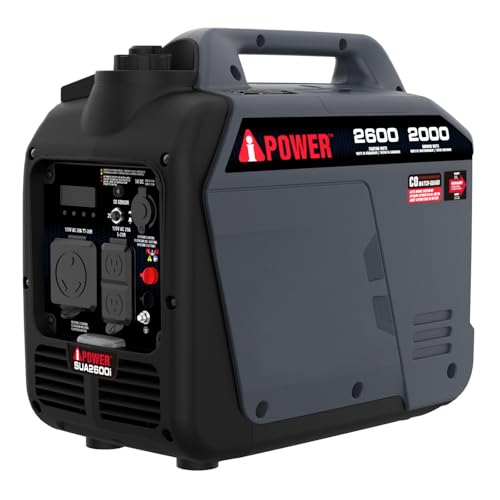
The A-iPower SUA2600i is a portable gasoline inverter generator built around an 80cc engine. It is rated at 2,600 starting watts and 2,000 running watts at 120V, which is enough for a mini fridge, coffee maker, fan, string lights, and device charging.
It is aimed at campers, tailgaters, and small RV owners who want compact backup power. At 38.7 pounds and 19.9 x 10.7 x 18.5 inches, it is easy to carry and fits in a vehicle, RV compartment, or garage. Electric start makes it simple to get going.
The standout features are the built-in CO sensor with automatic shutdown, low oil protection, and a digital data center for real-time monitoring. Inverter output stays under 3% THD, which suits laptops, tablets, and CPAP machines. At 62 dBA it runs about as quietly as a normal conversation, and automatic idle control lowers fuel use and noise when demand drops.
The main limits are capacity and tank size. The 0.9-gallon tank delivers up to 9 hours at 25% load, so heavier loads mean shorter runs and more refueling. The 2,000 running watts will not support large appliances or a full-size RV air conditioner, though parallel-ready ports allow a second unit to be added.
Overall, the SUA2600i is a sensible choice for light-duty camping, tailgating, and emergency backup of small essentials. Buyers who value safety features, low noise, and portability will find it a good fit, provided their power needs stay modest.
Engine: 80cc internal combustion. Starting watts: 2,600W. Running watts: 2,000W. Voltage: 120V at 60Hz. Fuel: Gasoline. Tank: 0.9 gal. Runtime: up to 9h at 25% load. Noise: 62 dBA. THD: under 3%. Outlets: 4. Weight: 38.7 lbs. Dimensions: 19.9 x 10.7 x 18.5 in. Warranty: 3-year limited. In the box: generator, owners manual, quick start guide, toolkit.

Pros
- High 11000W running output covers whole-home backup demands
- Tri-fuel flexibility with gasoline, LPG and natural gas
- Multiple start options including remote and recoil backup
- Built-in CO sensor and digital display improve safety and monitoring
- Generous 3-year warranty with lifetime technical support
Cons
- Heavy at 242.5 lbs, so moving it requires effort and planning
- Noise level and runtime figures are not published in the listing
- Large footprint needs significant storage and placement space
The GENMAX GM15000ET is a high-capacity tri-fuel generator delivering 11000 running watts and 15000 starting watts. It runs on gasoline, LPG or natural gas, which makes it a flexible choice for home backup, job sites and emergency preparedness.
It is aimed at homeowners who want to keep major appliances running during an outage, as well as contractors who need dependable power on site. The 120V/240V voltage transfer switch and 2-wire auto start function make it a good fit for setups that rely on automatic transfer or solar battery charging.
Standout features include a digital display for real-time operating data, a built-in CO sensor, a DC outlet, and an LED rope light that illuminates the panel at night. Starting is easy thanks to one-button electric start, a remote key and a recoil backup. The 10.56 gallon fuel tank supports long run periods for household needs.
Build quality is supported by 32 mm frame tubes intended for long-term durability, and the kit includes hoses, connectors, tools and a rain cover to get you running quickly. The main drawbacks are the weight of 242.5 lbs, the large footprint, and the lack of published noise and runtime figures.
Overall, the GM15000ET is a strong option for buyers who need serious power with fuel flexibility and modern safety features. Its 3-year warranty and lifetime technical support add confidence for long-term ownership.
Running watts: 11000W. Starting watts: 15000W. Fuel types: gasoline, LPG, natural gas. Tank size: 10.56 gallons. Frequency: 60 Hz. Voltage: 120V/240V. Starting: electric, remote and recoil. Weight: 242.5 lbs. Dimensions: 31.57 x 27.95 x 28.66 in. Warranty: 3 years.

Pros
- Rated 7800W running power with 10500W peak output
- Tri-fuel flexibility across gasoline, LPG, and natural gas
- Long runtime of up to 13.5 hours at 25% load
- Multiple start options including remote and recoil start
Cons
- Weighs 120.9 pounds, which limits how easily it can be moved
- No noise level is stated in the product information
- Runtime figure applies only to 25% load
The GENMAX GM10500XiT is an open frame inverter generator rated at 7800W running power and 10500W peak power. It is designed to run on gasoline, LPG, or natural gas, which gives owners flexibility when fuel availability changes.
This generator is well suited to home backup during outages, as well as RV camping and construction site use, as the product listing states. Its inverter design is intended to provide stable power with THD of 3% or less, which the listing says suits sensitive electronics such as smartphones and laptops.
Standout features include electric one-button start, remote start, and recoil start, along with a 2-wire automatic start function for charging solar batteries. The control panel offers a digital display, USB ports, a battery charging port, and a CO alarm. Parallel operation is also supported for larger power needs. The included accessories cover fuel hookups for natural gas and LPG, a rain cover, and basic tools.
The unit weighs 120.9 pounds, so it is best treated as a semi-portable generator rather than something to carry frequently. The listing does not publish a noise rating, so buyers who need quiet operation should check this before purchasing. The runtime of up to 13.5 hours applies at 25% load.
For buyers who want a versatile tri-fuel inverter generator with multiple start options and a 3-year warranty, the GENMAX GM10500XiT is a practical choice for home backup and mobile power use.

Pros
- Tri-fuel flexibility with 6000 running watts on gasoline
- Clean pure sine wave power suitable for sensitive electronics
- Multiple start methods, including automatic start during outages
- Built-in CO sensor and EPA certification
Cons
- Running output drops to 5500 watts on propane and 4800 watts on natural gas
- Noise level is not listed in the source data
- Large footprint at 24 x 18.9 x 20.87 inches
The GENMAX GM8000iETC is an 8000-watt tri-fuel inverter generator designed for home backup, camping, and RV use. It runs on gasoline, propane, or natural gas, and a dedicated selector switches between them. Gasoline provides 8000 surge watts and 6000 running watts, propane provides 7250 surge and 5500 running watts, and natural gas provides 6500 surge and 4800 running watts.
The generator produces pure sine wave power with 3% or less total harmonic distortion, which makes it suitable for laptops, phones, and medical equipment. A powered 312cc 4-stroke OHV engine drives the unit, and it includes a digital display that shows running hours, load level, fuel level, amps used, overload status, and low oil warnings.
Starting options include push-button electric, a remote key fob, Bluetooth app control, and a recoil backup. A 2-wire automatic start function can run the unit during power outages, which suits unattended operation. The outlet panel includes a 120V/240V 14-50R outlet for EVs and large tools, a 120V L5-30R outlet, two 120V 5-20R GFCI outlets, and USB A/C ports. The unit also supports parallel operation.
A built-in CO sensor adds a safety feature, and the generator is EPA certified for sale in the USA. The package includes a dual-purpose screwdriver, oil funnel, remote control key, and spark plug socket wrench. The listing describes a 3-year limited warranty with ongoing technical support.
The GENMAX GM8000iETC suits buyers who want fuel flexibility and clean power for sensitive devices. Its listed dimensions of 24 x 18.9 x 20.87 inches make it a sizable unit, and the source data does not include a noise rating or weight, so buyers should confirm those details before purchase.
Our Top Picks for 2026
Best Overall: Westinghouse 12500 Watt Dual Fuel Home Backup Portable Generator, Remote Electric Start, Transfer Switch Ready, Gas and Propane Powered
This unit earns the top role because it is the closest fit to a 12,000-watt target, rated at 12,500 peak and 9,500 running watts on gasoline, and 11,200 peak and 8,500 running watts on propane. Its outlets include two GFCI 120V 5-20R 20A receptacles, one transfer switch ready L14-30R 30A outlet, and one RV ready 14-50R 50A outlet. The listing describes up to 12 hours of run time, a remote start key fob, electric and recoil start, and automatic low oil shutdown on a 457cc engine.
Skip this if: you need more than 9,500 running watts on gasoline, since the 12,500 figure is a peak rating.
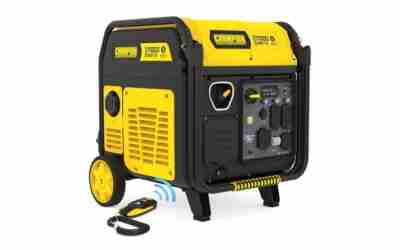
View on Amazon.comLightest Option (Compromise Pick): A-iPower Quiet Inverter Generator, 2600W RV Ready, EPA & CARB Compliant CO Sensor, Portable Ultra-Light Weight For Backup Home Use, Tailgating & Camping (SUA2600i)
This is a compromise pick for buyers who put portability ahead of output. The A-iPower SUA2600i is rated at 2,600 starting watts and 2,000 running watts from an 80cc engine, well below the 12,000-watt intent of this list. It weighs 38 pounds, and its 0.9-gallon fuel tank is listed for up to 9 hours at 25% load. Inverter output is listed at under 3% total harmonic distortion, which suits laptops, tablets and CPAP machines, and it includes a CO sensor with automatic shutdown and low oil protection.
Skip this if: you need to run 12,000 watts, since 2,000 running watts is about one-sixth of that target.
View on Amazon.comBest Running Power: GENMAX 15000W Tri-Fuel Portable Generator – 2025 Model with ATS, CO Sensor, Digital Display & 50A Output Perfect for Home Backup, Construction Sites & Emergency Power (GM15000ET)
Choose this model when you want the most running capacity in this lineup. The GM15000ET is rated at 11,000 running watts and 15,000 peak watts, and it carries a 10.56-gallon fuel tank. It is tri-fuel, switching between gasoline, LPG and natural gas, and it includes an automatic transfer switch (ATS), a CO sensor, a digital display and a 50A output. A DC cigarette lighter outlet and an LED rope light add everyday convenience, and the listing includes a 3-year warranty with lifetime technical support.
Skip this if: you need a compact or light unit, since the listing does not give a weight or dimensions for this model.
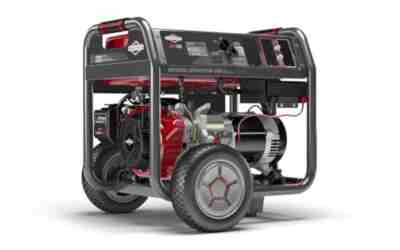
View on Amazon.comMost Compact Option: GENMAX 10500 Peak Watt Tri Fuel Open Frame Inverter Generator, with ATS, CO Sensor, digital display and 50A, Ideal for Home backup, construction site and RV Camping (GM10500XiT)
The GM10500XiT earns the compact role. Its listing describes a compact, lightweight open frame design rated at 7,800 running watts and 10,500 peak watts. It runs on gasoline, LPG or natural gas, and includes an ATS, a CO sensor, a digital display, a 50A outlet, and direct current outputs paired with USB ports. The listing also highlights an improved muffler, carburetor and intake system for better energy efficiency. Browse the full range in our By Power category.
Skip this if: you need 12,000 peak watts, since 10,500 peak is 1,500 watts short of that target.
View on Amazon.comBest Smart Controls: GENMAX 8000w Tri-Fuel Inverter Generator Features 2Wire Auto Start/Stop, Bluetooth APP Control, CO Sensor, Digital Display & 50A Outlet, Ideal for Home Backup & Camping, EPA Compliant (GM8000iETC)
This model fits buyers who value app control and automatic starting. It is rated at 6,000 running watts on gasoline, 5,500 on propane and 4,800 on natural gas, with surge ratings of 8,000, 7,250 and 6,500 watts. It offers five start options: push-button electric, a remote key fob, Bluetooth app, recoil backup and ATS 2-wire auto-start during outages. A 312cc 4-stroke OHV engine powers a digital display that shows running hours, load level, fuel level and amps used, and the listing describes THD of 3% or less.
Skip this if: you need high output, since its 6,000 gasoline running watts is half of the 12,000-watt target.
View on Amazon.comQuick Comparison: Side by Side
- – Powerful 457cc Engine.
- – Dual Fuel Flexibility.
- – Multiple Start Options.
- – Built-in CO sensor with automatic shutdown improves safety.
- – Quiet 62 dBA operation suits campsites and tailgates.
- – Lightweight and compact for easy transport.
- – High 11000W running output covers whole-home backup demands.
- – Tri-fuel flexibility with gasoline, LPG and natural gas.
- – Multiple start options including remote and recoil backup.
- – Rated 7800W running power with 10500W peak output.
- – Tri-fuel flexibility across gasoline, LPG, and natural gas.
- – Long runtime of up to 13.5 hours at 25% load.
- – Tri-fuel flexibility with 6000 running watts on gasoline.
- – Clean pure sine wave power suitable for sensitive electronics.
- – Multiple start methods, including automatic start during outages.
- – Heavy at 210 lbs.
- – 74dB Noise Level.
- – Lower Peak Watts on Propane.
- – 2,000 running watts will not handle large appliances or an RV air conditioner.
- – Small 0.9-gallon tank means frequent refueling at higher loads.
- – Parallel operation requires buying a second unit and kit.
- – Heavy at 242.5 lbs, so moving it requires effort and planning.
- – Noise level and runtime figures are not published in the listing.
- – Large footprint needs significant storage and placement space.
- – Weighs 120.9 pounds, which limits how easily it can be moved.
- – No noise level is stated in the product information.
- – Runtime figure applies only to 25% load.
- – Running output drops to 5500 watts on propane and 4800 watts on natural gas.
- – Noise level is not listed in the source data.
- – Large footprint at 24 x 18.9 x 20.87 inches.
Buying Guide for 2026
Running Watts Versus Peak Watts
Peak watts are short surge ratings for starting motors, while running watts are what a unit can sustain, so size your loads against running watts. The Westinghouse is rated at 9,500 running watts on gasoline and the GENMAX GM15000ET at 11,000, so the GENMAX has 1,500 more watts of headroom (11,000 minus 9,500). Suppose your loads total 9,000 running watts. The Westinghouse on gasoline clears that with 500 watts to spare (9,500 minus 9,000), but on propane its 8,500 running watts fall 500 short.
Fuel Type and Output
Fuel changes the rating on the GENMAX GM8000iETC, which delivers 6,000 running watts on gasoline, 5,500 on propane and 4,800 on natural gas. Natural gas therefore costs you 1,200 running watts compared with gasoline (6,000 minus 4,800), so size for the fuel you actually plan to use. Multi-fuel flexibility only helps if that fuel is available where you will run the unit. For context on smaller classes, see our 4,000 to 7,999 watts category.
Outlets, Transfer Switch Readiness and Runtime
Outlet mix decides how you connect the unit. The Westinghouse lists two GFCI 120V 5-20R 20A outlets, a transfer switch ready L14-30R 30A outlet and an RV ready 14-50R 50A outlet. The GENMAX models list a 50A output and an ATS, and the GM8000iETC adds an ATS 2-wire auto-start. Runtime is the other key spec: the Westinghouse lists up to 12 hours, and the A-iPower SUA2600i lists up to 9 hours at 25% load from its 0.9-gallon tank. The GENMAX listings we reviewed do not state a runtime figure, so check that before you buy. Our generator buying guides explain how to read these specs.
Why Trust Our Reviews
We build these picks from manufacturer specifications and aggregated owner feedback, comparing running watts, fuel options, outlet layouts and warranty terms across each listing. We do not claim hands-on testing. Where a spec is missing from a listing, we say so rather than estimate it, and we label compromise picks as compromises so you can see where a unit falls short of the 12,000-watt target.
Frequently Asked Questions
What is the difference between peak and running watts?
Peak watts describe the short surge a generator can deliver, usually when a motor starts. Running watts describe what it can sustain over time, and that is the number to size loads against. The Westinghouse lists 12,500 peak watts but 9,500 running watts on gasoline. Westinghouse also notes that its units may contain minimum residual oil or a fuel odor from factory testing, so expect a smell on first use and run it outdoors.
Can one of these generators power a whole house?
Only with careful load planning. The Westinghouse has a transfer switch ready outlet, which is meant for connection through a compatible transfer switch rather than through a standard outlet. Confirm that your total running load stays under the running rating for your fuel. If your needs are smaller, our best budget 4000 watt generator guide covers units in a lower output class.
Are CO sensors enough for indoor use?
No. Four of the five listings mention a CO sensor, including the GENMAX GM8000iETC, but a sensor is a backup feature and not a reason to run any generator indoors. Keep these units outdoors, away from windows and doors, and at a safe distance from the house.