

Our editorial team weighed PulsarProducts's published specifications and how it stacks up against similar products in the generators category. What stands out: Lightweight at 37.5 lbs, 5-Hour Runtime, and Versatile Outlets. Where it falls short: Needs Gas/Oil Mix and Manual Recoil Start. That puts it at 7.8/10 on our WG Score – a solid, dependable choice.
 Reviewed byEthan
Portable generators vs home generators comes down to this: choose a portable to run essentials for less, or a standby unit to power the whole house automatically.
Portable generators vs home generators: what actually differs
A portable generator is a movable unit with its own fuel tank that you start by hand. A home generator, also called a standby generator, sits on a pad outside, connects to a natural gas line or a propane tank, and starts itself when the power drops.
The practical split is effort versus money. A portable costs far less up front, but during the outage you roll it out, fuel it, start it and connect it. A standby unit costs several times more, but it keeps the furnace, refrigerator and lights running while you sleep or are away.
| Feature | Portable generator | Home standby generator |
|---|---|---|
| Installation | None for cords to appliances; an interlock or transfer switch for hardwired circuits | Fixed pad, gas or propane connection, automatic transfer switch, permit, licensed pros |
| Fuel | Gasoline, propane or dual fuel that you store and refill | Utility natural gas line or a propane tank |
| Starting | Manual: you start it and connect the load | Automatic when an outage is detected |
| Typical output | Roughly 3,000 to 12,000 watts | Roughly 10 to 24 kW |
| Where it loses | Refueling, noise, setup in bad weather, limited whole-house capacity | Upfront cost, permits, and you cannot take it with you |
The largest portables and the smallest standby units overlap near 10,000 to 12,000 watts. Above that, only standby units go higher, and only standby units switch over without you.
Decision rule: what has to run during an outage?
If your must-run list fits inside a portable’s running and starting watts and you can walk outside to start it, buy portable. If you need central air, someone depends on powered medical equipment, or you are often away, buy standby.
- Essentials only (refrigerator, furnace fan, sump pump, lights, phone charging): a portable, with cords or an inlet and interlock.
- Most of the house: standby is the simpler fit. A large portable with a transfer switch can cover many circuits only if you rotate big loads by hand.
- Medical needs: ask your equipment provider about backup requirements. Automatic start removes the gap, though a battery backup for the critical device is still wise.
- Renting: a portable, since you usually cannot install a permanent unit and you can take a portable with you.
- Owning for many years: compare the cost table below against local quotes for both options.
Worked example: sizing a portable generator for essentials
Motors need a burst of power to start. Size for the running watts of everything on at once, plus the largest extra surge of any single motor, assuming motors start one at a time. Extra surge is starting watts minus running watts. All figures are typical values; read the nameplates on your own appliances.
| Load | Running watts | Starting watts | Extra surge |
|---|---|---|---|
| Refrigerator | 700 | 2,200 | 1,500 |
| Furnace fan | 600 | 1,800 | 1,200 |
| Sump pump | 800 | 2,000 | 1,200 |
| LED lights | 150 | 150 | 0 |
| Phones, router, TV | 250 | 250 | 0 |
| Total and peak | 2,500 | 4,000 | 1,500 (largest) |
Running total: 700 + 600 + 800 + 150 + 250 = 2,500 watts. Add the largest extra surge, the refrigerator’s 1,500 watts, and the peak is 2,500 + 1,500 = 4,000 watts. A generator rated for at least 2,500 running watts and 4,000 starting watts covers this list, and a 5,000-watt-class unit leaves room to spare. When you are ready to compare that class, see these 5,000-watt portable generators for home use.
Now add a 3-ton central air conditioner at about 3,500 running watts and about 10,000 starting watts, and an electric range at about 8,000 watts with all elements on. The range is resistive heat, so it adds no motor surge. The AC’s extra surge is 10,000 – 3,500 = 6,500 watts, which is now the largest.
| Scenario | Running watts | Largest extra surge | Peak watts |
|---|---|---|---|
| Essentials only | 2,500 | 1,500 | 4,000 |
| Essentials + central AC | 6,000 | 6,500 | 12,500 |
| Essentials + central AC + range | 14,000 | 6,500 | 20,500 |
With the AC, the peak of 12,500 watts is already above the 12,000-watt top of the portable range. With the range as well, you need a standby unit at the large end of the 10 to 24 kW range, or you must run the AC and range one at a time.
Connecting a portable generator: cords, interlock or transfer switch
Never plug a generator into a wall outlet with a double-ended cord. It backfeeds the utility lines and can electrocute line workers. For placement, carbon monoxide alarms and refueling, follow the manual or label.
- Extension cords: heavy-duty, outdoor-rated cords run straight to a refrigerator, lights or sump pump. No electrician is needed, but hardwired loads such as a furnace or well pump stay off.
- Interlock kit with a generator inlet: a mechanical plate on your panel that stops the main breaker and the generator breaker from being on together. It lets you feed any circuit in the panel that the generator can carry.
- Transfer switch: a separate subpanel holds the circuits you chose at installation. It is simple to operate, but you are limited to those circuits.
A licensed electrician should install either one. The National Electrical Code and your local jurisdiction govern the work, so confirm permit and inspection rules with your building department. The inlet amperage and plug type must match your generator’s outlet. Standby units also require permits and licensed gas and electrical work.
Portable vs home generator cost and upkeep
Compare total cost, not just the sticker price. These are typical U.S. ranges, and local quotes set your actual figure.
| Cost item | Portable with inlet and interlock | Home standby |
|---|---|---|
| Unit | $500-$2,500 | Included in installed price |
| Connection hardware and labor | $500-$1,500 | Included in installed price |
| Total upfront | $1,000-$4,000 | $10,000-$20,000 installed |
| Upkeep | You perform oil, filter and spark plug service on the manual’s schedule | Professional service on the manufacturer’s schedule |
The standby price covers the unit, pad, gas line, wiring, transfer switch and permit. The portable price assumes you add an inlet and interlock; plain cords cost only the cord.
Noise, runtime and fuel in a long outage
Noise. Open-frame portables are generally the loudest, and inverter portables are generally quieter. Compare the decibel ratings in the manuals, and check that they are measured at the same distance.
Runtime. Hours per tank depend on the load, and spec sheets state runtime at a stated load. Compare models at the same load. A 2,500-watt essentials list burns more fuel per hour than a light load, so a portable needs repeated refills in a multi-day outage, and gas stations may have no power.
Fuel supply. A natural gas line removes the refilling, though supply is not guaranteed in every disaster. A propane tank must be sized for your outage length, and a supplier must be able to reach you. A portable that burns propane or both fuels lets you store fuel longer; compare dual fuel portable generators for home backup.
Our Top Picks
Ready to shop? These are the top-rated options from our hands-on roundup, Best Portable Generators For Home Power Outage of 2026.

Honda EU2200iTAN 2200W Super Quiet Portable Inverter Generator with CO-Minder - Ideal for Camping, RV, Home Backup
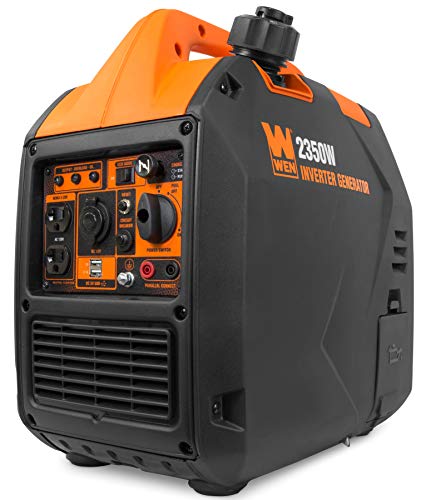
WEN 56235i 2350W Super Quiet Portable Inverter Generator - Ultra Lightweight 39lbs, Fuel Shut-Off, Clean Power for Camping RV

Pulsar PG1202SA 1200W Portable Gas Generator with Handle - Compact Camping Powerhouse
As an Amazon Associate we earn from qualifying purchases. Product prices and availability are accurate as of the date/time indicated.
Frequently Asked Questions
Is an inverter portable generator enough for a refrigerator?
Yes, if its rated starting watts cover the refrigerator’s nameplate, such as the 2,200 starting watts in the example above. Inverter models also produce cleaner power for electronics.
Which is quieter, a portable or a standby generator?
An inverter portable is typically the quietest option. Compare decibel ratings from each manual at the same distance rather than judging by type.
Can a portable generator run a window air conditioner?
Yes, if the generator covers the unit’s starting watts on its nameplate. A window unit is far smaller than the central air in the example.
Can I take a standby generator with me when I move?
No, plan to leave it. It is tied to a pad, a gas line and a transfer switch, while a portable goes with you.
Can I install a standby generator myself?
Usually not. Gas piping, wiring and permits normally require licensed professionals, and doing it yourself may affect the warranty.
{“@context”: “https://schema.org”, “@type”: “FAQPage”, “mainEntity”: [{“@type”: “Question”, “name”: “Is an inverter portable generator enough for a refrigerator?”, “acceptedAnswer”: {“@type”: “Answer”, “text”: “Yes, if its rated starting watts cover the refrigerator’s nameplate, such as the 2,200 starting watts in the example above. Inverter models also produce cleaner power for electronics.”}}, {“@type”: “Question”, “name”: “Which is quieter, a portable or a standby generator?”, “acceptedAnswer”: {“@type”: “Answer”, “text”: “An inverter portable is typically the quietest option. Compare decibel ratings from each manual at the same distance rather than judging by type.”}}, {“@type”: “Question”, “name”: “Can a portable generator run a window air conditioner?”, “acceptedAnswer”: {“@type”: “Answer”, “text”: “Yes, if the generator covers the unit’s starting watts on its nameplate. A window unit is far smaller than the central air in the example.”}}, {“@type”: “Question”, “name”: “Can I take a standby generator with me when I move?”, “acceptedAnswer”: {“@type”: “Answer”, “text”: “No, plan to leave it. It is tied to a pad, a gas line and a transfer switch, while a portable goes with you.”}}, {“@type”: “Question”, “name”: “Can I install a standby generator myself?”, “acceptedAnswer”: {“@type”: “Answer”, “text”: “Usually not. Gas piping, wiring and permits normally require licensed professionals, and doing it yourself may affect the warranty.”}}]}













