

Our editorial team weighed Home's published specifications and how it stacks up against similar products in the generators category. What stands out: Truly Handheld Size, Includes Solar Panel & Lights, and Quiet, Gas-Free Operation. Where it falls short: Tiny 4Wh Capacity and Slow 5W Solar Input. That puts it at 7.7/10 on our WG Score – a solid, dependable choice.
 Reviewed byDaniel
Expect solar power on a rainy day to be roughly 10–25% of a panel’s rated output in heavy rain, and about 30–50% under lighter cloud. Panels keep working on diffuse light, but a 200W panel that makes about 750 Wh on a sunny day may make only 75–375 Wh. Here is the math and how to plan for it.
How much power do solar panels make on a rainy or cloudy day?
Panels do not need direct sun. They convert diffuse light that passes through clouds, so they keep producing in rain. What changes is how much light gets through, and that depends on cloud thickness far more than on whether water is falling.
The ranges below are approximate. Published figures vary because cloud density, time of year, sun angle and panel type all change the result.
| Sky condition | Typical output vs. a clear day |
|---|---|
| Thin high cloud or haze | About 70–90% |
| Fog | About 50% |
| Overcast, light rain | About 30–60% |
| Thick low cloud, steady rain | About 15–30% |
| Heavy storm, dark sky | About 10–25% |
Some sources claim heavy rain cuts output by 80–90%, which matches the bottom row. Others quote 30–50% for cloudy days, which matches the middle rows. Both can be right; they describe different skies. When you plan backup power, use the low end of the range.
What does a 200W panel make on a sunny day versus a rainy day?
Here is a worked example you can redo with your own numbers. Assumptions: 5 peak sun hours on a clear day and about 75% real-world efficiency after wiring, heat and charge-controller losses. Peak sun hours vary by location and season, so check NREL’s PVWatts calculator for your address.
Sunny day: 200W × 5 hours × 0.75 = 750 Wh.
| Condition | Output factor | 200W panel | 100W panel |
|---|---|---|---|
| Clear day | 100% | 750 Wh | 375 Wh |
| Light cloud or haze | 70–90% | 525–675 Wh | 260–340 Wh |
| Overcast | 30–50% | 225–375 Wh | 110–190 Wh |
| Heavy rain | 10–25% | 75–190 Wh | 40–95 Wh |
That 75–190 Wh from a 200W panel is about enough to charge a phone several times and run LED lights, but not a refrigerator. A small power station with a 300 Wh battery could need two or more heavy-rain days from a single 100W panel just to refill.
Does rain hurt solar panels or help them?
Rain does not hurt panels. Panels are built to be weatherproof and are tested for rain and hail. Rain also rinses off loose dust and pollen, which can nudge output up afterward. It will not remove bird droppings, sap or caked-on grime.
Portable and foldable panels are a different story. The panel surface is usually rain-tolerant, but check the ingress protection (IP) rating for the junction box and connectors, since it varies by model. The power station or charge controller it plugs into is often not waterproof. Keep it dry and off the wet ground, and run the cable in through a sheltered spot.
Panel type matters a little. Monocrystalline panels generally hold up somewhat better in dim light than older polycrystalline designs, and thin-film panels can do relatively well in diffuse light. The difference is small compared with cloud thickness, so do not buy on this alone.
How many days of battery backup should you plan for in a storm?
Plan for 2–3 days of reserve for a typical multi-day storm, and more if outages in your area run longer. Then assume panels give you only 10–25% of normal output on those days.
Worked example: your essential loads (fridge, router, lights, phone charging) use about 1,000 Wh per day. You have 400W of panels.
- Sunny-day production: 400W × 5 h × 0.75 = 1,500 Wh. You are covered.
- Storm-day production at 20%: 1,500 × 0.20 = 300 Wh.
- Daily shortfall: 1,000 − 300 = 700 Wh.
- Three storm days: 3 × 700 = 2,100 Wh.
- Add about 15–20% for inverter losses and not draining the battery to zero: roughly 2,500 Wh of battery.
Decision rule: to cover a full day on panels alone at 20% output, you need about five times the panel wattage you would size for a sunny day. Here that is about 1,333W instead of 267W. For most people it is cheaper to size panels for normal days and buy battery for the bad ones.
If your loads are bigger, a whole-home setup is a different job. Our roundup of solar generators for home backup shows what capacities are available.
How can you get more power from solar in poor weather?
- Remove shade first. A shadow across part of a panel can cut output more than cloud does. Move portable panels out of tree or roofline shade.
- Face the panel at the brightest part of the sky. In diffuse light, exact tilt matters less than on a clear day. Do not spend your effort chasing the sun; just avoid lying flat in a spot where water pools.
- Add panel wattage within your input limit. Every power station has a maximum solar input in watts, volts and amps. Check your model’s specs. Staying under those limits, a bigger array wastes some power on sunny days but helps a lot on gray ones.
- Use an MPPT charge controller. Most quality power stations have one. It harvests more from low-light conditions than a basic PWM controller.
- Keep a second charging source. Charge from a wall outlet before the storm arrives, or from a car’s 12V socket while driving. Starting a storm at 100% battery is the biggest single gain.
- Cut loads, not just add supply. Run the fridge only as needed, switch to LED lights, and skip heating loads like coffee makers and space heaters.
If you are shopping for panels to pair with a power station, see our picks for solar panels for portable power stations and portable foldable solar panels.
Is solar still worth it in rainy or cloudy climates?
Yes, because storms are only part of the year. A common planning range is about 3.5–5 kWh per day for every 1 kW of panels, averaged across the year including cloudy days. Your number depends on location, roof angle and shading, so run your address through PVWatts.
Home example: a 7 kW system at 4 kWh per kW averages about 28 kWh per day. A clear summer day may be higher, and a heavy-rain day at 10–25% of a good day could drop to a few kWh. At an example rate of 17 cents per kWh, losing 20 kWh on a stormy day is about $3.40 in avoided bills. A rainy day costs you little; a rainy month matters more.
Regional patterns differ. The Pacific Northwest has long gray winters with low output for months. Florida storms are often afternoon bursts, so mornings can still produce well. The Northeast has strong summers and weak winters. Cloudy countries such as Germany and the UK still run large solar fleets, which shows that lower output is not zero output.
For a fuller look at home systems, see our guide to emergency solar generators.
Rainy-day safety and a quick planning checklist
Safety:
- Do not climb onto a wet roof or clean roof panels in the rain. The surface is slippery and there is a shock risk.
- Unplug portable panels and keep cables off standing water during lightning.
- After flooding, lightning or storm damage, have a licensed installer inspect a roof system, including grounding and rapid shutdown, before turning it back on. Requirements depend on local code and the NEC edition your area uses.
- If you add a gas generator as a backup charger, run it outdoors, well away from windows and doors, never in a garage, and use a working CO alarm inside.
Checklist before a storm:
- Charge your battery to 100% from the wall.
- Calculate your daily essential Wh and multiply by 2–3 days.
- Assume 10–25% panel output and subtract it from the total.
- Confirm your panels’ voltage and amp limits against the power station’s input.
- Stage a dry spot for the power station and a sheltered cable path.
Our Top Picks
Ready to shop? These are the top-rated options from our hands-on roundup, Best Portable Power Stations Solar Panel of 2026.

DJI Power 1000: 1024Wh LiFePO4 Portable Power Station, 2200W Output, 23dB Silent, Solar Generator for Camping & Home Backup

MARBERO 172Wh Solar Generator with 40W Panel - 200W Portable Power Station for Camping, Emergencies, CPAP & Outdoors
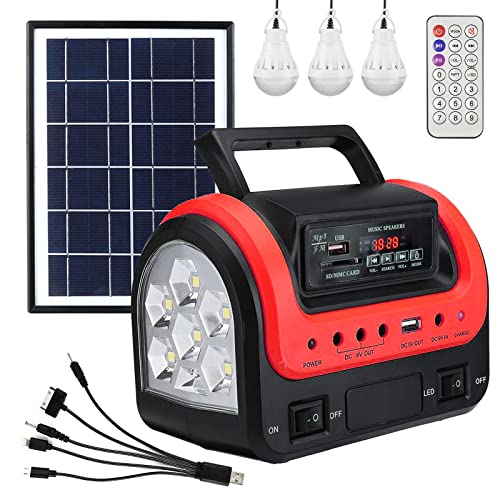
Upusa SDM-0603 Solar Generator Portable Power Station with 10W Panel
As an Amazon Associate we earn from qualifying purchases. Product prices and availability are accurate as of the date/time indicated.
Frequently Asked Questions
Do solar panels work at night or in winter?
Not at night, since there is no light to convert. In winter they still work, but days are shorter and the sun is lower, so output is usually well below summer levels. Snow-covered panels produce little until the snow slides off or is cleared safely.
Will a 100W solar panel charge a power station in the rain?
Yes, but slowly. In heavy rain a 100W panel may produce only about 40–95 Wh per day, based on 10–25% of a roughly 375 Wh clear day. That is a small top-up, not a full recharge of a large battery.
Is it safe to leave portable solar panels out in the rain?
Many are rain-tolerant, but it depends on the model’s IP rating, so check the manual. Keep the power station, adapters and any exposed connections dry, and unplug panels during lightning.
How many solar panels do I need to run a house on cloudy days?
Fully powering a house on heavy-rain days from panels alone would take roughly four to ten times the array you need on a sunny day, which is usually impractical. Most homes use grid power or batteries to cover the gap.
{“@context”: “https://schema.org”, “@type”: “FAQPage”, “mainEntity”: [{“@type”: “Question”, “name”: “Do solar panels work at night or in winter?”, “acceptedAnswer”: {“@type”: “Answer”, “text”: “Not at night, since there is no light to convert. In winter they still work, but days are shorter and the sun is lower, so output is usually well below summer levels. Snow-covered panels produce little until the snow slides off or is cleared safely.”}}, {“@type”: “Question”, “name”: “Will a 100W solar panel charge a power station in the rain?”, “acceptedAnswer”: {“@type”: “Answer”, “text”: “Yes, but slowly. In heavy rain a 100W panel may produce only about 40–95 Wh per day, based on 10–25% of a roughly 375 Wh clear day. That is a small top-up, not a full recharge of a large battery.”}}, {“@type”: “Question”, “name”: “Is it safe to leave portable solar panels out in the rain?”, “acceptedAnswer”: {“@type”: “Answer”, “text”: “Many are rain-tolerant, but it depends on the model’s IP rating, so check the manual. Keep the power station, adapters and any exposed connections dry, and unplug panels during lightning.”}}, {“@type”: “Question”, “name”: “How many solar panels do I need to run a house on cloudy days?”, “acceptedAnswer”: {“@type”: “Answer”, “text”: “Fully powering a house on heavy-rain days from panels alone would take roughly four to ten times the array you need on a sunny day, which is usually impractical. Most homes use grid power or batteries to cover the gap.”}}]}













