Our editorial team weighed PowerSmart's published specifications and how it stacks up against similar products in the generators category. What stands out: Dual Fuel Flexibility, Quiet Operation, and Reliable Recoil Start, Solid Build. Where it falls short: Manual Recoil Start, Harder in Cold and ~4-Hour Runtime at 50% Load. That puts it at 8.4/10 on our WG Score – an excellent, well-rounded option.
 Reviewed byTristan
In the inverter generators vs regular generators decision, an inverter wins for electronics, quiet and loads under about 4,500 running watts, and a regular generator wins on price per watt above that. You pay more for an inverter, but you get cleaner power, lower noise and less weight.
How inverter and regular generators make power
A conventional generator ties the engine directly to the alternator. To hold the 60 Hz that US appliances expect, the engine must run at a fixed speed, usually about 3,600 rpm, whether you load it with 100 watts or 4,000 watts. That is why it is loud and burns fuel even at light load.
An inverter generator makes raw AC, converts it to DC, then electronically rebuilds clean 120-volt, 60 Hz AC. Because the output is rebuilt, the engine can slow down at light loads and speed up when you add a load. Many models have an eco or economy switch for this, so check your manual for how yours behaves.
The extra electronics add cost, which is why inverters are priced higher per running watt.
Inverter generators vs regular generators: typical specs
These are typical ranges, not guarantees. Noise, distortion, weight and fuel use vary by model and load, so confirm figures on the manufacturer’s spec sheet before you buy.
| Feature | Inverter generator | Regular generator |
|---|---|---|
| Common output | About 1,000 to 4,500 W, a few larger | About 2,000 to 12,000+ W |
| Noise (rated, usually at a stated load and distance) | About 50 to 65 dB | About 65 to 85 dB |
| Power quality (THD) | Usually under 3% | Often 5% or more, sometimes much higher |
| Fuel use at light load | Engine slows, so usually lower | Engine stays near 3,600 rpm, so it drops less |
| Fuel use at full load | Close to a regular unit of the same output | Close to an inverter of the same output |
| Weight and handling | Lighter in the 1,000 to 3,000 W range, many carry-friendly | Heavier frame; 3,500 to 5,000 W units are often wheeled |
| Price per running watt | Rule of thumb: often about double | Lower |
| Parallel option | Common on many models | Rare |
Read the noise number correctly
Decibels are logarithmic, so a 10 dB drop sounds roughly half as loud. Makers usually quote noise at a stated distance (many use 23 feet) and a stated load, often 25%. An inverter near full load is louder than its headline number. If campground or HOA limits matter, see our best inverter generators for camping and compare dB at the same load.
Where each one loses
- Inverter loses on: cost per watt, top-end output, and fuel savings that shrink as you approach full load.
- Regular loses on: noise, power quality, light-load fuel use and weight.
Which is safer for laptops, TVs and a CPAP?
An inverter generator is the safer choice for sensitive electronics. Total harmonic distortion (THD) measures how far the output departs from a smooth sine wave. Lower is better, and inverter units usually list under 3%, close to utility power. Many makers and electronics guides use under 5% as a rule of thumb for sensitive gear.
Laptop and phone chargers often tolerate rough power, but TVs, furnace control boards, variable-speed refrigerators and CPAP machines are more likely to misbehave or wear out sooner on a noisy waveform. A surge protector does not clean up the waveform.
- CPAP: follow the device manual and ask your equipment supplier. If the machine is medically critical, add a battery backup rather than relying on a generator alone.
- Only have a regular generator? Charge a portable power station from it, then run laptops and medical devices from the station.
- Check the label: look for a listed THD figure. If none is published, assume it is not an inverter-grade output.
When a regular generator is the better buy
A regular generator wins when you need a lot of power for the money. Above roughly 4,500 running watts, inverters get scarce and expensive, while conventional units reach 7,500 watts and more. They also suit rugged, noisy-tolerant jobs: circular saws, air compressors, sump pumps, and 240-volt loads. Many inverter models lack a 240-volt outlet, so check before assuming one can run a well pump.
Worked example: sizing a small backup load
These are typical figures, so use each appliance’s nameplate for yours.
- Add running watts: refrigerator 200 + sump pump 800 + LED lights 100 + TV and laptop 200 = 1,300 W.
- Find the largest extra start load. The pump starts at about 2,000 W, so the extra is 2,000 – 800 = 1,200 W.
- Peak = 1,300 + 1,200 = 2,500 W.
You need a generator with at least 1,300 running watts and 2,500 surge watts. A 3,000-watt-class inverter covers this with room to spare, and you also get clean power for the TV and laptop. Browse our 3,000-watt inverter generators for models in that range.
Add a 240-volt well pump that needs several thousand watts to start, or central air, and a conventional or very large unit starts to make more sense.
Common mistake: shopping by starting watts alone. The running rating must cover everything on at once, and the surge rating must cover the biggest motor start on top of that.
Can you run two inverter generators together?
Yes, many inverter generators can be paralleled to roughly double output. Two 2,000-watt-class units give about 4,000 running watts, which is how small, portable units reach RV air conditioner and larger backup loads.
- Parallel-ready models: both units must support it, and many makers require the same model or a listed compatible one.
- Parallel cable or kit: use the manufacturer’s own. For a 30-amp RV outlet, the maker’s kit usually adds that outlet.
- Follow the startup order in the manual, usually connecting the cable before or while starting the units.
- Check each outlet’s amp limit. A single 20-amp, 120-volt outlet tops out near 2,400 W, so split loads across outlets.
The Honda EU2200i is one example sold with a parallel option, and our Honda EU2200i review covers the details. Paralleling gives you portability and redundancy, but two units often cost more than one larger conventional generator.
Regular generators are generally not designed for parallel use. Never join two generators with a homemade cord.
Safety rules that apply to both types
Run any generator outdoors, with the exhaust pointed away from doors, windows and vents. Follow the manual or label for distance; many say at least 20 feet from the house. Never run one in a garage, basement or enclosed space, even with the door open. Put battery-powered carbon monoxide alarms in the home.
Never backfeed the house by plugging a generator into a wall outlet. Power a house panel only through a properly installed transfer switch or interlock, ideally by a licensed electrician following the NEC and local code. Let the engine cool before refueling, and store fuel in approved containers.
Decision rule: which one should you buy?
Add up your running and surge watts first. If electronics are involved or the total stays under about 4,500 running watts, buy an inverter. If you run tools or pumps, need more than about 4,500 watts or have a tight budget, buy a regular generator.
Choose an inverter if
- You power laptops, TVs, a CPAP, a furnace control board or other electronics.
- You camp, tailgate or live under noise rules.
- You carry the unit often.
- Your load is mostly lights, a fridge, a sump pump and small appliances.
Choose a regular generator if
- You need more than about 4,500 running watts.
- You use heavy tools or 240-volt equipment.
- Cost per watt matters more than noise.
If you need over 4,500 watts and also protect sensitive electronics, pair a conventional generator with a power station, or consider a large inverter or a parallel pair. For home outages, start with our best inverter generators for home backup power.
Our Top Picks
Ready to shop? These are the top-rated options from our hands-on roundup, Best Power Inverter Generators For Home of 2026.

Westinghouse iGen2800 2800 Peak Watt Super Quiet Lightweight Portable Inverter Generator - Gas Powered, Parallel Ready
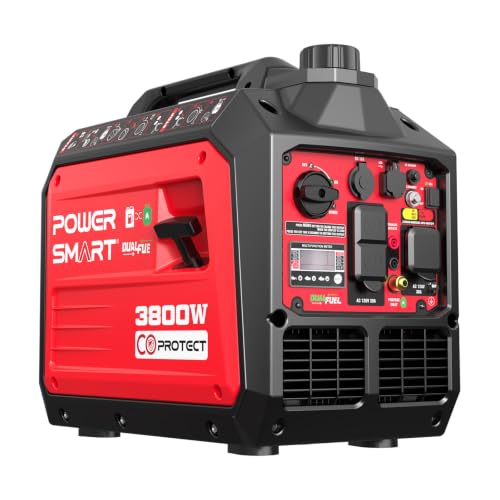
PowerSmart 3800 Watt Dual Fuel Inverter Generator Quiet Portable Gas Propane with CO Sensor RV Ready
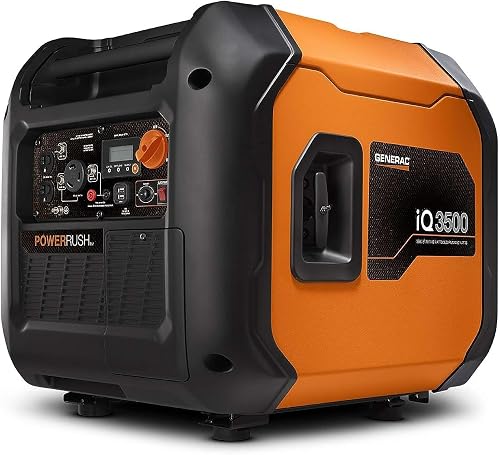
Generac iQ3500 3500W Portable Inverter Generator - Quiet, Lightweight, Electric Start, CARB Compliant for Camping & Jobsites
As an Amazon Associate we earn from qualifying purchases. Product prices and availability are accurate as of the date/time indicated.
Frequently Asked Questions
Can an inverter generator run a whole house?
Usually not with one portable unit. A 3,000 to 4,500 watt inverter can run chosen circuits like the fridge, lights and furnace fan through a transfer switch or interlock. Central AC, an electric range or a well pump often needs 7,500 watts or more, so size from your own load list.
Can an inverter generator run an RV air conditioner?
Often yes, if sized right. A 13,500 BTU unit commonly needs roughly 2,000 to 3,000 watts to start without a soft-start kit, and less with one. A 3,000-watt inverter or two paralleled 2,000-watt units often manage it, but check the AC nameplate and the generator’s surge rating.
Does a surge protector make a regular generator safe for a laptop?
Not reliably. A surge protector guards against voltage spikes but does not clean up a distorted waveform or unstable frequency. For a laptop on a regular generator, charge a power station from the generator first, or use an inverter generator with a listed THD under 3%.
Is an inverter generator always quieter than a regular one?
Usually at light load, but not always. Inverters slow the engine when the load is small, which cuts noise. Near full load, many get close to their rated dB, which makers measure at a stated load and distance. Compare ratings at the same load and distance.
{“@context”: “https://schema.org”, “@type”: “FAQPage”, “mainEntity”: [{“@type”: “Question”, “name”: “Can an inverter generator run a whole house?”, “acceptedAnswer”: {“@type”: “Answer”, “text”: “Usually not with one portable unit. A 3,000 to 4,500 watt inverter can run chosen circuits like the fridge, lights and furnace fan through a transfer switch or interlock. Central AC, an electric range or a well pump often needs 7,500 watts or more, so size from your own load list.”}}, {“@type”: “Question”, “name”: “Can an inverter generator run an RV air conditioner?”, “acceptedAnswer”: {“@type”: “Answer”, “text”: “Often yes, if sized right. A 13,500 BTU unit commonly needs roughly 2,000 to 3,000 watts to start without a soft-start kit, and less with one. A 3,000-watt inverter or two paralleled 2,000-watt units often manage it, but check the AC nameplate and the generator’s surge rating.”}}, {“@type”: “Question”, “name”: “Does a surge protector make a regular generator safe for a laptop?”, “acceptedAnswer”: {“@type”: “Answer”, “text”: “Not reliably. A surge protector guards against voltage spikes but does not clean up a distorted waveform or unstable frequency. For a laptop on a regular generator, charge a power station from the generator first, or use an inverter generator with a listed THD under 3%.”}}, {“@type”: “Question”, “name”: “Is an inverter generator always quieter than a regular one?”, “acceptedAnswer”: {“@type”: “Answer”, “text”: “Usually at light load, but not always. Inverters slow the engine when the load is small, which cuts noise. Near full load, many get close to their rated dB, which makers measure at a stated load and distance. Compare ratings at the same load and distance.”}}]}