Our editorial team weighed EFECOFLOW's published specifications and how it stacks up against similar products in the generators category. What stands out: Excellent App Control, Reliable for Critical Devices, and Wheels & Handle for Portability. Where it falls short: Heavy at 99 lbs and No Outlet Dust/Water Covers. That puts it at 8.5/10 on our WG Score – an excellent, well-rounded option.
 Reviewed bySarah Watts
If you are shopping for best 4000 watt solar generators, the strongest all-round choice in this roundup is the EF ECOFLOW Portable Power Station 3600Wh DELTA Pro. It delivers 3600W rated output that X-Boost can lift to 4500W, plus a LiFePO4 battery and fast recharge options. Looking for the closest match to a true 4000W rating? Start with the GRECELL S5. Explore more units in our 4,000 to 7,999 watt category.

Pros
- Exceptional app for intuitive setup, monitoring, and energy management
- Reliable runtime for critical devices like oxygen concentrators and heat presses
- Rugged build with wheels and handle for portability despite weight
- Outstanding customer service with proactive support
- Fast solar compatibility keeps power flowing off-grid
Cons
- Heavy at 99 pounds, challenging to move without wheels
- No built-in dust/water covers for outlets
- Occasional reports of charging errors requiring support
The EcoFlow DELTA Pro 3600Wh is a high-capacity portable power station designed for demanding users needing robust backup power for home outages, RV camping, off-grid living, or professional mobile setups. With its LiFePO4 battery chemistry, it offers long-lasting safety and up to 4000 cycles of life, making it suitable for both residential and commercial applications where reliability is key.
Standout features include a 3600W AC output expandable to 4500W via X-Boost, powering heavy-duty appliances like refrigerators, tools, or medical equipment without issue. Users praise its real-world performance, such as running heat presses at markets or oxygen concentrators for over 10 hours on a single charge. Fast X-Stream charging refills it in 2.7 hours from a wall outlet, or via solar in under 3 hours with 1600W input, while the intuitive app provides remote monitoring and customization for optimal energy use.
Build quality is solid with a rugged ABS exterior, collapsible handle, and wheels for maneuverability, though its 99-pound weight demands two people for initial transport. Multiple ports including five AC outlets, USB-C 100W, and Anderson ensure versatility, and quiet fanless operation suits indoor emergencies.
Drawbacks include the heft making solo repositioning tough and lack of outlet covers for dusty environments. Rare firmware or overload issues have been noted but resolved via support.
Overall, the DELTA Pro delivers exceptional value for power-intensive needs, earning high marks for performance and support. It's a top choice for proactive power independence.
Capacity: 3600Wh LiFePO4 battery
Output: 3600W AC (7200W surge, X-Boost 4500W), 5x 120V outlets
Charging: 2.7H AC (1800W), 2.8H solar (1600W max), car/EV options
Ports: 15 total (USB-A/C, DC, car, Anderson)
Weight/Dims: 99 lbs, 25"L x 11.2"W x 16.4"H
Extras: App control, expandable to 25kWh
Pros
- World's smallest 3kWh design verified by Frost & Sullivan for superior portability
- Long-life LiFePO4 battery with 6000+ cycles to 80% capacity
- Versatile inputs and outputs including RV-specific ports
- Fast 10ms UPS and pass-through charging for uninterrupted power
- App integration for customizable remote control
Cons
- Weighs 58 pounds, limiting handheld portability for some users
- Requires app for advanced features, which may not suit everyone
- New model with limited real-world user feedback available
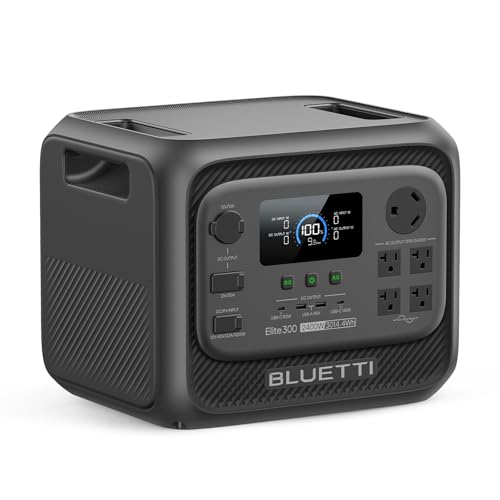
The BLUETTI Elite 300 is a groundbreaking portable power station packing 3014Wh of LiFePO4 battery capacity into the world's smallest 3kWh footprint, as verified by Frost & Sullivan. It targets homeowners facing power outages and RV enthusiasts needing reliable off-grid energy, with dedicated TT-30 RV and 12V/30A DC ports for direct appliance connections.
Standout features include 2400W AC output with 4800W surge to run fridges, lights, routers, TVs, and even start high-demand devices like kettles. The 10ms UPS function ensures critical gear like computers stays online during blackouts, while pass-through charging lets it power devices during recharges. Fast solar input up to 1200W and app-controlled scheduling add flexibility for home backups or camping.
Build quality shines with a durable LiFePO4 battery rated for 6000+ cycles, compact dimensions of 14.4 x 12 x 11.7 inches, and intuitive app via Bluetooth or Wi-Fi for monitoring and customization. At 58 pounds, it balances power and portability but may require two hands for moving.
Drawbacks include its weight for solo transport and reliance on the app for full smart features. As a newer release, long-term user data is emerging.
Overall, the Elite 300 excels as a versatile, space-saving powerhouse for emergency home use and RV adventures, earning strong recommendation for those prioritizing compact reliability.
Capacity: 3014Wh LiFePO4 (6000+ cycles)
Output: 2400W AC (4800W surge), TT-30 RV, 12V/30A DC
Inputs: 1800W AC, 1200W solar, car charger
Dimensions: 14.4 x 12 x 11.7 inches, 58 lbs
Features: 10ms UPS, app control, pass-through charging

Pros
- High 3600W output powers air fryers, microwaves, and RVs effectively
- Fast recharging and solar compatibility extend off-grid runtime
- UL-certified UPS ensures no interruptions for security cams and calls
- Compact for its capacity, praised in reviews for camping and backups
- Durable build with 5-year warranty and positive real-world tests
Cons
- Heavy at 59.5 pounds, often requires two handles or a cart to move
- Lacks built-in wheels or cord storage, reducing true portability
- One review noted shutdowns in sub-15°F temps despite specs
The Jackery HomePower 3000 is a high-capacity portable power station designed for homeowners, RVers, and anyone needing robust backup during outages or off-grid adventures. With 3072Wh LFP battery storage and 3600W output (7200W surge), it powers essentials like refrigerators for up to 2 days, fans, lights, routers, and even microwaves or air fryers, making it a go-to for emergencies, storms, or dry camping.
Standout features include a UL-certified UPS that switches in under 20ms to prevent disruptions to security systems, medical devices, or video calls. Versatile charging reaches full in 2.2 hours via AC, supports solar up to 80% in 9 hours with two 200W panels, and offers app monitoring plus multiple ports like dual 100W USB-C PD and RV TT-30. Feedback highlights its real-world prowess, running RVs for days, powering 43-inch TVs, and handling power tools effortlessly.
Build quality shines with ChargeShield 2.0 AI tech extending battery life to 4000 cycles, a space-efficient CTB design that's 47% smaller and 43% lighter than competitors, and a sturdy honeycomb base. At 59.5 pounds and 16.4 x 12.8 x 12 inches, it's portable with dual handles but heavy for solo lifting, prompting some users to add carts.
Drawbacks include its weight limiting easy mobility and rare cold-weather issues below 15°F in one test. Overall, the HomePower 3000 excels as a reliable, future-proof solar generator for home backups and RV use, earning strong praise for performance and value.
Capacity: 3072Wh LFP Battery
Output: 3600W Continuous (7200W Surge), 120V AC
Ports: 4 AC, TT-30 RV, USB-C PD (x2), USB-A, DC
Charge Time: 2.2 Hours AC (0-100%), 9 Hours Solar (80% with 400W)
Weight/Dimensions: 59.5 lbs, 16.4"L x 12.8"W x 12"H
Warranty: 5 Years
Ideal for RV owners dry camping, homeowners in storm-prone areas, or off-grid enthusiasts. Pair with SolarSaga 200W panels for renewable charging. Consider weight if solo portability matters; opt for carts or lighter models like Explorer 2000 v2 for less power needs. Test fridge runtime matches real use at 30+ hours per reviews.

Pros
- Compact and powerful design praised for build quality and stability in reviews
- Excellent customer service with quick warranty replacements
- Reliable UPS and app features for critical backups
- Supports high solar input for efficient renewable charging
- Versatile for tools, fridge, Starlink, and tiny homes
Cons
- Solar charge controller may interrupt briefly with panel shading or low wattage
- Display shows 15-20 second delay in registering watt usage
- Hefty 63.3-pound weight limits easy portability for solo camping
The Pecron F3000LFP is a high-capacity portable power station designed for homeowners, RV owners, campers, and anyone needing robust emergency backup. With 3072Wh LiFePO4 battery and 3600W pure sine wave output, it powers heavy-duty appliances like refrigerators and air conditioners alongside everyday devices, making it a versatile solar generator for off-grid living or outages.
Standout features include ultra-fast 2-hour AC recharging, compatibility with up to 1600W solar input, and 13 ports for simultaneous device charging, including 100W USB-C for laptops. Users report rock-solid inverter performance for tools and Starlink, reliable UPS switching under 20ms, and app-based monitoring. Real-world tests show it sustains fridges and fans effectively, with strong solar performance in clear conditions.
Build quality impresses with a compact 19.3 x 11.6 x 11.1-inch frame that's sturdy yet portable enough for most, though its 63.3 pounds requires some muscle. Reviewers highlight its value over pricier competitors like EcoFlow, praising Pecron's responsive support for issues like screen replacements.
Drawbacks include occasional solar input drops from shading and a brief delay in watt display, but these rarely impact overall reliability. For the power and features, it's a smart buy.
Verdict: Excellent for reliable home backup, RV power, or camping essentials. Choose it if you prioritize capacity, speed, and expandability over ultra-lightweight designs.
Key Specs:
- Capacity: 3072Wh LiFePO4 Battery
- AC Output: 3600W (6 outlets)
- Ports: 2x 100W USB-C, 2x 18W USB-A, 1x Car Port, 2x DC 5525
- Charging: 1800W AC (2 hours), 1600W Solar (25-120V), Car
- Dimensions: 19.3"L x 11.6"W x 11.1"H
- Weight: 63.3 Pounds
- Special Features: UPS (8-20ms), App Control, Portable
- Voltage: 220V AC

Our Top Picks for 2026
Best Overall: EF ECOFLOW Portable Power Station 3600Wh DELTA Pro
The DELTA Pro earns the top spot because it combines a 3600Wh LFP battery with 3600W AC output, and X-Boost raises that to 4500W for heavier loads. Its X-Stream charging is the standout: the listing states a full recharge in 2.7 hours on 1800W wall outlets and 2.8 hours with four 400W solar panels. Five AC outlets cover most home backup needs, and two units can be paired for 7200W.
Skip this if: you need a 4000W rated output, since this unit is rated 3600W and reaches 4500W only with X-Boost.
View on Amazon.comBest for 4000W Output: GRECELL-4000W Portable Power Station, 5040Wh Solar Generator with LiFePO4 Battery
The GRECELL S5 is the closest match to the wattage you searched for, with 4000W output (7000W peak) and a 5040Wh LiFePO4 battery, the largest capacity in this roundup. It offers 16 outputs, including six AC outlets, and an AC input of up to 1800W brings the battery to full in about 1.5 hours. Capacity can grow from 5.04kWh to 10.08kWh with an additional battery.
Skip this if: you do not plan to buy the expansion battery, since the extra 5.04kWh is sold separately.
View on Amazon.comBest for RV: BLUETTI Elite 300 Portable Power Station, 3014Wh LiFePO4 Battery Backup
The Elite 300 is the RV specialist in this group. It includes a TT-30 RV outlet and a 12V/30A DC output for 12V appliances, and it carries 3014Wh in a compact body. Its 2400W output (4800W surge) covers typical household loads, and a 10ms UPS switch keeps computers and routers running during outages.
Skip this if: you need 4000W, since the 2400W output sits well below the wattage you are targeting.
View on Amazon.comBest for Home Backup: Jackery HomePower 3000 Portable Power Station, 3600W Output, 3072Wh LFP Battery Solar Generator
The HomePower 3000 pairs 3600W output, with a 7200W surge, to a 3072Wh LFP battery that the listing says can run a fridge, fan, Wi-Fi router and lights during an outage. Its UL-certified UPS switches within 20ms, and dual 100W PD ports handle phones and tablets. Hybrid AC and DC charging refills the battery in 1.7 hours, or 2.2 hours on AC alone.
Skip this if: you want solar included, since the 200W SolarSaga panels are an optional add-on.
View on Amazon.comBest for Many Devices: pecron Portable Power Station F3000LFP, 3072Wh Solar Generator, 3600W LiFePO4 Battery Home Backup
The F3000LFP suits households with a lot of electronics. Its 3600W pure sine wave output is rated for refrigerators, air conditioners and power tools, while 13 ports include six AC outlets and two USB-C ports with 100W PD for laptops. Its 8-20ms UPS mode protects computers and medical devices during outages. Recharging from 0% to 100% takes about 2 hours on AC at 1800W max. If you also want gas-powered options, see our budget 4000 watt generator picks.
Skip this if: you need the fastest recharge, since 2 hours on AC trails the 1.5-hour figure for the GRECELL S5.
View on Amazon.comBest Capacity: ABOK Ark3600 Portable Power Station 3600W, 3840Wh LiFePO4 Battery
The Ark3600 offers 3840Wh of capacity, the second-largest battery here, and the listing says it can expand to 11520Wh. Its 3600W rated output and 4500W peak cover most household appliances, and it has 15 output ports, including one 30A AC outlet and four 20A AC outlets. A telescoping handle and wheels make it easier to move between the garage, the campsite and the house.
Skip this if: you live where temperatures drop below freezing, since the listing says charging needs temperatures above 32°F and may take 30 minutes to 2 hours to begin.
View on Amazon.comQuick Comparison: Side by Side

- – Excellent App Control.
- – Reliable for Critical Devices.
- – Wheels & Handle for Portability.
- – Ultra-Fast 1.5-Hour Recharge.
- – Expandable Capacity.
- – Safe, Long-Life LiFePO4 Battery.
- – World's Smallest 3kWh Design.
- – 6,000+ Cycle LiFePO4 Battery.
- – RV-Specific Ports.
- – 3600W Output.
- – Fast Recharging, Solar Compatible.
- – UL-Certified UPS.
- – Compact, Powerful, Stable Build.
- – Excellent Customer Service.
- – Reliable UPS & App Features.
- —
- – Heavy at 99 lbs.
- – No Outlet Dust/Water Covers.
- – Occasional Charging Errors.
- – Heavy at 112 lbs.
- – Solar Panels Sold Separately.
- – Large Storage Footprint.
- – Heavy at 58 lbs.
- – Requires App for Advanced Features.
- – Limited Real-World Feedback (New Model).
- – Heavy at 59.5 lbs.
- – No Built-In Wheels or Cord Storage.
- – Rare Shutdowns Below 15°F.
- – May Interrupt With Shading/Low Wattage.
- – 15-20s Display Delay.
- – Heavy at 63.3 lbs.
- —
Buying Guide for 2026
Running Watts Versus Your Heaviest Load
A 4000W label only matters if your heaviest appliance fits under it. To estimate runtime, divide battery capacity by the load in watts. For example, the pecron F3000LFP’s 3072Wh divided by 3600W is about 0.85 hours, or roughly 51 minutes at full rated output before inverter losses. The ABOK Ark3600 at 3840Wh divided by 3600W gives about 1.07 hours on the same basis. For appliance-focused picks, see our solar generators for appliances guide.
Battery Capacity and Expansion Room
Capacity ranges from 2400W-class units with 3014Wh to the GRECELL S5 at 5040Wh. If you expect your needs to grow, check expansion first. The GRECELL S5 can reach 10.08kWh with an added battery sold separately, and the ABOK Ark3600 is listed at up to 11520Wh. Units without a stated expansion path are better matched to a fixed backup load.
Recharge Time and Solar Input
Recharge speed depends on your input source. The GRECELL S5 is listed at 1.5 hours on AC input, the pecron F3000LFP at about 2 hours on AC, and the Jackery HomePower 3000 at 1.7 hours on hybrid AC and DC. The EcoFlow DELTA Pro lists 2.8 hours on four 400W solar panels. If solar is your main charging source, confirm panel wattage and compatibility before you buy.
Outlets, Ports and Surge Handling
Count the outputs you will use at once. The GRECELL S5 lists 16 outputs with six AC outlets, the pecron F3000LFP lists 13 ports, and the ABOK Ark3600 lists 15. Pay attention to surge ratings as well: the Jackery HomePower 3000 is listed at 7200W surge and the BLUETTI Elite 300 at 4800W surge, which matters for motor-driven loads.
Why Trust Our Reviews
Our picks are based on specs and owner feedback, not on hands-on testing. We compare rated watts, surge ratings, battery capacity, recharge times and port counts as listed in each product’s data, then check those numbers against patterns in aggregated owner feedback. We update the roundup when specs change, and we flag any unit that falls short of the 4000W target instead of stretching the numbers.
Frequently Asked Questions
Can a 4000 watt solar generator run a refrigerator and an air conditioner?
The pecron F3000LFP lists refrigerators and air conditioners among its supported loads, with 3600W pure sine wave output. Motors draw a higher startup surge than their running watts, so check the appliance’s startup rating before you connect it. Add the running watts of everything you plan to run at once, and keep that total below the rated output.
Do I need solar panels to make these units useful?
No. Every unit here can recharge from a standard AC wall outlet, with listed times from about 1.5 to 2.7 hours depending on the model. Solar adds a recharge option for off-grid use, such as trips in a 3000 watt camping generator setup. Solar panels are optional for the Jackery HomePower 3000, so budget for them separately.
Why do rated watts and peak watts differ so much?
Rated watts are the continuous output the unit can supply over time, while peak or surge watts are brief bursts used to start motors. The GRECELL S5 is rated 4000W with 7000W peak, and the Jackery HomePower 3000 is rated 3600W with 7200W surge. Use the rated figure for steady loads and the surge figure only to confirm that motor startups will not trip the unit.
Will charging work in cold weather?
Cold weather can block charging on some lithium units. The ABOK Ark3600 listing says to charge only above 32°F (0°C), and at lower temperatures charging may take 30 minutes to 2 hours to begin. Bring the unit indoors to warm up before charging, and plan backup power around that delay if you rely on it during winter outages.