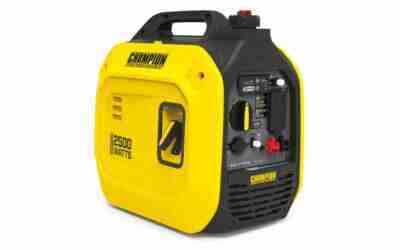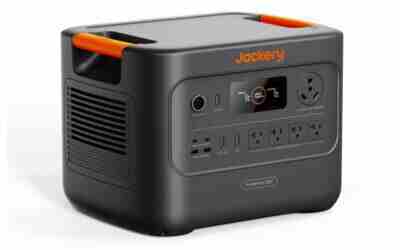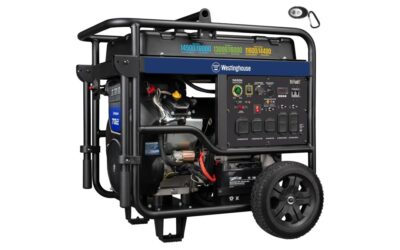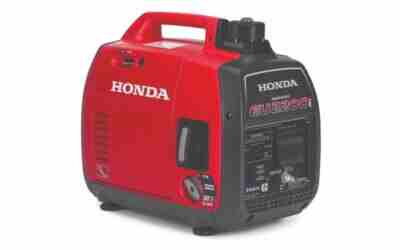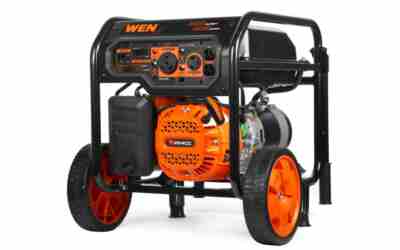

Our editorial team weighed WEN's published specifications and how it stacks up against similar products in the generators category. What stands out: Ample Power for Multiple Appliances, CO Sensor & Multiple Outlet Types, and Long Runtime. Where it falls short: Heavy at 120 lbs and Needs Regular Fuel & Maintenance. That puts it at 8.2/10 on our WG Score – an excellent, well-rounded option.
 Reviewed bySarah Watts
How much power do you actually need from a portable generator for home backup? The answer depends on what you want to keep running during an outage. For essentials like lights, a refrigerator, and charging devices, a unit with around 2,000 to 4,000 running watts is usually sufficient, while larger homes may want 4,500 or more to power additional circuits. In this roundup, we compare 5 models from PowerSmart, WEN, Pulsar to help you match capacity to your needs. For a broader look at portable options, see our best portable generators for home power outage guide.
Whether you are preparing for storm season, planning a camping trip, or need a jobsite power source, the right generator balances wattage, fuel type, noise, and portability. We evaluated each model based on its specifications and user feedback, focusing on the features that matter most for home use. Below, we answer common questions, provide a detailed buying guide, and highlight our top picks for 2026.
What to Know Before Choosing Home Portable Generators
What Size Generator Do I Need for Home Backup?
Start by listing the appliances you want to power simultaneously. A refrigerator typically draws 600 to 800 running watts, a sump pump around 800 to 1,000, and lights and electronics add a few hundred more. If you want to run a window air conditioner, expect to add 1,200 to 1,500 watts. For most homes, a generator with 3,000 to 5,000 running watts covers the basics. The models in this list range from 1,800 running watts (Pulsar G2319N) to 4,500 running watts (WEN GN5602X and GN5600), so you can choose based on your essential circuits.
Should I Choose an Inverter or a Conventional Generator?
Inverter generators produce cleaner power with less than 3% total harmonic distortion, making them safe for sensitive electronics like laptops and smartphones. They are also quieter and more fuel-efficient at partial loads. Conventional generators are typically larger and more affordable for the same wattage, but they produce higher distortion and more noise. In this roundup, the PowerSmart 3800, Generac iQ3500, and Pulsar G2319N are inverters, while the two WEN models are conventional portable generators with lower THD but still suitable for powering tools and appliances.
What Is Dual Fuel and Do I Need It?
Dual fuel generators run on either gasoline or propane, giving you flexibility during fuel shortages. Propane has a longer shelf life and burns cleaner, while gasoline is more readily available. The PowerSmart 3800 is the only dual fuel model in this list, offering 3,300 running watts on gasoline and 3,100 on propane. If you live in an area prone to extended outages, having a propane option can be a lifesaver.
How Important Are Safety Features Like CO Sensors?
Carbon monoxide (CO) sensors are critical for safety. They automatically shut down the generator if dangerous CO levels are detected, protecting you and your family. All models in this roundup except the Pulsar G2319N include a CO shutdown sensor. The WEN models feature the Watchdog CO Shutdown Sensor, and the PowerSmart includes a built-in CO sensor. Always operate generators outdoors and away from windows and doors.

Pros
- Dual fuel capability reduces dependency on single fuel source
- Quiet operation suitable for residential and campground use
- Reliable recoil start and solid build quality noted in reviews
- Clean inverter power protects laptops and medical equipment
Cons
- Manual recoil start requires physical effort in cold weather
- Runtime limited to around 4 hours at 50% load on a full tank
- Propane mode delivers slightly lower peak output than gasoline
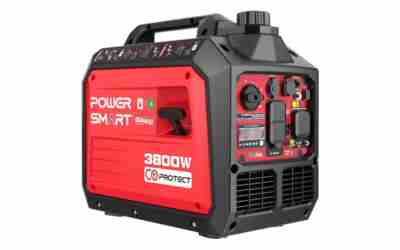
The PowerSmart 3800 Watt Dual Fuel Inverter Generator delivers portable power for home backup, camping, and tailgating. It runs on gasoline or propane and produces clean sine wave electricity suitable for electronics.
Users highlight easy starting, steady voltage output, and sufficient power for appliances, lights, and RV air conditioning. The CO safety sensor and overload protection add reliable safeguards during extended operation.
At 50.7 pounds with a compact footprint, the unit moves easily between locations. Noise levels remain acceptable for most outdoor settings while the parallel-ready feature allows capacity expansion when needed.
Drawbacks include the manual start mechanism and shorter runtime compared to larger stationary models. Overall it provides good value for users who need mid-range portable inverter power without excessive bulk.

Pros
- Ample power for multiple appliances and tools
- Safety-focused CO sensor and multiple outlet types
- Long runtime reduces downtime
- Electric start simplifies use
- Three-year warranty and service support
Cons
- At 120 pounds, requires two people for frequent moves
- Gas-powered needs regular fuel and maintenance
- Larger size may limit storage in small vehicles
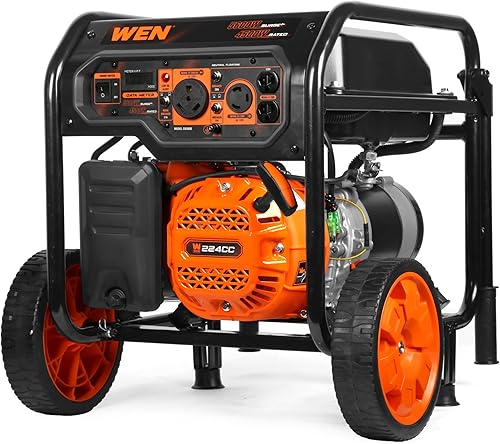
The WEN GN5602X is a robust 5600-watt starting portable generator powered by a 224cc four-stroke engine, designed for RVers, campers, job sites, and home backup needs. It excels in delivering consistent power to essentials like refrigerators, AC units, power tools, and RV appliances, with RV-ready and transfer-switch outlets for versatile connectivity.
Standout features include electric start for push-button ease, a CO shutdown sensor for family safety by detecting and halting high carbon monoxide levels, and up to 12.5 hours of runtime on a 4.3-gallon tank. The onboard digital meter tracks voltage, frequency, and runtime, helping users monitor efficiency during extended use. Multiple outlets, including two 120V 20A, one 30A RV TT-30R, and one 30A L5-30R, support simultaneous device operation without overload worries.
Build quality shines with a durable frame, wheel kit for mobility, and compact dimensions of 22.44 x 16.93 x 18.5 inches. WEN's legacy since 1951 ensures reliable performance backed by a three-year warranty and service network. While heavy at 120 pounds, the transport aids make it manageable for most users.
Potential drawbacks include its weight for solo handling and reliance on gasoline, which demands storage and refills. Noise levels typical of conventional generators may disturb quiet campsites.
Overall, the GN5602X offers exceptional value for demanding power needs, earning high marks for safety, runtime, and versatility. Ideal for those prioritizing dependable backup without complexity.
Power: 5600 starting watts, 4500 running watts
Engine: 224cc 4-stroke, electric start
Fuel & Runtime: Gasoline, 4.3-gallon tank, up to 12.5 hours at half load
Outlets: 1x 30A TT-30R (RV), 1x 30A L5-30R (transfer switch), 2x 120V 20A 5-20R
Dimensions & Weight: 22.44"L x 16.93"W x 18.5"H, 120 lbs
Other: CO sensor, wheel kit, digital data meter, 60Hz, 120V
Pros
- Versatile outlets for RV, transfer switch, and standard use
- Long runtime reduces refueling needs
- Easy mobility with wheels and handles
- Compliant 224cc engine for reliable power
- Comprehensive data display for monitoring
Cons
- Gas-powered, requiring fuel storage and refills
- Conventional generator may produce noisier operation than inverters
- Heavier build suited for stationary or wheeled transport
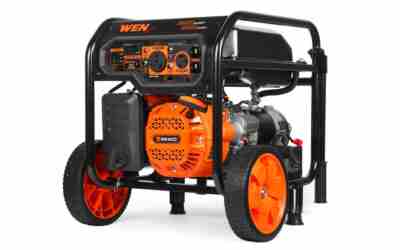
The WEN GN5600 is a robust portable generator designed for homeowners, RVers, campers, and contractors needing reliable backup power. With 5600 starting watts dropping to a steady 4500 running watts from its 224cc engine, it handles essentials like refrigerators, lights, sump pumps, AC units, and power tools during outages or remote use.
Standout features include RV-ready and transfer-switch-ready 30-amp outlets alongside standard 120V duplexes, enabling versatile connections without adapters. Real-world performance shines in extended runtime up to 12.5 hours at half load from a 4.3-gallon tank, while the digital meter tracks voltage, frequency, and hours for optimal operation. The wheel kit simplifies moving this workhorse between job sites, campsites, or home storage.
Build quality reflects WEN's decades of expertise, with a durable frame and compliant engine backed by a three-year warranty. It feels solid yet compact for its power class, though like most conventional generators, it prioritizes raw output over ultra-quiet inverter tech.
Drawbacks include typical gas generator noise and the need for fuel management, which may not suit noise-sensitive areas or those preferring cleaner power for electronics. Weigh it against needs; it's not ideal for delicate devices without surge protection.
Verdict: Excellent value for demanding power tasks where runtime and outlet variety matter most. Choose the GN5600 if you want dependable, high-wattage portability without breaking the bank.
Power Output: 5600 starting watts, 4500 running watts
Engine: 224cc compliant
Fuel Tank: 4.3 gallons, up to 12.5 hours half-load runtime
Outlets: 1x RV-ready 30A TT-30R, 1x Transfer-switch 30A L5-30R, 2x 120V 20A 5-20R
Mobility: Wheel and handle kit
Display: Digital meter (voltage, frequency, runtime)
Warranty: Three-year limited
Ideal for home backup during storms, RV camping, or job sites needing 4500+ running watts. Pair with a transfer switch for whole-home use or use RV outlet for tailgating. Consider fuel stabilizer for storage and ear protection for noise.
Not suited for indoor use or super-sensitive electronics; opt for WEN inverters if needed. Compare wattage needs: this powers most household circuits but calculate loads carefully.
Pros
- Exceptionally quiet operation ideal for recreational use
- Lightweight and durable for superior portability
- Electric start simplifies use in any condition
- Clean power output protects electronics
- CARB compliant for use in all states
Cons
- Requires gasoline refueling for extended runtime
- Battery may need occasional maintenance or charging
- Not designed for whole-home backup applications
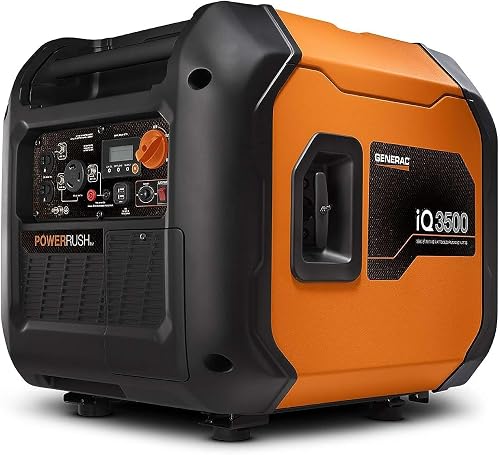
The Generac iQ3500 is a versatile 3,500-watt portable inverter generator tailored for outdoor enthusiasts, tailgaters, campers, and professionals on jobsites who need reliable, clean power without the bulk of traditional generators. Its lightweight yet rugged build makes it easy to transport, while delivering enough juice for small appliances, tools, and sensitive electronics like laptops during outages or adventures.
Standout features include the innovative PowerDial for seamless start, run, and stop functions with electric start capability via an included battery, plus PowerRush technology that boosts starting capacity by over 50% for demanding motor-driven equipment. Dual engine speeds allow selection between quiet Economy Mode for fuel savings and full power for heavy loads, with advanced inverter tech ensuring ultra-clean power and 40% noise reduction compared to standard models. USB ports add convenience for charging devices on the go.
Build quality shines with a durable enclosure that withstands rugged use, parallel-ready design for expandable power, and protective features like low-oil shutdown. Real-world performance excels in keeping lights on during outages, powering food trucks, or enhancing camping setups with movie nights, all while minimizing fuel use and disturbance.
Drawbacks include dependency on gasoline, which requires safe storage and refills, and the need for battery upkeep. It is not suited for large-scale home backup.
Overall, the iQ3500 earns high marks for balancing power, portability, and quiet efficiency, making it a top pick for mobile power needs with a strong verdict for anyone prioritizing convenience and reliability.
Power Output: 3,500 Watts (starting/running)
Fuel Type: Gasoline
Start Type: Electric Start (battery included)
Key Tech: Inverter, PowerRush Advance, Economy Mode
Compliance: CARB Compliant
Ports: USB, Parallel Ready
Ideal For: Camping, Tailgating, Jobsites, Small Appliances

Pros
- Lightweight and portable for camping or tailgating
- Pure sine wave output protects electronics
- Parallel ready for expanded power needs
Cons
- Gasoline only with no dual fuel option
- No electric start system included
- Limited runtime on a single tank
The Pulsar 2300W inverter generator provides portable power suitable for camping trips and outdoor events. Its compact design and low weight make it simple to carry and store.
Stable sine wave technology ensures safe operation of laptops, phones, and other sensitive devices. The included USB outlet adds convenience for charging small electronics directly.
Parallel capability allows users to link units for higher output when needed. Fuel efficiency supports up to 4.8 hours of runtime at half load.
Potential drawbacks include reliance on gasoline and the absence of an electric start. Overall this model offers solid performance for users seeking a lightweight inverter generator.
Buying Guide for 2026
Power Output: Starting vs. Running Watts
Every generator has two wattage ratings: starting (surge) watts, which handle the initial draw of motor-driven appliances, and running (rated) watts, which sustain continuous operation. For example, the WEN GN5602X provides 5,600 starting watts and 4,500 running watts, making it capable of running a refrigerator, sump pump, and lights simultaneously. The PowerSmart 3800 offers 3,800 starting and 3,300 running watts on gasoline, enough for a few essentials. To determine what you can run, add up the running watts of all devices you plan to use at once, and ensure the total does not exceed the generator’s rated output.
As a practical calculation, consider the Pulsar G2319N with 1,800 running watts. If you want to power a 700-watt refrigerator and 500-watt sump pump, that totals 1,200 watts, leaving 600 watts of headroom for lights and phone charging. This shows that even a smaller inverter can handle critical loads if you manage them carefully.
Fuel Type and Runtime
Fuel choice affects runtime, storage, and convenience. Gasoline is widely available but degrades over time. Propane lasts longer and burns cleaner, but you need to keep tanks on hand. The WEN models have a 4.3-gallon gas tank and provide up to 12.5 hours of half-load runtime, ideal for overnight outages. The Pulsar G2319N runs up to 4.8 hours at half load on 1.18 gallons, which is less but acceptable for short camping trips. The Generac iQ3500 features an Economy Mode to reduce fuel consumption and noise, extending runtime during light loads.
Noise Levels and Portability
Noise is a major consideration, especially for camping or neighborhoods with noise restrictions. Inverter generators are generally quieter. The PowerSmart 3800 operates at 70 dB at 23 feet, comparable to a normal conversation. The Generac iQ3500 offers a 40% reduction in noise compared to conventional generators, and its lightweight design makes it easy to transport. The Pulsar G2319N weighs under 47 lbs and features a compact suitcase design, perfect for tailgating. The WEN models include wheel kits for easy movement despite their larger size.
Outlets and Connectivity
Check the outlet panel to ensure it matches your needs. For home backup, a transfer-switch-ready outlet (NEMA L5-30R) allows you to connect directly to your home’s electrical panel. The WEN GN5602X and GN5600 both include this receptacle, along with standard 120V 20-amp outlets and an RV-ready TT-30R outlet. The PowerSmart 3800 is RV ready, and the Generac iQ3500 offers USB ports for charging mobile devices. If you plan to use the generator for RV trips, make sure it has a TT-30R outlet.
Safety Features
Safety should never be compromised. Look for CO sensors, low-oil shutdown, and circuit breakers. All models in this list except the Pulsar G2319N have CO sensors. The Generac iQ3500 also has low-oil level shutdown to protect the engine. Additionally, inverter generators provide clean power, reducing the risk of damaging sensitive electronics. Always follow the manufacturer’s safety guidelines and never run a generator indoors.
Our Final Picks for 2026
Best Overall: WEN GN5602X 5600W Portable Generator Electric Start RV-Ready CO Sensor 4500 Running Watts
The WEN GN5602X combines robust power with essential features. With 5,600 starting watts and 4,500 running watts, it can handle most home backup needs, including a refrigerator, sump pump, and lights. The electric start makes it easy to begin operation, and the Watchdog CO Shutdown Sensor adds peace of mind. Its 4.3-gallon tank provides up to 12.5 hours of runtime at half load, and the included wheel kit simplifies transport.
Skip this if: You need a quieter inverter model for camping or sensitive electronics, as this is a conventional generator with higher noise levels.
View on Amazon.comBest Value: PowerSmart 3800 Watt Dual Fuel Inverter Generator Quiet Portable Gas Propane with CO Sensor RV Ready
The PowerSmart 3800 offers dual fuel flexibility at a budget-friendly price point. It delivers 3,300 running watts on gasoline and 3,100 on propane, making it suitable for essentials. Its inverter technology produces clean power with less than 3% THD, safe for laptops and phones. At 70 dB, it is quiet enough for camping, and the built-in CO sensor enhances safety. Weighing just 50.7 lbs, it is relatively portable for its capacity.
Skip this if: You need more than 3,300 running watts to power larger appliances or a whole house, as this unit is best for smaller loads.
View on Amazon.comBest for Camping and Tailgating: Generac iQ3500 3500W Portable Inverter Generator – Quiet, Lightweight, Electric Start, CARB Compliant for Camping & Jobsites
The Generac iQ3500 is designed for portability and quiet operation. Its lightweight construction and electric start with a PowerDial make it easy to use anywhere. PowerRush Advance Technology provides over 50% more starting capacity, perfect for powering tools and motor-driven equipment. With a 40% noise reduction and Economy Mode, it is ideal for campsites and tailgates. USB ports allow convenient device charging.
Skip this if: You need a generator with a transfer-switch-ready outlet for home backup, as this model lacks a NEMA L5-30R receptacle.
View on Amazon.comWhy Trust Our Reviews
At WikiGenerators.com, we are committed to providing accurate and unbiased information. Our team analyzes product specifications, user feedback, and industry standards to evaluate each generator. We do not claim hands-on testing; instead, we rely on data-driven comparisons to help you make an informed decision. Our reviews are independent, and we may earn a commission if you purchase through our links, but this does not influence our recommendations.
We prioritize transparency and safety, ensuring that every product we recommend meets essential criteria such as power output, runtime, and safety features. For more details on our methodology, visit our Portable Generator Category page.
Frequently Asked Questions
Can I use a portable generator to power my whole house?
Most portable generators, including those in this roundup, are not designed to power an entire house. They are best for running essential appliances like refrigerators, lights, and sump pumps. To power a whole house, you would need a standby generator with a transfer switch. For more information, check our home backup inverter generators guide.
How do I connect a generator to my home’s electrical system?
You should use a transfer switch installed by a qualified electrician. This prevents backfeeding, which is dangerous to utility workers and your equipment. The WEN models include a NEMA L5-30R outlet that is transfer-switch-ready, making connection easier. Never plug a generator directly into a wall outlet.
What is the difference between starting watts and running watts?
Starting watts (surge) is the brief burst of power needed to start motor-driven appliances, while running watts (rated) is the continuous power required to keep them running. For example, a refrigerator may need 2,000 starting watts but only 700 running watts. Always ensure the generator’s starting watts exceed the sum of all starting loads, and its running watts exceed the sum of all running loads.
Are inverter generators worth the extra cost?
Inverter generators are worth it if you need clean power for sensitive electronics, quieter operation, and better fuel efficiency. They are also more portable. However, they are typically more expensive than conventional generators for the same wattage. If you only need to power tools and basic appliances, a conventional generator like the WEN GN5600 may be sufficient.
Quick Comparison: Side by Side
- – Dual Fuel Flexibility.
- – Quiet Operation.
- – Reliable Recoil Start, Solid Build.
- – Ample Power for Multiple Appliances.
- – CO Sensor & Multiple Outlet Types.
- – Long Runtime.
- – Versatile RV/Transfer-Switch Outlets.
- – Long Runtime.
- – Wheels & Handles.
- – Exceptionally Quiet.
- – Lightweight & Durable.
- – Electric Start.
- – Lightweight, Great for Camping.
- – Pure Sine Wave Output.
- – Parallel-Ready.
- – Manual Recoil Start, Harder in Cold.
- – ~4-Hour Runtime at 50% Load.
- – Lower Peak Output on Propane.
- – Heavy at 120 lbs.
- – Needs Regular Fuel & Maintenance.
- – Large, Limited Storage Fit.
- – Needs Gasoline Storage.
- – Noisier Than Inverter Models.
- – Heavier, Better for Wheeled Transport.
- – Needs Gasoline Refueling.
- – Occasional Battery Maintenance.
- – Not for Whole-Home Backup.
- – Gasoline Only.
- – No Electric Start.
- – Limited Tank Runtime.