Our editorial team weighed Westinghouse's published specifications and how it stacks up against similar products in the generators category. What stands out: Quiet & Fuel-Efficient, Remote Fob Start, and Telescoping Handle & Wheels. Where it falls short: Heavy at 105.8 lbs and Finicky Electric Starter. That puts it at 8.4/10 on our WG Score – an excellent, well-rounded option.
 Reviewed byEthan
Why generators are rated in kVA: the alternator’s limit is set by voltage and current, and the maker can’t know your load’s power factor. To get usable watts, multiply kVA by power factor. At a typical 0.8, a 7.5 kVA generator delivers about 6,000 watts (6 kW), though the exact figure depends on the model’s nameplate.
Why generators are rated in kVA instead of kW
A generator has two separate limits. The engine limits how much real work it can do, measured in kilowatts (kW). The alternator limits how much current it can carry before its windings overheat, measured in kilovolt-amperes (kVA).
Alternator heat depends on current, and current depends on the load’s voltage and amps, not on how much of that current does useful work. A maker can’t know whether you will plug in a heater, a motor or a mix. So the alternator is rated in kVA, which is safe for any load.
This is why kVA shows up mostly on standby, commercial and international generator sets. If you are comparing whole-house units, our home standby generator guide shows how those sets are usually labeled.
kVA vs kW and power factor in plain terms
kW (real power) is the power that actually runs your appliances: heat, light, motor shaft work. kVA (apparent power) is the total electrical load the generator must supply, which includes some current that moves back and forth without doing work.
Think of a glass of beer with foam. The full glass is kVA. The beer you can drink is kW. The foam is the wasted part. Power factor (PF) is the share of the glass that is beer.
- Resistive loads (space heaters, incandescent bulbs, electric ranges) have a PF near 1.0. kW and kVA are almost equal.
- Inductive loads (motors, compressors, pumps, transformers) have a lower PF, often 0.6 to 0.9 depending on the device and its load.
The formula is one line: kW = kVA × power factor. Flip it to size from a load: kVA = kW ÷ power factor.
How to convert kVA to kW (with a quick table)
Multiply the kVA rating by the power factor on the nameplate. Many commercial and three-phase sets are rated at 0.8 PF, but this varies by model. Some inverter-based units are rated at 0.9 to 1.0, so always read the label instead of assuming 0.8.
| Rating (kVA) | Usable kW at 0.8 PF | Usable kW at 0.9 PF |
|---|---|---|
| 5 | 4.0 | 4.5 |
| 7.5 | 6.0 | 6.75 |
| 10 | 8.0 | 9.0 |
| 12.5 | 10.0 | 11.25 |
| 20 | 16.0 | 18.0 |
To go the other way, divide. A 10 kW load at 0.8 PF needs 10 ÷ 0.8 = 12.5 kVA of generator. Multiply kW by 1,000 to get watts.
Common mistake: reading a 10 kVA label as 10,000 watts. At 0.8 PF it is 8,000 watts.
Worked example: a 7.5 kVA generator vs a real appliance list
Start with the generator: 7.5 kVA × 0.8 PF = 6.0 kW, or 6,000 running watts.
Now a sample backup list. These are typical estimates; your appliance labels or manuals give the real numbers.
| Appliance | Running watts (estimate) | Extra surge on startup (estimate) |
|---|---|---|
| Refrigerator | 700 | 1,500 |
| Sump pump (1/2 hp) | 800 | 1,600 |
| Furnace blower | 600 | 1,200 |
| Microwave | 1,000 | 0 |
| Lights and chargers | 200 | 0 |
| Total | 3,300 | Largest single surge: 1,600 |
Method: add all running watts (3,300), then add only the largest startup surge, since motors rarely start at the same instant (1,600). Peak is about 4,900 W, which fits under 6,000 W with roughly 1,100 W of headroom.
Do not load a generator to 100% of its rating. Keep continuous load comfortably below the rated output and confirm surge limits in the manual.
Single-phase vs three-phase kVA math
The kVA formula changes with the phase, because it counts how many conductors share the current.
- Single-phase: kVA = volts × amps ÷ 1,000. Example: 240 V × 31.25 A = 7.5 kVA.
- Three-phase: kVA = 1.732 × volts × amps ÷ 1,000. Example: a 20 kVA set at 208 V can carry about 20,000 ÷ (1.732 × 208) = 55.5 A per phase.
After that, the PF step is the same. A 20 kVA three-phase set at 0.8 PF gives 16 kW.
Watch the nameplate. A three-phase set may allow only a portion of its rating on a single-phase connection, and the limit differs by model. Most homes use single-phase 120/240 V, so a three-phase rating matters mainly for shops, farms and commercial buildings.
Why US portable generators list watts, and which number to use
Portable generators sold in the US are usually labeled in running watts and starting watts because shoppers compare them against appliance labels, which are also in watts. Inverter units produce clean output at a PF close to 1.0, so their watt and VA ratings are close. Browse our inverter generator roundup to see how these are listed.
Do not mix up the two ratings:
- Starting (surge) watts are a short burst, a few seconds, to start motors. They are not a kVA rating.
- kVA is a continuous apparent-power rating, and it needs the PF to become watts.
Decision rule: size on kW (watts) for running loads, then check that the largest motor’s startup surge fits the surge rating. Use kVA only to find kW, or when a load such as a large motor lists its own kVA.
A low-PF load, like a loaded motor, can draw more current than its watts suggest. That can push the alternator to its kVA limit before the engine reaches its kW limit. If you want flexibility on fuel while sizing, see our dual fuel generator picks, and for general backup sizing see the portable generator guide.
How to read a generator nameplate and avoid common mistakes
Look for these fields on the label or in the manual:
- kW or W: the engine-limited real power.
- kVA: the alternator-limited apparent power.
- PF (cos φ): the rating basis, often 0.8 but not always.
- Phase and voltage: single or three-phase, such as 120/240 V.
- Amps: the maximum current per output.
Quick check: kVA × PF should roughly match the kW on the label. If it does not, the rating basis differs, so go by the manual.
Common mistakes:
- Assuming 0.8 PF for every unit.
- Comparing one brand’s kVA to another brand’s watts.
- Ignoring motor startup surge.
- Sizing to 100% of rated output.
Safety: connect a generator to a house only through a transfer switch or interlock installed by a licensed electrician, following the NEC and local code. Never backfeed through an outlet. Run generators outdoors, and follow the manual for distance from windows, doors and vents, because of carbon monoxide.
Our Top Picks
Ready to shop? These are the top-rated options from our hands-on roundup, Best 5000 Watt Portable Generators of 2026.

Westinghouse iGen5000DF 5000 Peak Watt Dual Fuel Inverter Generator - Super Quiet RV Ready Remote Start

WEN RV-Ready 4000-Watt Open Frame Inverter Generator GN400iM
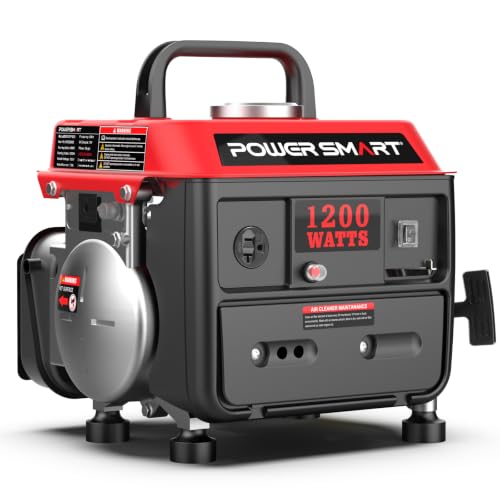
PowerSmart 1200W Portable Gas Generator 900W Rated 2-Stroke 39 lbs for Camping Emergency
As an Amazon Associate we earn from qualifying purchases. Product prices and availability are accurate as of the date/time indicated.
Frequently Asked Questions
Is a 10 kVA generator the same as 10 kW?
No. kW equals kVA times power factor. At a common 0.8 PF, a 10 kVA generator gives about 8 kW. If the nameplate lists a PF of 1.0 the two match, so check the label for your specific model.
Can I run 6,000 watts of appliances on a 7.5 kVA generator?
Only at its limit, and only if the nameplate PF is 0.8. That leaves no margin for startup surges. Keep continuous load well below 6,000 W and confirm the surge capacity in the manual.
What happens if my load’s power factor is lower than the generator’s rating?
The load draws more current for the same watts. The alternator can reach its kVA limit and overheat while the engine still has spare kW. You then have less usable wattage than the label suggests, so reduce the load.
Do inverter generators need a kVA conversion?
Usually not. Most US inverter generators are labeled in watts, and their output runs near a power factor of 1.0, so watts and VA are close. If a model lists both, use the watt figure to size against appliances.
{“@context”: “https://schema.org”, “@type”: “FAQPage”, “mainEntity”: [{“@type”: “Question”, “name”: “Is a 10 kVA generator the same as 10 kW?”, “acceptedAnswer”: {“@type”: “Answer”, “text”: “No. kW equals kVA times power factor. At a common 0.8 PF, a 10 kVA generator gives about 8 kW. If the nameplate lists a PF of 1.0 the two match, so check the label for your specific model.”}}, {“@type”: “Question”, “name”: “Can I run 6,000 watts of appliances on a 7.5 kVA generator?”, “acceptedAnswer”: {“@type”: “Answer”, “text”: “Only at its limit, and only if the nameplate PF is 0.8. That leaves no margin for startup surges. Keep continuous load well below 6,000 W and confirm the surge capacity in the manual.”}}, {“@type”: “Question”, “name”: “What happens if my load’s power factor is lower than the generator’s rating?”, “acceptedAnswer”: {“@type”: “Answer”, “text”: “The load draws more current for the same watts. The alternator can reach its kVA limit and overheat while the engine still has spare kW. You then have less usable wattage than the label suggests, so reduce the load.”}}, {“@type”: “Question”, “name”: “Do inverter generators need a kVA conversion?”, “acceptedAnswer”: {“@type”: “Answer”, “text”: “Usually not. Most US inverter generators are labeled in watts, and their output runs near a power factor of 1.0, so watts and VA are close. If a model lists both, use the watt figure to size against appliances.”}}]}